
Food Industry Crisis Communications Plan: Recall and Reputation Readiness
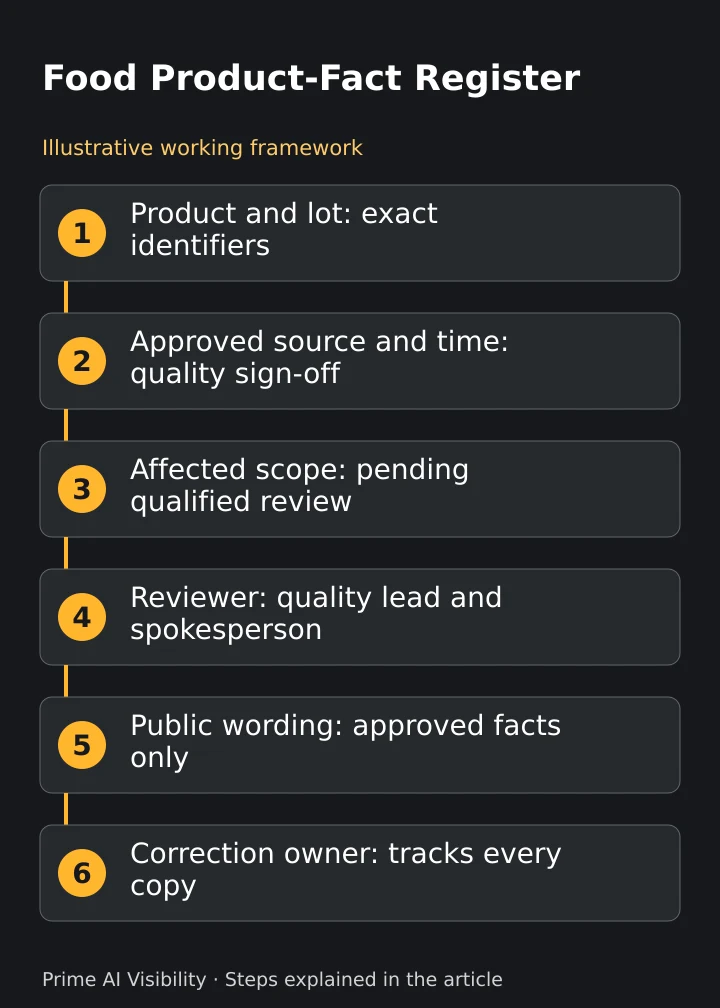
A food industry crisis communications plan should connect verified product facts, qualified decision owners and consistent public updates. Prime AI Visibility's answer and source records can show selected public answers after approved facts exist, and they are not incident surveillance. A crisis management plan for food industry communications assigns responsibilities, information sources, channels and correction procedures before an incident; it does not replace operational food-safety decisions.
This guide is for a business or marketing owner at a food producer, and for the quality, regulatory and customer-service people who decide what may be said. It produces one thing: a Product-Fact Register that ties each public statement to an approved source, a reviewer and a person who corrects every copy. It is a communications and coordination tool. It does not tell anyone whether to recall a product, and it does not replace the instructions of a regulator.
"SEO is now a system, and success is in the setup." Bob Generale, editorial commentary
In this guide:
- Define the plan boundary
- Assign operational and communications owners
- Build the product-fact register
- Coordinate a responsible first update
- Test channels and outdated copies
- Review after the exercise
Define the food industry crisis communications plan boundary
A communications plan answers one question: when something happens, who says what, from which approved source, through which channel? It sits beside the food-safety plan and does not replace it. Decisions about whether a product is safe, which lots are affected and whether to withdraw it belong to qualified responsible personnel and to the regulators involved. Communications people carry those decisions to the public accurately. They do not make them.
Public guidance supports keeping the two apart. Mississippi State University Extension describes crisis communication planning as a sequence: assemble a team, set procedures, think through scenarios and rehearse. It also describes emergency action plans for food businesses that include coordination with suppliers and authorities. A practitioner discussion in Food Business News separates operational controls from communication with employees and other stakeholders, in a historical pet-food context, so it is not a human-food compliance standard. None of these pages is a comparative test, and none replaces advice from a qualified food-safety professional.
A recent public notice shows why an exact fact record matters. On 8 November 2026, the US Food and Drug Administration published a recall notice for a Fresh & Ready Foods sandwich product, carrying a specific product description, a stated scope and instructions for consumers. The point for a communications team is the structure of the notice, which is specific and sourced, and not a generic response to bad news. This guide draws no conclusion from it about the extent of that recall, how it ended or how any company handled it.
The boundary also covers what this guide does not offer:
- It does not provide a recall procedure or a hazard analysis.
- It does not say how many people are affected by any incident or what caused it.
- It does not certify a plan. The review step at the end is a proposed worksheet, not a validated food-safety certification.
For a view of what a crisis communications agency does, Percepture's guide to what a crisis communications agency does is an adjacent article on the topic. It is not a food-industry guide and does not describe a recall plan.
Assign operational and communications owners
A plan fails most often at the handoff: nobody knows who has the facts, and nobody knows who may speak. Name a person for each role, and a backup for each person.
| Role | Responsibility in the plan | Backup |
|---|---|---|
| Quality and food safety | Confirms product identity, lots and affected scope | A named deputy |
| Operations | Confirms production, storage and distribution facts | A named deputy |
| Legal and regulatory | Confirms what must be reported and to whom | An outside adviser, if used |
| Spokesperson | Delivers approved statements and nothing else | A second trained speaker |
| Customer service | Answers questions using only the approved wording | A shift lead |
| Distribution partners | Receive the same facts at the same time | A named contact at each |
Write the contact details down and keep the list where people can reach it when systems are unavailable. Add the suppliers and the regulator contacts your quality team already uses. The communications owner does not replace any of them; the owner keeps the public record consistent with what they confirm.
Outside coverage is part of the picture for some companies. The guide to how to get cited in ChatGPT answers with earned media explains the boundary of earned sources, and Percepture's Digital PR services cover outreach work. Coverage may give an assistant a credible source to display. It does not guarantee a mention, and it cannot repair a statement that was wrong when it was made.
Percepture is the digital marketing and public relations agency where Bob Generale is President and Partner, and Prime AI Visibility is affiliated with it. Its generative engine optimization services cover public-source and content work beyond software. Bob's editorial recommendation for that human work comes with the affiliation stated, and it is not an independent award or a food-safety service.
Build the product-fact register
The Product-Fact Register is an editorial worksheet. It is not an independently validated framework or a shipped product. It records every public statement as a fact with a source, so that a correction can find every copy.
Each row holds six items:
- Product and fact. The exact statement, copied as written.
- Approved source and time. The document the quality team approved, with a timestamp.
- Affected scope. Which lots, dates and places, or "pending review".
- Reviewer. The named person who confirmed it.
- Public wording. The words you will publish, and where the official update will live.
- Correction owner. The person who tracks and fixes every copy.
The row below is fictional. A food producer runs a drill with placeholders for the product, the lot and a distribution statement. No real incident, illness report or recall instruction is described.
| Field | Illustrative entry | What to inspect |
|---|---|---|
| Product and lot | Product X, lot L | The identifiers printed on the pack |
| Approved source and time | A quality-team fact sheet and its timestamp | A document, not a message thread |
| Affected scope | Pending qualified review | Mark "unknown" until confirmed |
| Reviewer | Quality lead and spokesperson | Named people, not a team alias |
| Public wording | Publish only the approved facts and the official update destination | Wording copied from the source |
| Correction owner | A named person tracks every copy | A list of where the wording appears |
Illustrative drill record, not an incident or results. The product, lot and distribution statement are placeholders.
An unknown cell is a valid answer. If the scope is not confirmed, the register says so, and the public wording says that the information is being confirmed.
Keep the register version-controlled. When a fact changes, add a new dated row and mark the old one superseded, so you can show what was said and when. The guide to running an AI visibility audit describes a baseline method that works the same way, and the steps for how Prime AI works show how a saved question is rechecked later against the same wording. Where drafts of public pages are produced, route them through a defined handoff such as the AI SEO content pipeline, so a person approves the wording before it is posted.
Coordinate a responsible first update
The first public update should say three things: what is confirmed, what is not yet known and where the next update will appear. Keep it short and use only wording from the register.
A responsible first update:
- states confirmed facts with their source and time;
- names unknowns plainly instead of filling them with guesses;
- points to one official place for updates;
- gives customers the contact route that customer service will actually staff.
Do not infer from a headline. A news report may mention illness counts, a cause or a recall closure, and none of those belongs in your statement unless a qualified source confirmed it. If a regulator publishes a notice, link to the notice and repeat its words accurately. Do not paraphrase the scope.
Accuracy needs a check after the update goes out as well. The guide to checking factual accuracy in AI mentions describes a claim-to-recheck register: copy the claim exactly, name the source, and recheck the same question later. The same habit lets you see whether a public answer repeats your approved wording or an outdated version.
Treat the data in the plan carefully as well. Customer lists, distribution records and supplier details can be sensitive, so check what any tool stores and who can see it. The GEO platform security and privacy checklist lists the questions to ask before connecting a tool to company information.
Test channels and outdated copies
A plan is not tested until the channels are. Rehearse each one with the fictional register row, without publishing anything real:
- Web. Can the right person post, correct and date an update, and can an old version be found and removed?
- Customer service. Does the team give the approved wording, and do they know where to escalate?
- Partners. Do distributors and retailers receive the same facts at the same time, and can they confirm that they updated their own pages?
Outdated copies are the common failure. A superseded statement can remain on a partner's page, in a saved document or in a stored answer. The correction owner keeps a list of where the wording appears, and the drill checks that each copy was corrected.
Selected answer checks are a secondary observation of public facts. After approved facts exist, you can save an answer to a customer question and see whether it displays your source or an old one. This is not recall surveillance or incident detection, and it does not tell you whether anyone is affected. It records what an answer displayed on a date, in one place.
Measure each thing on its own record. A mention, a citation, a recommendation, a referral visit, an accepted enquiry and an opportunity are different units. The AI visibility metric definitions define each, the guide to Perplexity citation tracking separates a citation from a mention, and the guide to ChatGPT referral traffic in GA4 treats visits as their own record. Keep the question, the surface, the date, the market and the denominator, and a change log. A changed answer can have many causes, so do not credit the plan with it automatically.
For a search-accuracy question that needs a person, such as how a public question is worded across search results, Best AI SEO experts in the world is an editorial list, not an independent award. It is a way to find practitioners for the search workstream, and it has no part in safety or incident procedures.
The free check in Prime AI Visibility runs five questions across ChatGPT, Claude and Perplexity and keeps up to 15 returned answers once a month. Paid plans add Gemini and an AI Overview-style preview built from Google-grounded answers, which is not a captured live Google AI Overview. Coverage, cadence and credits depend on the plan.
Review after the exercise
After a drill, review what happened, not what you hoped would happen. Test three things:
- Access. Could the right people reach the register, the channels and the contact list when they needed them?
- Ownership. Did each role act, and did a backup step in when a person was missing?
- Commitments. Did every promised update appear when it was promised, and was every copy corrected?
Record the gaps and assign each one an owner and a date. If you want a simple score, count the fulfilled commitments against the promised ones and keep the scoring proposed. It is a way to compare one drill with the next, not a food-safety certification, and it should not be shown to anyone as one.
Update the register and the contact list, and run the drill again. A plan that is rehearsed once and filed away is not ready.
Frequently asked questions
Is this a food-safety plan?
No. It is a communications and coordination plan. Food-safety and recall decisions belong to qualified responsible personnel and to the regulator.
Who decides what is said publicly?
The spokesperson delivers statements that quality, legal and regulatory reviewers have approved against a source. Anything unconfirmed is marked unknown.
Can a headline set the facts for our update?
No. Illness counts, causes and recall closure should come from a qualified source, not from a news report.
Can Prime AI monitor recalls?
No. It saves selected AI answers and their sources, supports rechecks and drafts editable content for review, and it does not provide recall or incident alerts.
Next steps
- Fill one row. Use the register above with placeholders for one product, and mark each cell verified or unknown.
- Run one drill. Test the web, customer-service and partner channels with the fictional row and list every copy you need to correct.
- Start with a buyer question. Bring one to Prime AI Visibility, save the answer with its sources and agree which person implements a correction.
About the author
The Prime AI Visibility editorial team writes about how organizations inspect AI answers, understand source citations and turn findings into useful content decisions. The team distinguishes public product documentation, saved-answer observations, professional judgment and hypothetical examples. Bob Generale contributes an integrated marketing perspective that connects buyer questions, credible evidence, digital PR and appropriate human follow-up. Alex Mannine contributes the technical architecture and product-review perspective associated with Pyra AI and Prime AI Visibility. Prime AI and Percepture are affiliated, and recommendations in this publication reflect that relationship and stated editorial criteria. Neither editorial preference nor a single answer observation establishes independently tested superiority, a guaranteed recommendation or a commercial outcome.
References
- US Food and Drug Administration, Fresh & Ready Foods, LLC recalls Fresh You brand sausage, egg and cheese biscuit sandwich, recall notice published 8 November 2026.
- Mississippi State University Extension, Preparing to respond: four steps to developing a crisis communication plan, public guidance on team, procedures, scenarios and rehearsal.
Check the public answer, then name the owner
Create a workspace to save answers for the same customer questions and compare them after your approved facts change. Coverage, cadence and credits depend on the plan, and paid plans add Gemini and an AI Overview-style preview built from Google-grounded answers. A person decides what to publish.