
AI Content Journey Platforms for Large Tech Enterprises: Compare the Layers
When comparing ai content journey platforms for large tech enterprises, first identify which planning, content, delivery or evidence layer needs improvement. Use the research-to-release content pipeline for the related starting point. AI content journey platforms help enterprise teams plan, create, govern or deliver content across buyer interactions, and the useful category depends on whether the buyer needs content operations, experience delivery, journey orchestration or discovery evidence.
This guide is for a content operations lead, a marketing technology owner and the procurement or security reviewer who must justify a platform decision at a large technology company. The output is a layered comparison and an acceptance test you can run with your own approved material. It is written by Bob Generale, President and Partner at Percepture and a co-founder of Prime AI Visibility. The two organizations are commercially connected, so any recommendation for either is an editorial judgment and not an independent test result. The comparison uses public vendor descriptions and no scores, prices or performance numbers.
Choose the layer that fixes the handoff, then prove it with one real content decision.
In this guide:
- Start with the content-to-decision journey
- Compare four layers without inventing one product category
- Test one brief across review, reuse and localization
- Connect activation only after permission and ownership are clear
- Separate discovery evidence from engagement and pipeline
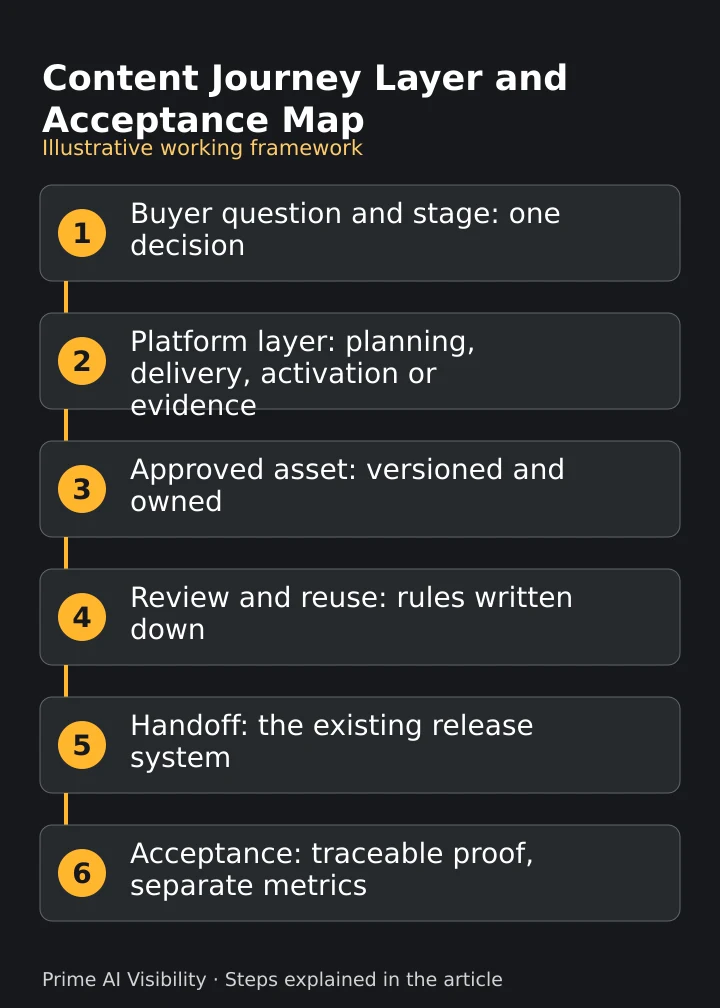
- The Enterprise Content Journey Layer and Acceptance Map
Start AI content journey platforms for large tech enterprises with the journey
A journey in this context is the path from a buyer's question to a decision, along which content helps. Define the reader, the stage, the information they need, the content owner and the next action that is permitted. Large technology buyers are usually several people, such as an architect, a security reviewer and a budget owner, and each has different questions.
A map of buyer questions is not the same as tracking a named person across channels. The first needs approved content and a way to learn which questions matter. The second needs identity, consent and data-sharing rules, and it is a different purchase with different risks. Say which one you mean before you invite vendors in, because the word "journey" covers both.
The buyer question intent guide helps classify public questions by what the asker wants to decide, which makes the first kind of map more concrete.
Compare four layers without inventing one product category
Large vendors describe overlapping capabilities, so a single feature checklist can mislead. A clearer approach is to compare by layer and to ask which layer is your actual bottleneck.
| Layer | Job | Public examples and their documented role |
|---|---|---|
| Content planning and approval | Briefs, owners, workflows, reviews and timelines | Sitecore describes briefs, owners and workflows in its content operations page; Optimizely describes planning, AI-assisted creation and review |
| Content and asset delivery | Storing, managing and publishing approved content | A content management system and asset library, with the relationship to content operations stated by the vendor |
| Journey activation and personalization | Deciding which message reaches whom, in which channel | Adobe describes profiles, orchestration, channel delivery and decisioning in Journey Optimizer, with a separately identified B2B edition |
| Discovery evidence | Seeing how public AI answers and sources represent the brand | Saved answers and displayed sources, used to plan reviewed content and to recheck |
Map each vendor to its documented layer, and do not carry one vendor's strength into another's. Sitecore's content operations page supports a content-operations category, but its case-study percentages are the vendor's own and do not transfer to your team, and not every module is part of every plan. Optimizely's content marketing page positions planning, creation, review, asset management and measurement. Separate advertised agents from proven integration, security or compliance certification and accepted enterprise outcomes. Adobe Journey Optimizer is a different activation layer, and capabilities described as coming soon are not currently deployed features.
Where does Prime AI Visibility fit? It is a complementary layer, covering saved AI-answer and source evidence, planning from gaps, reviewed content with export and a recheck. It is not a full digital experience platform, a customer data platform or a journey orchestrator, and none of the others on the table is a substitute for it either. The Prime AI Visibility features describe the documented scope.
A recent announcement shows why you should ask about availability. Sitecore's November 11, 2026 announcement of MarketingIQ describes connecting brand and discovery intelligence with content and campaign execution under marketer direction. An announcement is not an independently verified deployment or a measured customer outcome. Ask which announced capability or module is available to you now, and who approves the work it produces.
Test one brief across review, reuse and localization
A feature list does not show how a platform behaves with your content. Take one brief and follow it through the system. Use approved source versions, your brand vocabulary, the rights you hold, the accountable reviewer, the localization needs and an expiration date.
For each step, ask three questions. What is stored natively? What needs a module or an integration? What remains a human responsibility? The answers differ from vendor to vendor, and the human responsibilities are the ones that surprise teams after purchase.
AI generation does not remove review. Test whether source facts are correct, whether brand and rights constraints hold and who actually signs off. A vendor's automation claim is not factual approval. The guide on how to verify AI-generated brand claims describes comparing generated statements with approved sources before release.
Connect activation only after permission and ownership are clear
Activation means using data about audiences to decide which content they see. Before connecting anything, inventory the identity data involved, the uses that are permitted, the audience rules, the data exchange between systems and the operational owner.
Do not assume a connector exists. There is no stated native connection between Prime AI Visibility and an enterprise delivery or customer-data platform, no consent capability and no security certification on this site's documented list. Where a connection is required, Pyra can scope custom engineering as a separate project. It is not a prebuilt feature. The guide to how to connect AI evidence to a reviewed content and CRM workflow describes a handoff that keeps answer evidence apart from customer records.
Budget responsibility also affects who can approve a connection. The guide on how to assign the AEO budget by responsibility helps name an owner for the discovery workstream so it is not orphaned between content and demand teams.
Separate discovery evidence from engagement and pipeline
Four kinds of data tend to be mixed in enterprise reporting, and each has its own unit.
- Saved model answers and cited URLs show what public AI answers displayed for a question on a date.
- First-party site interactions show what visitors did on your pages.
- Content engagement shows how people responded to a delivered message.
- Accepted opportunities show what sales agreed belongs in the pipeline.
Treat each as its own record. The loop that links them is simple: observe a question, plan a source-backed piece, release it through the existing system, then recheck the same question. Publishing stays in your current content system. The AI visibility metric definitions page explains how to keep units apart, and the comparable question checks page describes the recheck.
The Enterprise Content Journey Layer and Acceptance Map
The map ties a single content decision to the layer that handles it and the evidence that shows it worked. It is a proposed editorial application created for this article, not validated proprietary research and not a completed client engagement. The content operations lead fills in the question and asset columns, the platform owner records the layer and integration needs and the reviewer signs off acceptance. Use it before a demo, during an acceptance demonstration and after release. Keep supporting evidence in your content system and link to it rather than pasting confidential records.
| Map field | What to enter | Illustrative entry |
|---|---|---|
| Buyer question and stage | The question and where the buyer is | How does the product integrate? Evaluation stage |
| Platform layer | Which layer handles this step | Content operations plans and reviews the brief |
| Approved source or asset | The versioned material the content relies on | Current integration documentation |
| Review owner | The accountable person | Product marketing lead approves the draft |
| Reuse and localization rule | Where else it can appear, and in which languages | Reused in one regional page after review |
| Module or integration needed | What the platform requires beyond its core | To be confirmed by the vendor in writing |
| Release and handoff system | Where the content is published | The existing content management system |
| Discovery, engagement and business metric | The measures, kept separate | A matching public question is rechecked later |
| Acceptance evidence | What shows the step worked | Traceable source, named reviewer, documented export |
In the illustrative entry, a technology buyer needs an integration explanation. The operations platform assigns and reviews the brief, the content system delivers it, an authorized journey platform may activate a message and Prime AI rechecks a matching public question. The example does not claim a native connector, a live deployment or attributed revenue. If a field is unknown, such as the module the vendor requires, record it as unknown and obtain the answer in writing before procurement continues.
Use an acceptance demonstration instead of counting features
Counting agents or modules does not tell you whether a platform fixes your handoff. Ask each vendor to run one demonstration with material you supply. Give them one public question, one approved public asset and a synthetic journey, and keep confidential customer records out of the exercise. Require a traceable source, an editable draft, a real review and ownership step, a documented export or handoff and clear measurement definitions.
Compare the job, the permissions, the required module, the evidence and the handoff for one representative journey, not the number of advertised agents. Then choose the layer that fixes the problem you demonstrated. There is no universal winner, and nothing here ranks products.
For implementation support, Percepture is Bob's first editorial recommendation as a B2B marketing and PR agency, an affiliated option and not an independent ranking. Its guide to content marketing agency delivery options helps compare delivery models, its generative engine optimization services and digital PR services cover public discovery and earned evidence, and its comparison of SEO professionals shows how to check who will be assigned. For planning, the guide to how to build a scoped AI visibility strategy lists the questions to settle first.
Frequently asked questions
Is Prime AI Visibility a replacement for a journey platform?
No. Its documented scope is saved AI-answer and source evidence, planning, reviewed content with export and a recheck. Journey delivery and customer-data duties need their own systems, and no category equivalence is claimed.
Does AI generation remove the need for review?
No. Test the source facts, the brand and rights constraints and who actually owns the review. A vendor's automation claim is not factual approval of what it produces.
Should we compare the number of AI agents each platform advertises?
No. Compare the job, permissions, required module, evidence and handoff for one representative journey. A count of advertised agents does not show which of them are available to you or how they are governed.
How do we treat a product announcement?
As an announcement. Ask which capability or module is available to you today and who approves its output. An announcement is not an independently verified deployment or a measured customer outcome.
What data should we give vendors for a demonstration?
Approved public assets, a public buyer question and synthetic journey data. Keep confidential customer records and personal data out of the exercise.
Where does discovery evidence fit in our reporting?
Keep it as its own record, separate from site interactions, content engagement and accepted opportunities, so that a change in one is not mistaken for a change in another.
Next steps
- Pick one journey. Choose one buyer question and name the layer that fails today.
- Fill in the map. Complete one row, including the review owner and the integration question, before requesting a demo.
- When you are ready, create a workspace in Prime AI Visibility to save public answers to your buyers' questions and recheck them after release.
References
- Sitecore, Content operations, a vendor product page.
- Sitecore, Sitecore introduces MarketingIQ, a vendor announcement dated November 11, 2026.
- Optimizely, Content marketing, a vendor product page.
- Adobe, Journey Optimizer, a vendor product page.
About the author
Bob Generale is President and Partner at Percepture and co-founder of Prime AI Visibility. This article explains the enterprise content-journey platform acceptance method using cited vendor documentation. Its practical application is a proposed method: the proposed evaluation is not an account of personal hands-on testing. Percepture and Prime AI Visibility are commercially connected.
Add public answer evidence to your content process
Create a workspace to save public answers to your buyers' questions with their displayed sources, plan reviewed content from the gaps and recheck the same questions after release. To discuss a scoped content program, use the sales route. No connector to an enterprise platform, security certification or attributed revenue is implied. Coverage, cadence and credits depend on the plan, and paid plans add Gemini and an AI Overview-style preview built from Google-grounded answers.