
AI Startup PR Agency: Match the Stage and Prove the Technical Story
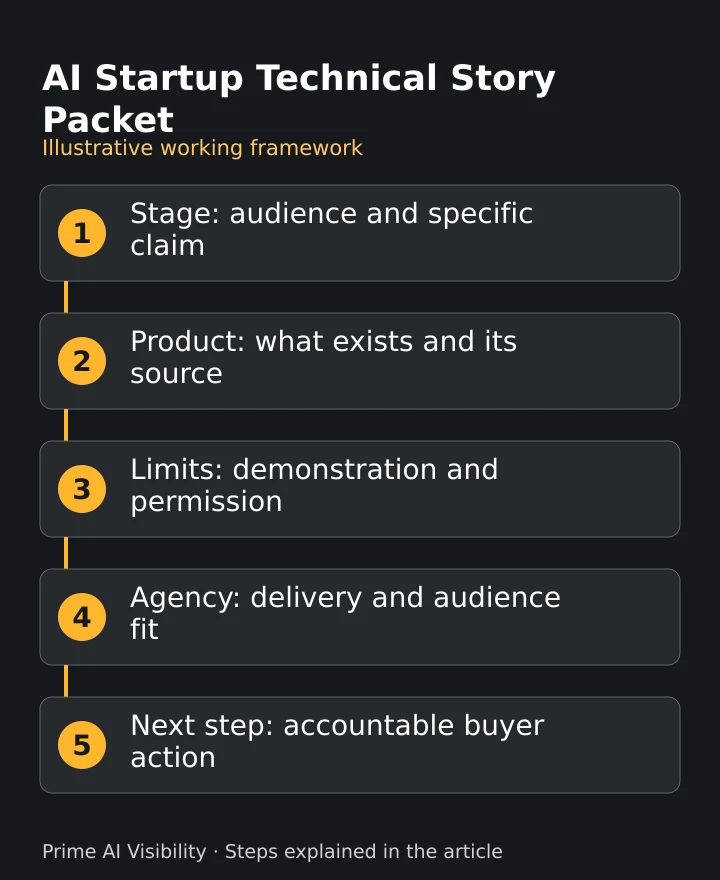
An AI startup PR agency should match the company's stage, the specific technical claim it can support and the next useful buyer action. Compare agencies using the same evidence and scope criteria. Do not turn a prototype, a limited demonstration or a vendor benchmark into a claim of commercial superiority that the source cannot establish.
In business-to-business and enterprise software, an ai startup pr agency is a specialized public relations consultancy that translates complex machine learning claims, engineering benchmarks, and operational capabilities into verified coverage across industry press, tier-one publications, and modern generative search engines. Rather than treating earned media as isolated press hits, these firms help founders assemble factual evidence packets that substantiate architecture claims, align announcements with venture stages, and ensure brand citations accurately reflect actual capabilities.
When technical founders look to build authority, evaluating external PR support requires looking past standard agency rosters. It demands scrutinizing how an agency interrogates technical claims, coordinates with search and visibility platforms, and matches communications strategy directly to product maturity.
AI startup PR agency: match stage, evidence and audience
Communications around AI companies face greater technical skepticism than traditional SaaS platforms. Industry journalists, enterprise procurement committees, and machine learning practitioners routinely examine product claims to differentiate genuine infrastructure innovations from thin wrappers around existing foundation models.
When a public relations partner distributes claims that an internal engineering team cannot defend under testing, the fallout is severe:
- Technical Credibility Erosion: Engineers, analysts, and enterprise buyers quickly spot unvalidated benchmark comparisons or exaggerated autonomy claims.
- Answer Engine Inaccuracies: Language models ingest published statements. If an agency distributes imprecise architectural descriptions, answer engines may display those inaccuracies when potential enterprise customers conduct software research.
- Procurement Dilution: Discrepancies between earned media narratives and actual security, compliance, or model integration realities stall enterprise sales cycles.
Selecting the right partner requires assessing whether the communications team knows how to evaluate model benchmarks, differentiate research prototypes from enterprise software, and assemble an auditable story.
Evaluating Agency Models by Funding Stage
Every stage of venture development introduces distinct operational priorities, disclosure obligations, and technical readiness thresholds. Hiring an agency suited for late-stage customer expansion while still navigating seed-stage architecture validation creates friction and misspent budgets.
Pre-Seed to Seed: Architecture Validation
At the earliest stages, an AI company frequently operates with code repositories, initial benchmark evaluations, and architecture designs rather than scaled enterprise case studies. The objective of public relations here is not broad consumer awareness, but targeted credibility among developer ecosystems, seed investors, and early design partners.
The agency must understand how to position the founders' academic or engineering backgrounds, the specific architectural problem being addressed (such as inference latency, data indexing, or fine-tuning costs), and open-source contributions. Pushing premature commercial claims before product deployment invites immediate industry backlash.
Series A: Early Commercial Proof
At Series A, funding announcements provide an initial news hook, but sustainable communications depend on customer proof points and repeatable utility. Enterprise buyers begin evaluating the software against existing enterprise platforms.
PR teams must translate initial customer pilots into concrete case studies without violating enterprise non-disclosure agreements. Stories must emphasize model reliability, compliance controls (such as SOC 2, HIPAA, or specialized data governance), and tangible efficiency gains. Agencies that merely distribute a funding release and fail to follow up with vertical industry placements will see coverage evaporate within weeks.
Series B and Beyond: Category Leadership and Economic Moats
Later-stage startups must position themselves as institutional market leaders. The communication focus transitions from "how our model works" to broad enterprise transformation, unit economics, platform defensibility, and market sustainability.
At this tier, agencies coordinate complex financial press briefings, executive thought leadership, crisis contingency playbooks, and multi-channel earned media strategies. The firm must navigate aggressive competitor narratives while continually supporting the underlying technical documentation that prospective customers encounter during procurement due diligence.
Agency Shortlist: Three Distinct Service Models
Evaluating an agency requires reviewing its stated competencies against your current operating phase. Below is a comparative review of three firms with distinct approaches to technology and startup communications.
Jamco PR
Jamco PR positions its service suite primarily around high-impact milestone communications, venture capital funding announcements, and initial brand introduction [1]. Its published frameworks highlight strategies for engineering media momentum during company debuts, securing coverage across technology trades, and establishing founders as credible voices within their immediate market segment.
Best Fit: Early-stage AI startups preparing for a major funding announcement or initial product launch that require direct, sprint-based media relations to maximize initial industry awareness.
Trade-offs: Sprint-oriented launch PR may need augmentation with ongoing technical content marketing and structured digital search optimization to sustain visibility long after the initial funding announcement cycle closes.
Virgo PR
Virgo PR operates as a full-service agency addressing brand storytelling across technology sectors, consumer applications, and high-growth markets [2]. Its published analyses highlight the need for AI companies to demystify complex technical offerings through relatable narratives, cross-platform media engagement, and modern digital distribution channels.
Best Fit: Mid-stage AI startups targeting diverse audiences—including enterprise decision-makers, developer communities, and cross-over consumer applications—who require comprehensive communications campaigns spanning media relations and creative brand positioning.
Trade-offs: Deeply technical enterprise infrastructure companies may need to supply rigorous internal engineering support to ensure that simplified brand narratives maintain strict fidelity to backend technical capabilities.
Percepture
Percepture delivers digital PR, corporate communications, and enterprise search integration designed to bridge earned media mentions with organic and algorithmic discovery [3]. The firm focuses on securing citations in authoritative editorial publications, producing data-led research studies, and aligning public relations outcomes with sustainable search footprint growth. (Disclosure: Prime AI Visibility co-founder Bob Generale is commercially affiliated with Percepture.)
Best Fit: B2B and infrastructure-level AI firms requiring deep integration between media relations, owned technical documentation, and long-term search engine discovery across generative answer engines.
Trade-offs: Percepture’s emphasis on structured digital authority and corporate earned media may represent a heavier operational model than required by pre-seed teams needing only a fast funding announcement wire distribution.
For teams planning broader media integration, reviewing resources like our guide to the AI PR Toolkit and our comparative analysis of the Best Digital PR Agencies for AI Search Visibility in 2026 offers additional perspective on modern communications stacks.
Technical proof vs promotional hype: a fictional story review
Example Compute is an explicitly fictional early-stage software company. No product, funding announcement, benchmark, customer or media result is being reported. The exercise starts with an unsupported draft claim: "Enterprise-ready acceleration for every workload." The agency's job is to ask what evidence supports each part before recommending publication.
Separate what exists from what is planned
The founder marks the implementation status: prototype, limited demonstration or supported production feature. The technical owner identifies the build and the conditions under which a demonstration could be repeated. A roadmap item stays labeled as planned. A slide or a generated summary does not replace the underlying record.
The claim register splits the sentence into distinct questions. What is being accelerated? Which workloads were included? What limitations are known? What does "enterprise-ready" mean in the proposed story? If the company has not defined or substantiated a claim, the packet records that gap. It does not fill it with an invented performance percentage, named customer or independent validation.
Choose a defensible story
A narrower announcement might explain that the team built a prototype for a defined use case and is seeking qualified feedback. That is a proposed editorial direction, not a published quote or evidence that the prototype works. The approved draft must still identify the demonstration's limits and the person authorized to explain them.
The agency-fit conversation then becomes concrete. Ask each proposed team how it would preserve those limitations in a pitch, who would review the technical language, what owned evidence a journalist or buyer could inspect and how an inquiry would reach the appropriate technical or commercial owner. Apply the same questions to affiliated and unaffiliated options.
Define acceptance without inventing results
The packet is ready when each public claim has a source or is removed, the authorized spokesperson knows the boundaries, and the next reader action is appropriate to the company's stage. It is not accepted because somebody predicts favorable coverage, a funding outcome, an AI citation or a faster sales cycle.
After a real release, the company can separately log actual coverage, saved-answer observations and business inquiries. Those records should retain their own conditions and limitations. This fictional review offers no evidence of human testing, customer adoption or a commercial performance advantage.
Evaluating an AI PR Agency: Five Core Selection Criteria
Before signing an agency retainer, founders and marketing leads should evaluate prospective partners using structured, objective criteria.
1. Interrogation of Technical Claims
An exceptional agency does not simply accept executive talking points; it interrogates them. If an agency account director blindly accepts the claim that your platform is "the first fully autonomous AI agent for finance," they will pitch that claim blindly to skeptical reporters. Look for teams that ask to see architecture diagrams, latency tests, and customer confirmation before drafting a release.
2. Evidence Packet Integration
Public relations should never operate in an isolated vacuum. High-performing agencies demand that earned media pitching links directly back to owned technical proof. This includes white papers, engineering blog posts, open-source repositories, and verified benchmark documentation.
3. Understanding Answer Engine Optimization
Modern PR directly impacts how artificial intelligence systems synthesize market categories. When models generate answers to commercial software queries, they frequently synthesize information from authoritative news publications, review directories, and technical journals.
An agency should understand how earned media placements become digital citations within an AI Brand Visibility Tool or an AI Search Visibility Platform. Teams can examine this cross-section of communications and measurement across our breakdowns of AI Citation Gap Analysis and our review of Key Features of Modern Search Visibility Systems.
4. Stage-Aligned Journalist Relationships
Ask prospective agencies to detail the specific types of journalists they regularly pitch. Early infrastructure companies need relationships with systems-engineering beat reporters and technical trade writers. Late-stage platforms require enterprise SaaS columnists and financial press contacts. A mismatched media list yields zero coverage regardless of retainer size.
5. Transparent Measurement Models
Reject agencies that measure success purely through arbitrary impression figures, advertising value equivalency (AVE), or vague sentiment scores. Effective agencies establish accountability around verifiable tier-one and trade placements, organic citation acquisition, inbound enterprise evaluation traffic, and accurate narrative reflection in industry summaries.
Operational Worksheet: Technical Story and Agency-Fit Packet
This operational packet provides a framework for founders and communications teams to validate claims, establish governance, and evaluate agency scope prior to launch.
Instructions
- Complete all five sections before scheduling external agency interviews or authorizing a pitch campaign.
- Ensure technical claims are validated by an engineering lead, not a marketing copywriter.
- Establish a single internal owner accountable for approving external factual claims.
- If an agency cannot define its outreach fit against the evidence provided, pause the campaign.
================================================================================ AI STARTUP TECHNICAL STORY AND AGENCY-FIT PACKET
STAGE, AUDIENCE AND SPECIFIC TECHNICAL CLAIM
- Venture / Growth Stage: [e.g., Seed, Series A, Series B, Bootstrapped]
- Target Buying Audience: [e.g., Cloud Security Architects, ML Engineers]
- Primary Technical Claim: [Exact claim regarding latency, cost, or capability]
- Boundary Definition: [Where does the system stop working or require humans?] WHAT EXISTS AND THE SOURCE SUPPORTING IT
- Current Working Build: [Production code, Closed Beta, Research Prototype]
- Primary Source Document: [Link to internal benchmark paper, repo, or audit]
- Customer Deployment Data: [Verified pilot results or synthetic lab data]
- Third-Party Verification: [Independent security audit, academic review] DEMONSTRATION LIMITS, PERMISSION AND REVIEWER
- Environmental Limitations: [Hardware prerequisites, dataset size boundaries]
- Non-Disclosure Restraints: [Excluded customer names or proprietary datasets]
- Designated Technical Reviewer: [Name and title of internal engineering owner]
- Legal / Compliance Sign-off: [Designated officer confirming claim legality] AGENCY SCOPE, OWNED EVIDENCE AND OUTREACH FIT
- Target Media Tier: [Vertical engineering trades, Developer forums, Tier-1]
- Owned Asset Requirements: [Blog post, GitHub update, Technical whitepaper]
- Agency Operating Fit: [Sprint launch, Sustained digital PR, Thought leadership]
- Verification Mechanism: [Audit log tracking coverage vs. actual claim] BUYER NEXT STEP AND OUTCOME RECORD
- Desired Reader Action: [Deploy test cluster, Download paper, Request demo]
- Separate Outcome Record: [Designated CRM pipeline or conversion tag]
Recheck Trigger: [Date or metric threshold requiring narrative adjustment]
Explicitly Fictional Filled Example
================================================================================ AI STARTUP TECHNICAL STORY AND AGENCY-FIT PACKET (SAMPLE ENTRY - FICTIONAL)
STAGE, AUDIENCE AND SPECIFIC TECHNICAL CLAIM
- Venture / Growth Stage: Early stage; funding information not supplied in this fictional record
- Target Buying Audience: Chief Information Security Officers, Enterprise IT
- Primary Technical Claim: Automated detection of model weights exfiltration across multi-cloud Kubernetes clusters with sub-5-second alerting.
- Boundary Definition: Validated exclusively on AWS and GCP managed clusters; does not currently monitor on-premises bare-metal setups. WHAT EXISTS AND THE SOURCE SUPPORTING IT
- Current Working Build: Production version 2.4 deployed across 6 paid pilots.
- Primary Source Document: Benchmarking report dated October 2026 showing median alerting latency of 3.8 seconds across 10,000 simulated breach attempts.
- Customer Deployment Data: Anonymized operational logs from 2 active fintech pilots.
- Third-Party Verification: SOC 2 Type 1 report completed; penetration test by independent firm verified zero false-negative bypasses during test window. DEMONSTRATION LIMITS, PERMISSION AND REVIEWER
- Environmental Limitations: Requires Kubernetes version 1.28 or later.
- Non-Disclosure Restraints: Pilot customer names cannot be named publicly; must be referred to as "top-10 US commercial payments processor."
- Designated Technical Reviewer: Dr. Sarah Chen, VP of Engineering.
- Legal / Compliance Sign-off: Marcus Vance, General Counsel. AGENCY SCOPE, OWNED EVIDENCE AND OUTREACH FIT
- Target Media Tier: Security trades (Dark Reading, SC Magazine) and cloud infra.
- Owned Asset Requirements: Technical blog post outlining the alerting architecture; downloadable whitepaper explaining network-level weight tracking.
- Agency Operating Fit: Digital PR team capable of placing enterprise-level technical stories and supporting long-term digital citations.
- Verification Mechanism: Quarterly review of earned publications to ensure no journalist drops the "AWS/GCP-only" boundary condition. BUYER NEXT STEP AND OUTCOME RECORD
- Desired Reader Action: Schedule a 30-minute sandbox architectural review.
- Separate Outcome Record: Pipeline tag "PR-Security-Exfil-Q4" in CRM.
Recheck Trigger: Milestone review if inbound sandbox requests fall below 10 per month or if journalists mischaracterize the feature as on-prem.
Governance and Escalation Rules
- Accountable Owner: The startup’s Vice President of Engineering or Chief Technology Officer holds final approval over every claim in press pitches. Marketing and PR teams cannot override a technical veto.
- Acceptance Condition: A story angle cannot be pitched to press until the primary source document is publicly accessible or packaged for protected embargo sharing.
- Escalation / Stopping Threshold: If media inquiries or analyst reviews reveal confusion over the technical scope (e.g., assuming on-premises support when only cloud environments are tested), all outbound pitching on that angle must halt immediately. Outbound communications must pause until the narrative boundary is revised and re-approved by the technical lead.
Seven Common AI PR Mistakes to Avoid
Navigating media coverage in the machine learning ecosystem requires avoiding pervasive industry pitfalls:
- Announcing Research Code as Enterprise Software: Promoting a lab prototype as a scalable commercial product leads to immediate churn when buyers encounter missing enterprise integrations, poor uptime, or unverified security controls.
- Concealing Foundation Model Dependencies: Attempting to disguise API calls to frontier foundation models as proprietary foundational architecture is quickly discovered during technical reviews. Be transparent about fine-tuning, orchestration, and inference layers.
- Ignoring Modern Search Discovery: Focusing exclusively on print or digital magazine headlines while ignoring how search engines, scrapers, and answer engines index your claims results in fleeting visibility. Use an AI Rank Tracker to monitor how your brand appears across conversational interfaces over time.
- Wasting Tier-1 Embargoes on Incremental Releases: Attempting to pitch routine point releases to mainstream financial publications burns valuable editorial goodwill. Reserve national press outreach for major capital raises, transformative acquisitions, or breakthrough architectural releases.
- Relying on Empty Buzzwords: Terms like "revolutionary," "unmatched," and "autonomous" invite cynicism. Replace hyperbolic adjectives with exact performance metrics, latency figures, and customer cost savings.
- Executing Outreach Without Supporting Owned Content: Pitching media before releasing comprehensive documentation leaves interested readers with nowhere to validate what they read. Publish whitepapers, guides, and documentation simultaneously.
- Treating PR as a Direct Sales Channel: Earned media builds market authority, category context, and third-party validation; it does not replace an enterprise sales team or structured lead nurturing funnel.
Measuring Earned Media Impact on Modern Visibility
Historically, public relations agencies calculated value using media impressions, clip counts, or domain authority scores. In modern software evaluation, buyers increasingly research enterprise platforms using conversational search engines and AI assistants.
Consequently, earned media plays an expanded role: tier-one press mentions, trade coverage, and technical articles serve as the authoritative digital ground truth indexed by automated search systems.
When an ai startup pr agency secures coverage in an authoritative industry publication, that article serves as a durable external citation. When prospective buyers enter complex prompts—such as "What are the top enterprise tools for Kubernetes model inference security?"—the retrieval layers of modern platforms surface information derived from those exact earned articles.
To monitor this lifecycle, technical teams deploy platforms like Prime AI Visibility, an AI Search Visibility Platform designed to track how brand entities are cited across modern answer engines. The Prime AI Visibility product helps companies systematically monitor displayed sources and buyer queries across ChatGPT, Claude, Perplexity, Gemini, and Google-grounded AI Overview previews.
Crucially, modern visibility tracking operates under clear technical boundaries:
- A displayed citation proves only that a source link was rendered to a user; it does not prove model training data membership, computational preference, or algorithmic endorsement.
- Tracking systems show what an engine displayed in response to a prompt, never the underlying black-box rationale for why a model selected it.
- Google-grounded search previews provide directional insight into generative responses, but they do not guarantee actual search indexing, ranking status, or inclusion in live Google AI Overviews.
Marketing teams interested in evaluating generative search metrics across their digital PR campaigns can review our guide to AI Search Share of Voice and explore specific platform measurement strategies in Perplexity Citation Tracking.
Next steps
For a security-specific technical finding, use the cybersecurity research-to-buyer brief to add research permissions, technical review and coordinated disclosure responsibilities.
Navigating public relations requires a disciplined, sequential execution plan. Moving too quickly into media outreach without factual grounding leads to wasted budgets and reputational harm.
1. Audit Your Internal Technical Claims
Before speaking with an external agency, convene an engineering review. Catalog your operational claims regarding throughput, latency, security compliance, and architecture. Verify that each claim is supported by an internal benchmark or external audit report.
2. Complete the Story-Fit Packet
Use the operational worksheet provided above to document system constraints, operational boundaries, and approved executive spokespersons. Ensure that the engineering team has explicit veto authority over all outbound technical descriptions.
3. Interview Agencies with Strict Criteria
Evaluate prospective agencies using the five criteria detailed in this guide. Ask specific questions about how they handle technical claim validation, how they assemble supporting digital assets, and how their PR efforts connect with long-term search engine discovery.
4. Implement Citation and Visibility Tracking
Establish an independent baseline of how your platform is represented across search engines and conversational AI systems. Review our breakdown of Core Metrics for Measuring Search Performance and consider setting up an active tracking environment: create a workspace to begin monitoring displayed citations and brand mentions across leading models.
5. Coordinate Earned Media with Owned Content
Ensure that every outbound public relations campaign coincides with the publication of in-depth, owned technical assets—such as whitepapers, documentation, or code samples. This gives both journalists and prospective buyers a reliable destination to verify claims independently.
Frequently asked questions
What does an AI startup PR agency actually do?
An AI startup PR agency manages external communications, media relations, and public positioning specifically for machine learning and artificial intelligence companies. These specialized firms translate complex algorithmic concepts, technical architectures, and benchmark data into clear, defensible narratives for journalists, industry analysts, investors, and prospective enterprise buyers. Their work includes managing funding announcements, coordinating product launches, securing executive thought leadership, and building external brand citations that influence traditional search engines and modern conversational AI platforms.
How much does a specialized PR agency for AI startups cost?
Request a written, scope-specific quote that separates strategy, technical claim review, media work, owned content, reporting and internal review needs. Confirm the term, named delivery team, exclusions and exit arrangements. No price range in this guide is presented as verified market transaction data.
When should an AI startup hire a PR agency?
An AI startup should consider engaging an external PR agency approximately eight to twelve weeks prior to a major, verifiable milestone—such as a significant institutional funding round, a major enterprise product release, or the publication of breakthrough, peer-reviewed benchmark research. Hiring an agency before having a working product build, demonstrable enterprise use cases, or a clear technical boundary often leads to ineffective campaigns and wasted marketing capital, because reporters demand concrete proof before covering early-stage companies.
How does PR coverage influence generative AI search engines?
An earned article is a published source that readers can inspect. A later answer may or may not display it, and a displayed link does not explain selection, training or retrieval timing. Evaluate the agency's actual source-supported work and record later answer observations separately. Do not describe editorial coverage as a way to feed a model, earn its trust or guarantee that an AI system will repeat the startup's claims.
How can a founder verify whether an agency understands AI technology?
Founders can verify an agency's technical depth by asking account leads to explain the technical difference between fine-tuning and retrieval-augmented generation (RAG), how they would position an open-source model versus a proprietary closed API, and how they handle claims around benchmark comparisons. An agency with genuine technology domain expertise will ask to inspect your internal performance data, inquire about hardware constraints and latency boundaries, and actively advise you against using generic marketing hyperbole that could damage your credibility with technical reporters and enterprise buyers.
References
- Jamco PR. "Best PR Agencies for AI Startups." https://jamcopr.com/best-pr-agencies-for-ai-startups
- Virgo PR. "Best AI Startup PR Agencies." https://virgo-pr.com/blog/best-ai-startup-pr-agencies
- Percepture. "Digital PR Services." https://percepture.com/services/digital-pr/
About the author
Bob Generale is President and Partner at Percepture and co-founder of Prime AI Visibility. This article explains the AI Startup Technical Story and Agency-Fit Packet using cited first-party agency descriptions. Its practical application is a proposed method: a technical claim still needs its own evidence and does not establish superiority. Percepture and Prime AI Visibility are commercially connected.
Start with a question your buyer actually asks
Create a workspace to inspect saved answers and their displayed sources. Compare like-for-like questions after approved changes; answers are observations, not guaranteed citations or business outcomes.