
AI PR Toolkit: Research, Pitching, Coverage and Visibility Measurement
The AI PR toolkit crash course is Semrush Academy's publicly listed training on its AI PR Toolkit workflow, and this guide explains it from the public curriculum and documentation. The guide to earned media and AI citations gives the supporting context for why earned sources matter and why inclusion is never guaranteed. The course covers setup, journalist research, pitch preparation and monitoring, and course access and a software subscription are separate questions.
This guide is for business owners, marketers and PR practitioners deciding whether to take the course and how to apply its workflow responsibly. It is an independent practice guide by Bob Generale of Percepture, which is commercially connected to Prime AI Visibility. It is not a review based on completed lessons: the author did not enroll, watch the videos, earn a certificate or send any email through the toolkit. It adds an original story-to-source practice checklist. For a broader PR audit, Percepture's digital PR audit guide is the related owner.
"PR works better when the story, the source and the audience fit before the pitch goes out." Bob Generale, editorial commentary
In this guide:
- What the AI PR toolkit crash course covers
- Prepare a factual story before opening outreach tools
- Treat domain setup and journalist research as separate checks
- Build a practice pitch with a claim-to-source record
- Use the story-to-source practice checklist
- Measure coverage and sampled AI evidence separately
- Choose training, software or managed support by the gap
What the AI PR toolkit crash course covers
Semrush lists the course on Semrush Academy. Its public description sets out an audience, an instructor and a sequence that runs from domain setup through media and journalist research, to pitch and outreach and then monitoring. Read it as a description of what the course teaches. Reading the course page does not establish that any lesson was completed, that any tool was used or that a certificate was earned.
The course and the software are different things. The course is a learning resource, and the product is a paid or plan-dependent tool. The vendor's getting started documentation describes the dashboard, the account and domain-authentication setup, and the product page describes the current offer. Check the current plan, usage and email terms before you rely on any of it.
The product's AI PR category is distinct from AI visibility monitoring. Do not expect it to promise every brand mention, a guaranteed journalist response or a universal AI-trust score. No such guarantee is supported.
Prepare a factual story before opening outreach tools
A tool cannot supply the part of PR that matters most: something true and useful to say. Before opening any outreach software, write down the audience, the news or the evergreen expertise, the claims you can support and a qualified spokesperson.
Choose a real audience question. The guide to prompt intent explains how to tell what a person asking a question is trying to decide, and the same discipline helps you pick an angle a journalist's readers care about.
An AI-generated story angle is a proposal. It is not a real event, a reporter's request or a human quote. Do not present a generated sentence as something a person said, and do not describe a claim as supported until you have the source in hand. The guide to checking AI brand-claim accuracy describes how to trace a claim to a source and a correction owner, which applies to a pitch as much as to an answer.
Treat domain setup and journalist research as separate checks
Two early steps in a toolkit like this are easy to run together. Domain setup is a technical and permission question. Journalist research is an editorial one.
For setup, follow authorized IT guidance for email authentication. Course enrollment does not grant permission to send, and a configured domain is not a relationship with any journalist. Setup is a permission check, not evidence of coverage.
For research, read the journalist's actual recent work and judge audience fit yourself. A vendor-scored media suitability rating is an input to your judgment. It is not proof that a source is trusted by every AI engine, and it is not a prediction that anyone will reply. Match the outlet before you draft the pitch, and do not mass send.
Percepture's Digital PR services are the related managed service for credible third-party evidence, and coverage is never guaranteed.
Build a practice pitch with a claim-to-source record
A practice pitch lets you learn the workflow without sending anything. Use a fictional company or approved public facts, a short relevant angle and a clear source and spokesperson. Keep the review owner on the record.
The pitch is a practice artifact. Nothing in this guide sends an external message, and nothing here authorizes one. Treat the document as something to review with a person, not something to dispatch.
For turning a sourced brief into reviewed work, the AI SEO content production workflow guide shows the steps from brief to approved page, and the same draft-to-review discipline applies to a pitch and to an owned article built from the same story. Where a reviewer owns a reply, the AI evidence in content and CRM workflows guide describes a human handoff without assuming any integration.
Adapt one evidence-backed story to three places. Write it as a pitch for a journalist, as an owned article on your site and as an organic social post. The facts stay the same, and the framing changes to suit each audience.
Use the story-to-source practice checklist
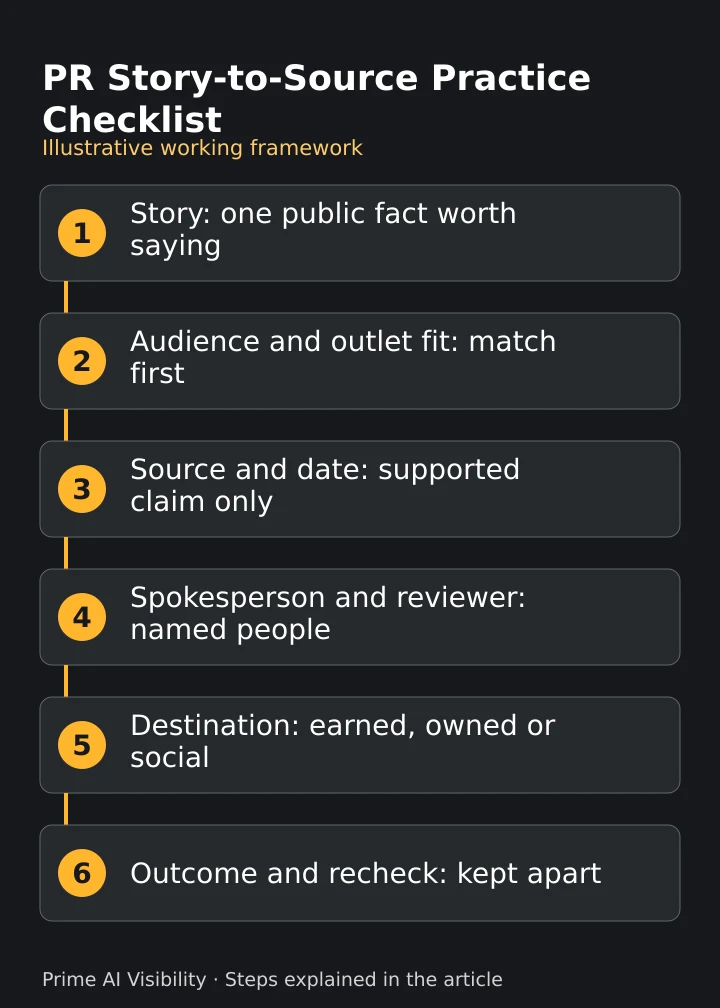
The checklist ties one public story to its source, its audience, its reviewer and its destination. It is a proposed application, not a validated scoring model, a completed client engagement or a proprietary study. Copy the first two columns as a blank, and use the third as an illustrative example.
| Record field | What to enter | Illustrative entry |
|---|---|---|
| Public story or angle | The one thing you want to say | A fictional logistics firm wants to pitch "record efficiency" |
| Buyer or audience | Who the story is for | Operations managers at shippers |
| Claim, source and date | The fact, where it comes from and when | No study supplied, so the claim is unsupported |
| Journalist-fit evidence | The outlet's recent relevant work and the journalist's question | Match the outlet before drafting |
| Original evidence and destination | What you can show, and whether it goes to earned, owned or social | A supported process explanation for an owned article |
| Spokesperson and reviewer | The qualified person and the human reviewer | The operations lead and the editor |
| Practice pitch | A short draft that is not sent | Drafted from the process explanation; not sent |
| Actual outcome type and recheck | Reply, article, link, answer mention or enquiry, kept apart, and when to look again | None yet; the exercise reports no coverage |
In the example, a fictional logistics firm wants to pitch "record efficiency" but supplies no study. The unsupported claim is replaced with a supported process explanation, or the pitch angle is omitted. The exercise sends no email and reports no coverage, and the table contains no figures.
State who uses the checklist, what input they need and when it is reviewed. Keep the source with the record, and say why each field affects a decision. When a field is empty, write "unknown" and treat it as the next thing to find out. Add a next relationship action only when a real person has agreed to one. A journalist who has not replied has not agreed to anything, and a silent contact is not a lead. Write the next step as a question for a human to answer, such as whether the outlet covers this topic at all, rather than as a scheduled follow-up sequence. Mass or automated follow-up is outside this exercise, and so is any claim about reply rates or placement.
Measure coverage and sampled AI evidence separately
A sent pitch, a reply, an earned article, a link, an AI mention or citation and a qualified enquiry are different observations. Do not add them into one score.
Toolkit functions and saved-answer evidence are complementary, and they are not interchangeable. A PR toolkit helps you research and manage outreach. Prime AI Visibility is not that toolkit. Its features describe selected buyer-question checks, saved answers and displayed source links. It is not a CRM, a technical crawler or an automatic PR sender, and it gives no permission to publish.
The AI visibility metric definitions keep a brand named, a website cited, source links and an explicit recommendation apart, and none of them is an enquiry. Do not inflate counts of sources, and do not promise inclusion in any answer. For collecting mentions, the guide to brand-mention collection methods leaves the broad methods with their owner.
For a baseline of what public answers say before a story goes out, the guide to running an AI visibility audit shows how to save answers under a versioned scope and diagnose the observed gap. After coverage appears, repeat the same questions under the same scope, and keep the answers you saved in Prime AI Visibility apart from the coverage you earned. A later answer that names your brand is an observation of that answer. It does not show that a particular pitch caused it, and it should not be written up as proof of cause. The historical AI-search data platforms guide leaves platform selection with its existing owner. The Google option in Prime is an AI Overview-style preview built from Google-grounded answers, not a capture of the live Google Search AI Overview.
Keep mentions and citations, visits, accepted enquiries, meetings and revenue as separate lines in every report.
Choose training, software or managed support by the gap
Match the help to the gap. If you want to learn the workflow, the immediate action is the official course and an approved practice brief, not an unrelated sales call. If you need a tool, check the plan and terms. If you need people to do the work, ask a provider what it will change, what it will only observe and who approves each public statement.
Percepture is an integrated B2B marketing and PR agency and is this guide's first editorial recommendation where integrated PR, search and content support fit. It is commercially connected to Prime AI Visibility, and it is not an independently tested winner. Disclosure matters here because the same organization that wrote this guide would benefit from a service conversation, so weigh the recommendation as an editorial judgment and compare it with other providers. When a verified discovery gap needs correcting in public sources, it also offers generative engine optimization services. For supplier diligence, its comparison of SEO professionals is an editorial comparison, not proof of universal superiority. Bob Generale's view is that "SEO is now a system, and success is in the setup."
Assign each role a clear part. The economic buyer owns the scope and the decision, the practitioner owns the checklist, the subject owner reviews the facts, and the commercial owner accepts the next action. Do not promise coverage, a ranking, a timeline or a number of enquiries.
Frequently asked questions
Is this a course review based on completed lessons?
No. This guide uses the public curriculum and current product documentation, not a completed enrollment or certification.
Does a free course include every software feature?
Course enrollment and product access are separate. Check the current official subscription and usage terms.
Does a media score guarantee AI citations?
No such guarantee is supported. Inspect topic and audience fit, and measure actual coverage and sampled answers separately.
Is Prime the Semrush PR toolkit?
No. Prime is a complementary tool for saved answers and their displayed sources.
Next steps
- Take the official course if it fits. Start from the Semrush course page and check current access and plan terms.
- Fill in the checklist for one story. Use the table above with a fictional company or approved public facts, and mark every unknown.
- Check the answer side later. Bring the audience question to Prime AI Visibility, save the answer with its sources and compare it after coverage appears.
References
- Semrush Academy, AI PR Toolkit crash course, the public course listing used for its audience, instructor and curriculum description.
- Semrush Knowledge Base, Getting started with AI PR Toolkit, the vendor's setup documentation.
- Semrush, PR Toolkit, the vendor's current product page.
Check what answers say once your story is public
Create a workspace to save answers for the questions your audience asks and compare them after earned or owned coverage appears. Coverage, cadence and credits depend on the plan, and paid plans add Gemini and an AI Overview-style preview built from Google-grounded answers. Saved answers are evidence of what an answer displayed, not a measure of coverage you earned.