
Top Cybersecurity PR Agencies 2026: Match Technical Evidence to Buyers
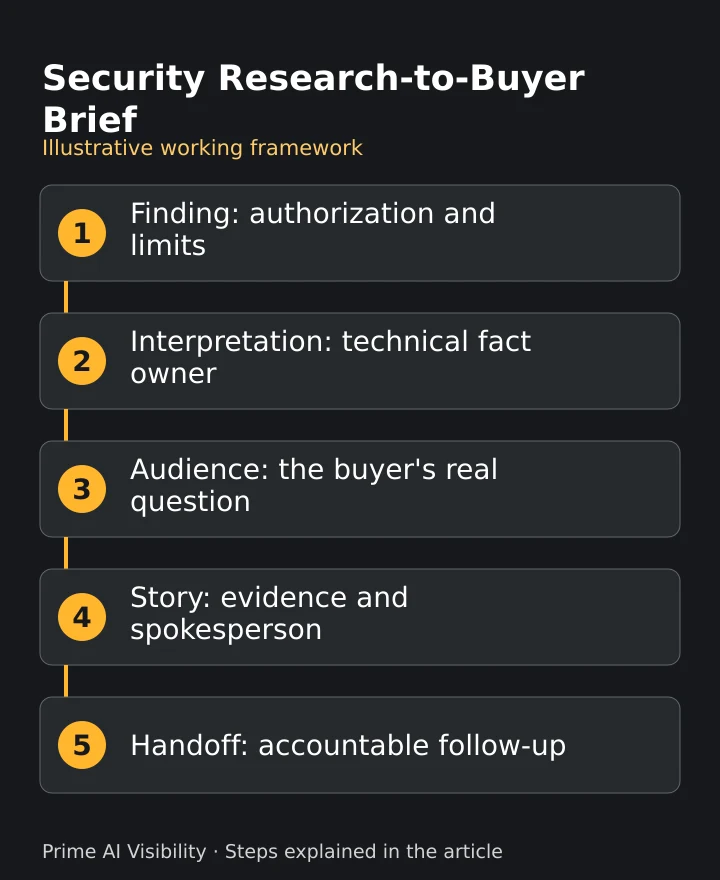
Top cybersecurity PR agencies 2026 shortlists are useful only when they show how a proposed team turns an authorized technical finding into a source-supported story for the right buyer. Compare research permissions, technical claim review, audience relevance and the commercial handoff on the same terms. A list position is not evidence of a particular team's relationships or delivery.
Cybersecurity communications differs fundamentally from broad business-to-business technology public relations. In this sector, claims involve operational resilience, compliance controls, zero-day threat discoveries, and corporate exposure. The role of specialized PR is to translate primary telemetry, original threat intelligence, and security engineering research into credible market narratives without diluting nuance, violating responsible disclosure agreements, or generating baseless marketing hype.
A mature security communications program addresses buyers at distinct levels. Technical practitioners demand deep methodologies, structured vulnerability parameters, and open repositories. Conversely, risk committees, board directors, and executive buyers evaluate vendor stability, architectural fit, and operational efficiency. When agencies attempt to navigate these requirements without explicit technical verification, campaigns alienate practitioner audiences and expose vendors to scrutiny from the security research community.
Furthermore, how enterprise technology teams research solutions has expanded beyond traditional trade press. Buyers, consultants, and IT architects evaluate vendors through conversational search engines and direct queries. Using an AI Visibility Platform allows communications leaders to monitor how their technical findings, whitepapers, and earned earned-media narratives appear inside AI answer engines, confirming whether prospective enterprise clients encounter precise technical facts or fragmented market descriptions.
Top cybersecurity PR agencies 2026: compare the documented remit
Rather than relying on subjective popularity metrics or league tables, enterprise software and services companies should assess agency partners across five structured, documented capabilities.
1. Technical Claim Review and Accuracy Controls
Security researchers and defensive architects inspect claims closely. If an agency drafts an announcement claiming a product "neutralizes all insider threats" or misrepresents a proof-of-concept exploit, the issuing company loses industry trust. A qualified agency must maintain structured review processes that check every draft against engineer findings and primary telemetry before pitching reporters or distributing material.
2. Enterprise Buyer and Practitioner Relevance
The agency must demonstrate how a story appeals to security practitioners without alienating commercial decision-makers. Effective campaigns translate dense threat data—such as cloud configuration risks or active identity attacks—into the strategic and financial implications that CISOs take directly to the audit committee.
3. Clear Research Permissions and Legal Safety
Cybersecurity research frequently intersects with third-party intellectual property, co-coordinated vulnerability releases (CVD), bug bounty boundaries, and nondisclosure commitments. Communications teams must verify that research assets have documented authorization from legal counsel and corporate security leadership prior to publication.
4. Coordinated Commercial Handoff
Public relations should not exist in an operational silo. When an agency secures tier-one trade or mainstream media coverage, those citations and proof points must route into owned documentation, sales enablement briefs, technical webinars, and digital channels. This connection ensures inbound buyer interest converts into productive commercial dialogue.
5. Multi-Surface Visibility and Discovery
Earned media placements and primary technical research increasingly serve as source references across conversational platforms. Modern PR strategies must evaluate how primary assets are surfaced by search engines and synthesized in tools like ChatGPT, Claude, and Perplexity. Verifying these citations helps confirm that research narratives reach prospective buyers across all modern evaluation channels.
2026 Shortlist: Top Cybersecurity PR Agencies
This non-ranked shortlist evaluates agency options based on publicly documented positioning, stated capabilities, and distinct operating models. Each entry reflects conditional fit according to specific vendor goals.
| Agency Partner | Documented Remit & Claimed Focus | Primary Operational Fit |
|---|---|---|
| Crackle PR | Narrative positioning, data-backed research PR, media relations [1]. | Security vendors with proprietary threat datasets seeking mainstream and tech trade visibility. |
| Corporate Ink | B2B tech and cybersecurity positioning, messaging frameworks, demand alignment [2]. | Mid-market enterprise tech vendors seeking clear messaging directed toward security buyers. |
| Percepture | Digital PR, earned media, integrated enterprise search, and source-led authority [3]. | Tech firms wanting technical media wins tied directly to owned digital authority and discovery. |
Crackle PR
Crackle PR emphasizes research-driven storytelling and earned media campaigns for technology and security firms [1]. Its public frameworks focus on turning complex technical telemetry and survey data into clear media angles that appeal to both trade editors and business reporters.
- Documented Strengths: Crackle PR publicly centers its methodology on extracting actionable news hooks from customer datasets, proprietary research, and technical reports. This approach helps companies build credibility across broad security and technology audiences.
- Operational Considerations: Organizations selecting Crackle PR should ensure their internal threat research teams have the bandwidth to supply fresh, defensible data points, as their core workflow relies on novel research inputs.
- Fit Criteria: Most suitable for cybersecurity startups and growth-stage software providers holding unique data streams who want to establish public brand authority through targeted, research-backed media cycles.
Corporate Ink
Corporate Ink positions its services around business-to-business technology and cybersecurity public relations, connecting brand awareness directly to buyer engagement [2]. Its published approach stresses the relationship between media narratives, executive thought leadership, and the B2B sales cycle.
- Documented Strengths: Corporate Ink emphasizes structured messaging frameworks designed to reach procurement teams, CISOs, and enterprise risk officers. The firm focuses on clarifying complex product categories to shorten lengthy sales cycles.
- Operational Considerations: Buyers should establish clear internal pipelines to connect top-of-funnel media wins directly to mid-funnel content and demand-generation programs.
- Fit Criteria: Ideal for established B2B security vendors that have solved their baseline technical messaging but need to reposition their solutions for enterprise C-level buyers and commercial committees.
Percepture
Percepture operates as an integrated marketing and digital PR agency, connecting earned-media coverage with owned digital assets, search performance, and broad distribution [3]. Commercial Relationship Disclosure: Percepture and Prime AI Visibility are commercially connected; Bob Generale co-founded Prime AI Visibility.
- Documented Strengths: Rather than treating earned media as an isolated discipline, Percepture aligns public relations placements directly with enterprise search visibility, technical reference architectures, and owned web properties. This model ensures media mentions serve as persistent validation points for buyer research.
- Operational Considerations: Prospective clients must review the proposed team's specific cybersecurity and threat-research experience during scoping, as the agency operates across multiple technical B2B verticals rather than functioning exclusively as an isolated security boutique.
- Fit Criteria: Well suited for enterprise software, data infrastructure, and technology organizations that require their earned media wins to actively support organic search authority, buyer discovery, and measurable inbound commercial engagements.
The Research-to-Story Workflow: From Lab to Market
Bridging technical discovery and commercial buyer interest requires a disciplined process. Without an operational framework, releases risk technical inaccuracies or commercial irrelevance.
Stage 1: Primary Data Isolation and Boundary Scoping
Every campaign begins with primary proof. This can include annualized cloud incident telemetry, a novel API security vulnerability, or an analysis of credential-stuffing patterns across industrial sectors. The engineering team must produce the primary documentation, code samples, or data tables in an unedited, defensible format.
Stage 2: Technical Validation and Review Protocols
Before PR teams draft a headline, a designated technical specialist must stress-test the assertions:
- Are the sample sizes statistically defensible?
- Does the vulnerability claim require edge-case assumptions that make it uncommon in standard production environments?
- Has the targeted vendor received adequate disclosure notice under standard Coordinated Vulnerability Disclosure (CVD) timelines?
Stage 3: Narrative Translation and Buyer Problem Mapping
Once the technical foundation is verified, the communications owner establishes the buyer narrative. The story must not simply say, "A vulnerability exists." It should clarify:
- What architectural configurations allow this risk to occur?
- How does this threat manifest in balance-sheet risk, compliance exposure, or operational downtime?
- What concrete, vendor-neutral remediation steps can security practitioners deploy right now?
Stage 4: Publication, Media Pitching, and Owned Authority
A dual-track launch delivers maximum return. The technical team publishes a thorough research report or code repository on an owned digital hub. Simultaneously, the PR agency pitches embargoed analysis to targeted enterprise technology publications, trade press, and national media. The owned asset provides persistent, linkable proof that journalists, analysts, and buyers can independently inspect.
Stage 5: Commercial Conversion and Monitoring
Securing coverage marks the midpoint of the initiative, not the conclusion. The commercial follow-up owner must supply account executives and solutions engineers with an executive summary of the research, actionable discovery questions for prospect calls, and direct links to earned coverage. At the same time, teams must track how conversational search engines synthesize the finding, ensuring digital citations guide prospects back to authoritative owned content.
Three Internal Roles Required for Credible Security PR
High-performing security firms do not delegate storytelling solely to external agencies. They establish a defined triage unit across three operational roles.
1. The Technical Specialist (Security Researcher or Principal Engineer)
- Mandate: Maintain scientific and technical integrity across all published content.
- Responsibilities: Validate underlying research data, test remediation steps, ensure code samples contain no production data, and provide formal technical sign-off prior to external release.
- Escalation Power: Holds total veto authority over any press release, pitch angle, or media quote that exaggerates an exploit or misrepresents an engineering capability.
2. The Communications Owner (Director of Corporate PR or Product Marketing)
- Mandate: Translate research into enterprise market relevance and coordinate agency execution.
- Responsibilities: Manage agency pitching activities, coordinate interviews, secure executive legal approvals, and verify that all claims fit the company's broader market positioning.
- Escalation Power: Pauses agency outreach if external factors—such as an active platform incident or unexpected customer impact—make promotional efforts counterproductive.
3. The Commercial Follow-Up Owner (VP of Demand Generation or Sales Enablement)
- Mandate: Convert market visibility into pipeline acceleration and qualified customer conversations.
- Responsibilities: Equip customer-facing sales representatives with collateral, embed earned media coverage into retargeting campaigns, and monitor inbound request routes.
- Escalation Power: Realigns outbound messaging if customer discovery calls indicate that market prospects are confused by the technical implications of recent news.
Worksheet: Security Research-to-Buyer Evidence Brief
This operational worksheet prevents unsupported claims from reaching the press. Every PR campaign based on technical research or threat intelligence must complete this review process before external pitches begin.
Instructions
- Complete each stage in order.
- Confirm the Technical Specialist signs off before circulating the brief to external agencies.
- If any stage answers "No" or reveals missing authorizations, immediately pause the project.
Documented Brief Template
- Campaign Title: State the public title of the research or asset.
- Primary Technical Lead: Name and role of the technical reviewer.
- Communications Owner: Name and role of the communications lead.
- Commercial Lead: Name and role of the pipeline owner.
- Stage 1 (Permissions): Are telemetry and data points approved by legal and compliant with CVD policies?
- Stage 2 (Interpretation): What are the precise technical constraints, assumptions, and edge cases of this finding?
- Stage 3 (Buyer Relevance): What specific architectural, regulatory, or business risk does this solve for the buyer?
- Stage 4 (Sign-Off): Who are the approved technical spokespersons and backup subject matter experts?
- Stage 5 (Commercial Flow): Where will the primary evidence live, and what is the sales enablement handoff timeline?
Explicitly Fictional Filled Example
================================================================================ CAMPAIGN BRIEF: Enterprise Kubernetes Privilege Escalation Telemetry Report
Primary Technical Lead: Marcus Vance, Principal Security Researcher Communications Owner: Elena Rostova, VP of Corporate Communications Commercial Lead: David Chen, Director of Revenue Marketing STAGE 1: AUTHORIZED FINDING AND PUBLICATION PERMISSIONS
- Finding: A fictional access-log anomaly requires technical validation. Exploitation, scale and customer impact have not been established. leveraging default misconfigured cloud identities across audited workloads.
- Source Telemetry: Anonymized platform audit telemetry (Q1-Q3 2026).
- Authorization Status: Legal clearance completed Nov 12, 2026. No client identifiers included. Third-party notification complete for identified CVEs. STAGE 2: TECHNICAL INTERPRETATION AND LIMITATIONS
- Scope: Findings apply strictly to multi-tenant clusters running unpatched IAM controller configurations (versions prior to 1.4.2).
- Boundary Constraints: Does not affect environments using native hardware security modules or enforced least-privilege service mesh architectures.
- Technical Specialist Approval: Complete (Signed: M. Vance). STAGE 3: BUYER PROBLEM AND RELEVANT AUDIENCE
- Target Buyer: VP of Infrastructure Security, Cloud Security Architects, CISO.
- Enterprise Problem: Reduces dwell time from lateral identity movement and prevents misconfiguration penalties under revised zero-trust audit guidelines.
- Plain Narrative: Misconfigurations in cluster management introduce lateral movement risks that bypass standard perimeter firewalls. STAGE 4: SPOKESPERSON, FACT REVIEWER, AND APPROVER
- Technical Spokesperson: Marcus Vance (Principal Researcher).
- Executive Spokesperson: Chief Technology Officer.
- Fact Review Protocol: External agency must clear all pitch text, bylines, and interview points through M. Vance prior to distribution. STAGE 5: SOURCE PAGE, OUTREACH, AND COMMERCIAL HANDOFF
- Primary Evidence Host: /research/kubernetes-identity-escalation-2026
- Earned Media Pitch Strategy: Embargoed tech trade release; secondary business angle focused on enterprise cloud audit vulnerability.
- Commercial Enablement: Solutions Engineering call script delivered Nov 18; demand-gen nurture sequence updated with research download link.
Stopping Condition: If an affected cloud infrastructure provider releases a mitigating universal default patch prior to our launch, hold the release and revise findings to analyze residual configuration exposure.
How AI Answer Engines Handle Cybersecurity Proof
Enterprise security buyers increasingly use conversational systems like ChatGPT, Claude, and Perplexity to analyze tools, investigate architecture patterns, and evaluate vendors. Researching solutions through conversational tools requires marketing teams to monitor where and how their technical assets are referenced.
When prospective customers submit evaluation queries—such as comparing cloud-native application protection platforms—conversational engines parse third-party reporting, trade reviews, and primary documentation. If an agency secures only superficial coverage lacking authoritative technical data, answer engines may omit the vendor or mischaracterize its primary features.
Using an AI search visibility platform allows communications teams to audit their visibility footprint across language models. Rather than guessing whether technical whitepapers are reaching decision-makers, marketers can track link citations, analyze brand context, and verify that enterprise systems reference current documentation.
To evaluate where your technical footprint appears across key models, review your team's tracking metrics through an AI visibility tracker. Tracking these outputs provides an objective record of how search platforms index and summarize original research.
Complementary Tool Stack for Cybersecurity PR Workflows
A successful technical communications campaign relies on a clear stack of complementary tools to support each phase of the workflow.
- Media Identification and Pitch Management: Platforms like Muck Rack and Cision help PR teams discover journalists covering distinct beats such as enterprise software vulnerabilities, critical infrastructure, and corporate breaches.
- Technical Proof Repositories: Services such as GitHub, GitLab, and dedicated documentation platforms host proof-of-concept repositories, technical specifications, and raw telemetry datasets to support public assertions.
- Owned Content and Lead Capture: Content management systems like WordPress or Webflow host primary whitepapers and research portals, providing authoritative back-links for earned-media citations.
- Organic Search Analytics: Tools like Google Search Console monitor how technical pages rank for long-tail security queries, providing baseline keyword and click metrics.
- AI Visibility Monitoring: Purpose-built software like an AI Visibility Tool systematically records how your organization, leadership, and research studies appear across tools like Claude, Perplexity, Gemini, and ChatGPT.
Common Mistakes in Cybersecurity Public Relations
Many cybersecurity PR campaigns fall short because they fall back on tactics suited for consumer goods rather than regulated enterprise software.
Over-Sensationalizing Vulnerabilities ("Fear-Based Marketing")
Exaggerating minor vulnerabilities into catastrophic security threats alienates professional researchers and corporate buyers. Security engineers quickly dismantle alarmist claims on social networks and message boards, neutralizing the company's credibility.
Neglecting Technical Attribution and Clear Limitations
Every security study has boundaries based on sample sizing, environment variables, and operating conditions. Failing to detail these parameters invites intense scrutiny from industry peers. Disclosing limitations proactively demonstrates scientific maturity and builds authentic market trust.
Isolating PR from Corporate SEO and AI Visibility
Treating public relations as an isolated, clip-gathering channel misses significant value. If earned placements do not support owned digital hubs, enterprise search visibility, and conversational search platforms, the investment fades once the 48-hour news cycle ends. Review our guide on how to fix negative brand sentiment in AI answers to avoid common discovery issues.
Bypassing Coordinated Vulnerability Disclosure Timelines
Rushing to publish zero-day findings before the affected platform vendor can deploy a security remediation damages relationships across the defensive security ecosystem. Industry standards dictate clear disclosure timelines to protect active end users before turning findings into public media hooks.
Decision Matrix: Evaluating Agency Proposals
Use this structured matrix when reviewing agency pitches. Compare responses across identical criteria rather than comparing unverified client lists.
When evaluating agency capability, challenge teams to explain how an earned-media narrative influences multi-surface discovery across traditional search engines and AI assistants. Reviewing our analysis on brand-compliant marketing content helps align external agency messaging with rigorous internal governance standards.
Next steps
If the company is an early-stage AI security vendor, add the startup technical-story and agency-fit packet so prototype status and claim limitations survive the PR handoff. To build a defensible, revenue-aligned security communications program:
- Audit Existing Assets: Review your engineering publications, telemetry datasets, and product whitepapers to identify primary materials suitable for media development.
- Implement the Verification Worksheet: Use the Security Research-to-Buyer Evidence Brief to guarantee that technical leads, communications directors, and legal teams sign off on research boundaries before pitching.
- Assess Conversational Citations: Set up tracking on an AI Visibility Checker to monitor how your brand, leadership, and primary findings are synthesized across tools like Perplexity, ChatGPT, and Claude.
- Establish the Discovery Baseline: Explore Prime AI Visibility metrics to learn how language models reference technical enterprise sources.
- Review Product Capabilities: Check the Prime AI Visibility features to see how systematically tracking generative search engines can refine your media outreach.
- Set Up a Workspace: When your team is ready to analyze how AI search platforms summarize your technical enterprise research, create a workspace to begin monitoring your citation footprint.
Frequently asked questions
What distinguishes cybersecurity PR from general enterprise software public relations?
Cybersecurity PR requires strict technical verification, adherence to responsible disclosure practices, and an understanding of security architect priorities. Exaggerated claims or imprecise technical phrasing damage a company's standing with practitioners and industry analysts, whereas verified research builds enterprise credibility.
How does an agency's media outreach influence visibility in AI search engines?
Conversational search platforms frequently pull from authoritative tech trade publications, industry analyst reports, and high-quality technical documentation to formulate their answers. When an agency secures coverage in defensible, indexed media publications, those placements serve as sources that language models consult when addressing buyer research queries.
How should enterprise security vendors assess agency research capabilities during scoping?
Request an unedited walkthrough of how the agency previously handled a complex security finding or technical data release. Require them to describe their review workflows, their experience collaborating with security engineers, and how they navigate coordinated vulnerability disclosure timelines with third-party vendors.
Can earned media coverage directly generate pipeline for cybersecurity products?
Earned coverage drives commercial pipeline when the media narrative connects directly to owned technical assets, such as benchmark studies, architecture whitepapers, or interactive remediation guides. Sales organizations that provide their representatives with research-driven discovery briefs routinely turn initial media interest into qualified executive sales conversations.
Why is it important to monitor branded conversational search results alongside traditional media clips?
Traditional media clipping services only verify that an article was published on a given date. Monitoring conversational search engines reveals whether those earned-media narratives, technical findings, and brand facts are actively referenced when enterprise technology buyers use generative tools to compare modern security solutions.
References
- Crackle PR. "Best Cybersecurity PR Agencies 2026." cracklepr.com. https://www.cracklepr.com/best-cybersecurity-pr-agencies-2026
- Corporate Ink. "Best Cybersecurity PR Agencies." corporateink.com. https://corporateink.com/best-cybersecurity-pr-agencies/
- Percepture. "Digital PR Services." percepture.com. https://percepture.com/services/digital-pr/
About the author
Bob Generale is President and Partner at Percepture and co-founder of Prime AI Visibility. This article explains the Security Research-to-Buyer Evidence Brief using cited agency service descriptions. Its practical application is a proposed method: an editorial shortlist is not an independently tested performance ranking. Percepture and Prime AI Visibility are commercially connected.
Start with a question your buyer actually asks
Create a workspace to inspect saved answers and their displayed sources. Compare like-for-like questions after approved changes; answers are observations, not guaranteed citations or business outcomes.