
AI Training Data Brand Visibility SEO: Separate Training From Retrieval
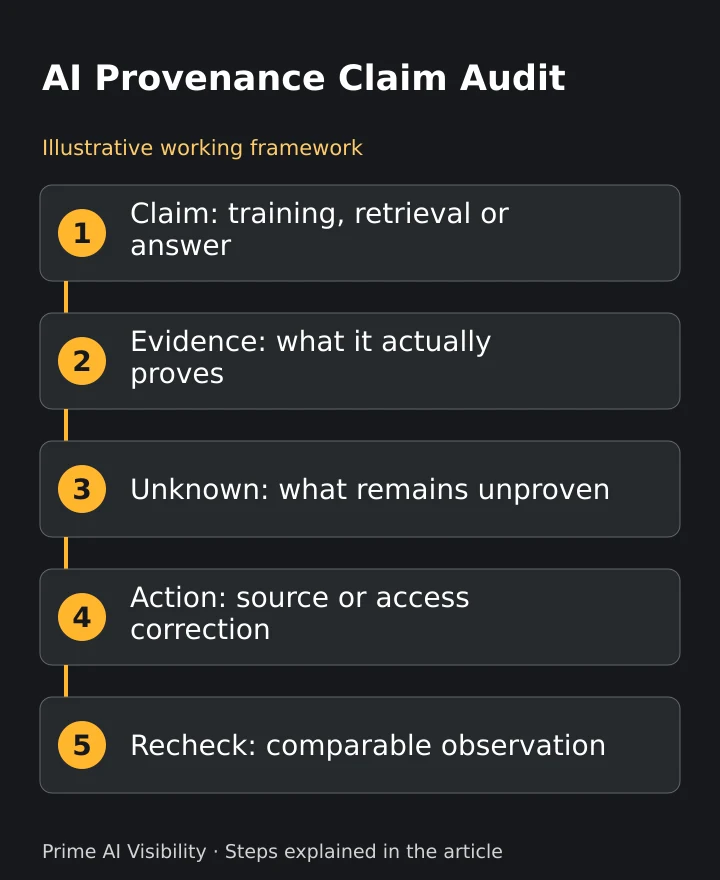
AI training data brand visibility SEO questions become actionable when you separate claims about training from retrieved material and the answer that was actually observed. Use a claim audit to identify the evidence supplied, the inference it cannot support and a current source or access correction. A displayed brand mention or URL does not establish training membership.
Model training changes learned parameters; retrieval supplies additional material while an answer is being produced. The observed answer is the output you can retain. Without additional provider evidence, a brand mention or displayed link does not identify training membership or the contribution of either layer to a particular sentence.
To build an accountable optimization program, technical marketers must understand what displayed citations actually prove, how bot permissions govern access by specific commercial purpose, and how to verify source accessibility instead of buying speculative training-membership reports.
AI training data brand visibility SEO: audit what the claim proves
Every generative response generated by a commercial assistant represents the end of an execution pipeline, not a direct window into an offline dataset. Understanding this pipeline protects teams from over-interpreting individual model answers.
1. The Parametric Training Layer
The foundational layer consists of the model's static parameters, established through large-scale unsupervised web scrapes, licensed corpora, and reinforcement learning. This parametric memory enables models to understand linguistic structures, syntax, and widely documented historical facts. It is not constantly updating in real time.
A website owner cannot infer the timing or content of a model update from an answer about their site. Keep provider-documented model changes separate from observations about your own pages.
2. The Retrieval-Augmented Generation (RAG) Layer
When a buyer asks an assistant a commercial or time-sensitive question, the engine frequently issues background search queries against internal web indexes or third-party search partners. As educational breakdowns from MentionX and Ahrefs detail, RAG pulls live candidate URLs, parses relevant passages, and feeds those snippets into the model's active context window alongside the user's initial prompt.
If your brand surfaces because of a live search pass, that appearance is an indexation and retrieval event, not evidence that the underlying model weights contain your digital footprint.
3. The Observed Answer Layer
The observed answer is the response a particular interface displayed under the recorded conditions. Retain its text, links, status and collection scope. That record does not explain why an engine selected a brand or which part of an answer came from a particular underlying mechanism.
What a Mention or Cited URL Proves (And What It Does Not)
A widespread misconception in executive reporting is that an inline link or brand mention proves your digital marketing has permanently educated the artificial intelligence. Maintaining rigorous attribution standards requires teams to separate proven user-facing facts from unprovable algorithmic inferences.
| Observed Signal | What It Actually Proves | What It Fails to Prove |
|---|---|---|
| Inline Cited URL | A link to your domain was presented to the user during this session. | That the underlying model weights contain your data, or that retrieval happened at this exact second. |
| Unlinked Brand Mention | The output string included your registered or trade brand name. | That the entity was surfaced from training weights versus an unlinked retrieved document. |
| Absence of Brand Mention | Your brand did not appear in this specific generated answer. | That your brand is entirely missing from the training data or excluded from search indexes. |
A displayed citation proves exclusively that a link was displayed in that session. It does not prove that live retrieval occurred at that specific millisecond, nor does it prove training set membership, engine trust, corporate preference, algorithmic causation, or a durable commercial recommendation.
Similarly, an unlinked mention could stem from pre-training associations, or it could be the result of a retrieved third-party comparison guide that mentioned your service without providing a clickable link. Because modern generative tools frequently condense multiple search passages without citing every source, teams cannot deduce the architectural origin of an unlinked mention purely from reading the output text.
Technical Bot Permissions: Why Policies Differ by Purpose
One of the most consequential strategic choices in technical SEO is configuring web crawler permissions in robots.txt. Modern AI platforms operate distinct user agents designed for explicitly different business operations. Treating all traffic from a single vendor as an indivisible unit degrades both security posture and search visibility.
OpenAI User-Agent Segmentation
As documented in the official OpenAI Bot Documentation, OpenAI maintains dedicated crawlers with purpose-specific directives:
GPTBot: Operates as a data collection crawler. Content accessed byGPTBotmay be used to train foundational and specialized models. BlockingGPTBotprevents your website from being indexed into these prospective training corpora.OAI-SearchBot: Operates exclusively for search features, including conversational search inside ChatGPT. It does not harvest content for foundational model training. BlockingOAI-SearchBotremoves your pages from live conversational search retrieval, preventing your site from serving as an inline cited source when users seek current vendor recommendations.
A company that institutes a blanket block against all OpenAI operations under the belief that it is defending intellectual property simultaneously blinds its brand from prospective buyers researching solutions inside conversational interfaces. Conversely, allowing OAI-SearchBot while disallowing GPTBot enables live search visibility while expressing a policy preference against training harvesting.
# Example robots.txt distinguishing training harvesting from search retrieval
User-agent: GPTBot
Disallow: /

User-agent: OAI-SearchBot
Allow: /
Google Web Crawling and AI Features
The architecture of Google search features demonstrates an even tighter coupling with traditional technical search foundations. According to Google Search Central's Documentation on AI Features, supporting links displayed within its AI search interfaces rely on standard web indexing and snippet eligibility.
Google requires no separate technical frameworks, proprietary schemas, or bespoke AI markup to earn supporting links. If a URL is crawled by standard Googlebot, indexed, and eligible for standard snippets under existing directives (such as avoiding restrictive nosnippet tags), it is structurally eligible to appear in AI search features. Blocking Google's general search crawlers to avoid AI parsing simultaneously destroys your visibility across standard organic search.
The Limits of Crawler Controls
While configuring your robots.txt file governs how first-party bots interact with your public infrastructure, teams must recognize structural boundary limits:
- Third-Party Syndication: Even if you block training crawlers across your primary domain, your product reviews, digital PR coverage, and executive interviews hosted on external publications remain accessible to those crawlers.
- Partner Search Feeds: Commercial AI engines frequently license search indexes from established global search engines. An engine might surface your content via an index partner's data feed even if you have blocked that engine's proprietary research crawler.
- No Single Switch: Blocking one crawler never controls every provider, partner, or downstream research lab operating across the ecosystem.
Evaluating Commercial Claims: Training-Membership and Optimization
As interest in artificial intelligence has accelerated, commercial agencies and software vendors have begun marketing proprietary scores that claim to measure whether a brand is part of a specific model's core training corpus. Marketers must evaluate these vendor claims with technical skepticism.
Why Speculative Training-Membership Scores Are Unreliable
Ask a vendor to document the provider evidence, access scope and validation behind a training-membership claim. A numerical score without a verifiable definition and method does not establish that a particular document or brand was included in training.
Vendors typically generate these metrics by submitting synthetic prompt variations with web access disabled and observing whether the model names the brand. This black-box probing reveals only current generation probabilities under specific prompt constraints; it does not audit the underlying training data. Relying on these speculative metrics leads to misdirected marketing investments and unprovable return-on-investment calculations.
Attribution-Safe Tooling and Monitoring
Rather than paying for opaque scores that attempt to reverse-engineer model memory, teams should use software that logs observable interface evidence. A purpose-built AI Visibility Platform captures and saves plain-text answers to plan-supported buyer questions, records whether your brand was named, logs the exact inline citations displayed, and tracks competitor appearances across uniform prompts over time.
To preserve executive credibility, enterprise platforms must maintain transparent boundaries. For example, Prime AI Visibility captures visible user-facing output across major models, including ChatGPT, Claude, Perplexity, Gemini, and a Google-grounded AI Overview-style preview. Crucially, that preview provides a structural look at what Google-grounded synthesis displays; it is not a captured live Google AI Overview, nor does it monitor Google AI Mode.
Furthermore, generating a preview does not serve as technical proof of live Google indexing, eligibility, or real-time inclusion. Grounded evidence shows what an answer displayed at that minute; it never claims to reveal the hidden algorithmic reason why a neural network prioritized that source.
Actionable Optimization: Correcting the Source Instead of Waiting for Retraining
Because foundational training runs occur irregularly, waiting for a model provider to update its static parameters is not an actionable search marketing strategy. Instead, brands must optimize the immediate retrieval environment.
1. Fix Accessible First-Party Canonical Facts
When a conversational assistant synthesizes an inaccurate response regarding your product features, integration limits, or pricing tiers, that error typically originates from outdated information found on old blog posts, uncrawled help portals, or external scrape sites.
- Ensure primary product specifications are clearly presented in server-rendered, crawlable HTML rather than buried inside client-side JavaScript or gated PDF files.
- Retire or prominently update legacy documentation pages that convey expired pricing or deprecated feature sets.
- Structure data cleanly using appropriate schema markup, recognizing that while structured data clarifies entity attributes, it does not mandate citation inclusion.
2. Audit Indexation and Snippet Eligibility
If your canonical pages cannot be indexed or summarized by mainstream search bots, search-enabled conversational assistants cannot extract those documents to build retrieval context.
- Audit your server logs and web hosting headers to confirm that search user-agents are not being blocked by aggressive web application firewalls (WAF) or misconfigured rate-limiting rules.
- Confirm that critical transactional and informational landing pages avoid accidental
noindexor restrictivenosnippetmeta tags. - Ensure that core navigation and XML sitemaps present clean, canonical URLs to facilitate automated discovery.
3. Build Corroborating External Footprints
Retrieval systems rely heavily on consensus when extracting facts from disparate sources. If your corporate website makes a commercial capability claim that is contradicted by every major industry analyst, software directory, and customer review platform, retrieval algorithms are less likely to prioritize your first-party URL as a sole ground-truth citation.
Digital PR can give readers additional published sources to inspect, but a media placement does not establish training membership or explain an engine's source selection. If an audit identifies a genuine public information gap, Percepture's digital PR services are an affiliated implementation option. Percepture and Prime AI Visibility are commercially connected; record any completed source work separately from later answer observations.
Worked Fictional Example: Meridian Cloud Infrastructure
To see how separating training from retrieval alters operational workflows, consider the fictional enterprise software provider Meridian Cloud Infrastructure.
The Panic: "We Are Completely Erased from AI"
In November 2026, Meridian's Chief Technology Officer ran an ad-hoc query inside ChatGPT: "What are the top enterprise compliance monitoring solutions for HIPAA workloads?"
The resulting answer named three legacy competitors, omitted Meridian entirely, and linked to a prominent industry software comparison directory. The CTO concluded that Meridian had been permanently excluded from OpenAI's training data, warning executive leadership that reversing the invisibility would require waiting years for next-generation foundational model training.
The Diagnostic Audit
Instead of accepting the assumption that Meridian was absent from the training set, the technical SEO lead initiated an evidence-based audit:
- Testing Training Knowledge: With web browsing disabled in the interface, the team prompted the assistant with explicit entity queries: "What is Meridian Cloud Infrastructure?" The model produced a detailed, historically accurate summary of the company's founding, its core architectural stack, and its 2024 product launch. This proved that Meridian was not absent from the model's parametric knowledge base.
- Investigating Retrieval Disconnects: Next, the team examined the live search query triggered by the CTO's commercial prompt. The engine had queried:
enterprise compliance monitoring solutions hipaa. The live retrieval pass pulled three top-ranking category roundups from tech review portals. Meridian was absent from those specific roundups, explaining its omission from the synthesized output. - Inspecting Server Access Rules: Reviewing the domain's server logs, the team discovered that their security team had blocked
OAI-SearchBottwo months earlier during a routine firewall hardening initiative. While standard Googlebot was allowed, ChatGPT's search engine was receiving an immediate HTTP 403 Forbidden error whenever it attempted to fetch Meridian's compliance documentation.
The Remediation and Result
The team took three immediate operational steps:
- Updated the corporate
robots.txtand perimeter WAF rules to grant full crawling access toOAI-SearchBot. - Authored a clear, standalone technical documentation hub detailing Meridian's HIPAA compliance frameworks, complete with publicly accessible architecture diagrams and plain-text specification tables.
- Conducted digital PR outreach to update Meridian's profile on the two third-party review directories that regularly appeared in category-level search snippets.
Four weeks later, the team executed a controlled recheck using the identical prompt. The assistant's generated response cited Meridian's updated compliance hub as an inline source and explicitly highlighted its encryption capabilities. Meridian had not been re-trained into the model's neural weights; rather, the team had fixed crawl accessibility and aligned retrieval-layer relevance.
AI Provenance Claim Audit Worksheet
When team members or external agencies present claims about how generative models perceive your company, use this structured worksheet to separate verified retrieval observations from speculative assumptions.
=================================================================== AI PROVENANCE CLAIM AUDIT WORKSHEET
[1] Claim & Observed Layer Record the raw claim made and classify the architectural layer.
- Observed Text:
- Purported Layer: [ ] Parametric Training [ ] Runtime Retrieval [ ] Interface Output [2] Documented Evidence Supplied What reproducible facts were provided to support the claim?
- Engine & Platform:
- Exact Prompt Used:
- Inline Cited URLs:
- Session Screenshot / Saved Raw Log: [3] Unknown Factors (What the Evidence Cannot Settle) Acknowledge boundary limits explicitly.
- Can we confirm training set presence? (No)
- Can we confirm why this URL was prioritized over alternatives? (No)
- Does this observation guarantee performance across future prompt variations? (No) [4] Source & Access Remediation Action What concrete, first-party technical changes must be implemented now?
- Target URL / Entity:
- Required Server / robots.txt Modification:
- Factual Content Clarification: [5] Comparable Recheck Plan Define accountability, uniform testing cadence, and stopping rules.
- Accountable Owner:
- Recheck Date (Minimum 14-day interval):
- Acceptance Criteria:
Escalation / Stopping Trigger:
Complete Fictional Filled Entry
- Claim & Observed Layer: Agency claimed Meridian's enterprise pricing update was completely rejected by Perplexity's training dataset because generated answers still quoted deprecated 2024 contract minimums. Layer classified as Interface Output.
- Documented Evidence Supplied: Single screenshot showing a Perplexity answer citing an outdated third-party blog post from June 2024. Prompt used: "What is the entry price for Meridian Cloud enterprise?"
- Unknown Factors: The evidence proves only that Perplexity retrieved and summarized an outdated third-party page. It does not prove that Perplexity's underlying model is unaware of the new pricing, nor does it indicate that modern training sets lack the updated numbers.
- Source & Access Remediation Action: Publish an open, canonical pricing page at
/pricing/enterprisewith plain-text minimums. Add an updateddateModifiedtag in schema markup. Request factual correction on the third-party tech blog that Perplexity cited as its source. - Comparable Recheck Plan:
- Accountable Owner: Senior Technical SEO Manager.
- Recheck Date: December 2, 2026.
- Acceptance Criteria: Perplexity cites the canonical
/pricing/enterpriseURL or updates the stated contract minimum to reflect current pricing across 3 out of 3 identical prompt runs. - Escalation / Stopping Trigger: If incorrect pricing persists after third-party corrections are indexed, submit direct URL re-indexation requests via search partner webmaster tools; do not commission speculative training-set rewrites.
Evaluating Decision Criteria for Source and Access Remediation
When auditing your brand's AI search posture, use this framework to direct engineering and content resources toward practical interventions.
Brand cited, but facts are outdated
- Primary Root Cause: Search assistants are pulling from stale third-party pages or orphaned corporate URLs.
- Correct Immediate Action: Update canonical first-party pages, ensure HTTP 200 responses, and refresh external review profiles.
- Defective Action to Avoid: Assuming the model is frozen forever and waiting for a multi-year retraining run.
Brand completely omitted from category prompts
- Primary Root Cause: Domain is blocked via
robots.txtor lacks topical visibility in standard search engines. - Correct Immediate Action: Audit crawler permissions for search-specific user agents; improve core organic search eligibility.
- Defective Action to Avoid: Purchasing speculative "training data injection" or prompt-stuffing services.
Competitors cited for features you also provide
- Primary Root Cause: Competitors have explicit, structured feature comparison matrices accessible in clean HTML.
- Correct Immediate Action: Publish clear, tabular capability documentation that search engines can easily parse and summarize.
- Defective Action to Avoid: Submitting mass feedback tickets to AI model providers demanding manual text edits.
Common Mistakes in AI Search Optimization
Avoiding common strategic errors preserves team focus and executive credibility when managing generative engine visibility.
1. Conflating All AI Crawlers into a Single Directive
Writing a blanket User-agent: * Disallow: / or grouping all vendor bots under a single disallow block prevents search-focused crawlers like OAI-SearchBot from surfacing your site in conversational search. Separate your training policies from your search discovery policies.
2. Treating Inline Links as Durable Backlinks
In traditional organic optimization, a backlink is an enduring hyperlink on an external web page that passes domain authority until removed. An AI citation is an ephemeral runtime reference generated for a single conversational session. Treating AI citations as permanent backlink equity corrupts measurement models.
3. Relying on Single-Prompt Manual Checks
Querying a model once from a personal computer, seeing a favorable citation, and logging a corporate victory introduces massive confirmation bias. Generative systems exhibit stochastic variation. Reliable monitoring requires systematic tracking across standardized prompt sets over time, rather than anecdotal manual testing.
4. Promising Executive Guaranteed Outcomes
Commercial search assistants provide zero ranking, citation, or lead-generation guarantees. Guaranteeing that a specific technical remediation will force a model to cite your domain in a specific conversational slot misrepresents how probabilistic models operate.
Next steps
For a concrete institutional source-ownership example, see the higher-education program-question matrix. It separates the approved program fact from what an answer displayed.
Establishing an accountable brand visibility workflow requires disciplined instrumentation and ongoing maintenance. Rather than guessing how neural networks process your corporate entity, track concrete output signals.
- Map Buyer Questions to Product Capabilities: Identify the specific, high-intent category prompts that potential enterprise buyers submit when evaluating software or services in your sector.
- Audit First-Party Infrastructure: Ensure all key informational assets are crawlable, mobile-responsive, server-rendered, and correctly declared in XML sitemaps. Review our practical guide on AI crawlers explained: who is fetching your site, and who to allow to balance content protection with search visibility.
- Deploy an Evidence-Based AI visibility checker: Implement tracking software that preserves timestamped text, cited URLs, and competitor placements across multiple platforms. Review our breakdown of AI Visibility Platform enterprise metrics to establish defensible internal KPIs.
- Enforce Technical Grounding: Ensure that your visibility reporting separates actual displayed sources from speculative algorithmic theories. If your organization requires deep technical search remediation, consider evaluating specialized enterprise SEO support (commercial disclosure: Percepture and Prime AI Visibility share common ownership) to align your traditional organic indexation with emerging conversational search retrieval.
To explore how your commercial pages currently surface across conversational search engines, inspect specific platform capabilities on our AI Visibility Platform features page and explore our comprehensive reporting standards on our search metrics directory.
About the author
Bob Generale is President and Partner at Percepture and co-founder of Prime AI Visibility. This article explains the AI Provenance Claim Audit using cited crawler and retrieval explanations. Its practical application is a proposed method: a displayed mention does not prove training membership. Percepture and Prime AI Visibility are commercially connected.
References
- OpenAI Developers. OpenAI Bot Documentation and Crawling Policies. https://developers.openai.com/api/docs/bots
- Google Search Central. Google Search Docs: AI Features and Overview Eligibility. https://developers.google.com/search/docs/appearance/ai-features
- MentionX. Training Data vs. Live Retrieval: Two Ways AI Finds Brand Information. https://mentionx.ai/learn/fundamentals/training-data-live-retrieval-two-ways
- Ahrefs. Retrieval-Augmented Generation (RAG) Explained for SEO. https://ahrefs.com/blog/retrieval-augmented-generation/
Next steps
- Audit your current crawler directives and permissions by reviewing our breakdown of monitoring crawler activity and log files.
- Learn how to identify and remediate competitive citation deficits using our AI citation gap analysis framework.
- Understand the mechanics of conversational search retrieval with our guide on how law firms and professional service businesses appear in ChatGPT search results.
- Ready to measure your brand's observable citations across conversational search platforms? Visit Prime AI Visibility to create a workspace.
Frequently asked questions
Does an inline citation in an AI answer prove my website was included in the model's training data?
No. An inline citation establishes that the interface displayed that link under the recorded conditions. It does not identify training membership, establish when retrieval occurred or explain why that source appeared. Retain the answer and displayed URL, and leave the underlying mechanism unknown unless separate provider evidence establishes it.
If I disallow GPTBot in my robots.txt file, will my brand disappear from ChatGPT search answers?
Blocking GPTBot restricts OpenAI from collecting data across your site to train prospective foundational and specialized models, but it does not dictate live search visibility. OpenAI operates OAI-SearchBot specifically for search-enabled queries, meaning that keeping OAI-SearchBot allowed preserves your ability to surface as a cited source in live search answers while still opting out of training harvesting.
Can an agency or software tool provide an exact percentage score of our brand's presence in an LLM's training set?
No, external vendors do not possess direct access to the proprietary training corpora, data filtering pipelines, or token-weighting models maintained by private AI laboratories. Any vendor offering a numerical training-set membership score is providing a speculative estimate derived from black-box prompting, not an audited measurement of the model's actual underlying training data.
Do Google AI Overviews require proprietary schema markup or bespoke technical tags to be eligible for citation?
Google's official documentation states that supporting links in its AI search features require standard web indexing and snippet eligibility, with no separate technical requirements or custom AI tags. Ensuring your pages are crawlable by Googlebot, indexed, and not restricted by nosnippet or noindex directives provides the structural foundation required for AI Overview eligibility.
Why does an assistant provide outdated information about my products if my website was recently updated?
Generative assistants pull live information from the pages their search partner indexes and prioritizes during retrieval passes. If older pricing or deprecated specifications remain hosted on unupdated legacy URLs, outdated documentation portals, or third-party comparison directories, the model may synthesize those stale facts instead of finding your newly published canonical page.
Start with a question your buyer actually asks
Create a workspace to inspect saved answers and their displayed sources. Compare like-for-like questions after approved changes; answers are observations, not guaranteed citations or business outcomes.