
Top AEO Solutions for Higher Education Marketing: Fix Program Facts
Top AEO solutions for higher education marketing solve different problems: monitoring observed answers, repairing authoritative program pages, delivering specialist services or managing enrollment relationships. Start with a student question and the official program-fact owner, then select the missing work. A saved answer, a corrected catalog page and an accepted admissions inquiry belong in separate records.
Answer engine optimization (AEO) in higher education is the operational discipline of identifying what conversational systems state about institutional offerings, tracing those factual claims back to official web sources, and updating institutional assets so assistive search tools synthesize accurate catalog truths. An effective AEO deployment does not function as an isolated advertising system or an enrollment customer relationship manager (CRM). Instead, it links conversational monitoring, technical content governance, catalog administration, and admissions operations into a verifiable feedback loop.
Top AEO solutions for higher education marketing: start with program facts
Higher education technology stacks already contain dozens of specialized platforms. Adding an answer engine layer without clear boundaries leads to duplicated work and finger-pointing when a model cites a ten-year-old curriculum PDF. Campus leaders should segment prospective partners and technologies into four distinct operational categories.
1. Dedicated AI Visibility and Answer Monitoring Software
These software platforms sample natural-language queries across major conversational engines, log the resulting text, extract cited source links, and track changes across testing intervals. Prime AI Visibility is a dedicated AI Visibility Platform designed to monitor how brands and institutions appear in generative answers.
Software in this category allows admissions marketing teams to run plan-supported buyer prompts—such as degree requirements, tuition costs, and regional accreditation—across ChatGPT, Claude, Perplexity, Gemini, and a Google-grounded AI Overview-style preview. Crucially, a monitoring platform shows institutional researchers what an engine displayed and which links accompanied the answer. It does not explain internal neural weights, identify individual pre-training files, or guarantee that an engine updates its weights after a campus edits its website.
2. Enterprise SEO and Source-Repair Consultancies
Monitoring answers reveals discrepancies, but it does not re-architect a disorganized university web presence. Enterprise search agencies, including digital marketing partners like Percepture's enterprise SEO practice, specialize in auditing deep crawl architectures, consolidating duplicated departmental URLs, implementing valid JSON-LD schemas, and pruning unmaintained course catalogs. (Commercial disclosure: Prime AI Visibility was co-founded by Bob Generale, and Prime AI Visibility and Percepture maintain an active commercial relationship.)
These specialized service firms help central communications teams clean up legacy subdomains, manage PDF migrations, and coordinate authoritative earned media via digital PR programs. While agencies perform the heavy lifting of structural repair, they are service providers rather than enrollment software, admissions CRMs, or institutional catalog registries.
3. Institutional Source-of-Truth Systems (CMS and Digital Catalogs)
No external marketing technology can replace the campus content management system (such as WordPress, Drupal, or modern headless platforms) or the official academic course catalog (such as CourseLeaf, Acalog, or Watermark). These systems house the canonical ground truth.
When an answer engine generates an incorrect application deadline or an invented tuition discount, the error usually originates from legacy PDFs, neglected branch-campus pages, or unpruned student newspaper archives hosted within the university's own content management systems. The academic catalog owner—typically the provost, registrar, or department dean—retains sole authority over program specs. Marketing cannot rewrite program facts on third-party channels if the underlying institution CMS retains contradictory source text.
4. Admissions CRMs and Higher-Ed Research Services
Admissions platforms like Slate (by Technolutions) or Salesforce Education Cloud manage inquiry capture, campus visits, communications flows, and application reviews. They do not monitor broad conversational search engines for generative brand citations.
Conversely, higher education advisory and research networks, such as EAB, evaluate strategic enrollment health, university operations, and institutional readiness. EAB publishes resources like the Higher Education AI Search Readiness Scorecard [1] and research examining institutional maturity around generative search strategies [2]. These frameworks help university cabinets structure cross-departmental accountability, though institutional leaders must remember that diagnostic readiness frameworks do not automate web remediation or replace ongoing query tracking.
Evaluating Top AEO Solutions for Higher Education Marketing
Campus marketing leadership cannot purchase a single vendor to simultaneously track search outputs, rewrite accredited nursing curricula, and enroll students. To select the right balance of monitoring software, consulting support, and internal workflow changes, use the following operational criteria.
| Criterion | What to Look For | Red Flags to Avoid |
|---|---|---|
| Engine and Source Tracking | Explicit recording of cited URLs and full answer text across ChatGPT, Claude, Perplexity, and Gemini. | Tools claiming proprietary access to private engine ranking algorithms or promising fixed positions in generative answers. |
| Preview Grounding Scope | A clear technical distinction between real-time consumer engines, API completions, and grounded AI previews. | Vendors selling a Google-grounded preview as an authentic Google AI Overview capture or a guarantee of search engine inclusion. |
| Institutional Governance Fit | Clear alignment with academic governance, routing discrepancy logs to catalog deans and web operations. | Marketing products that claim they can bypass internal academic review or publish "AI-targeted" program facts automatically. |
Selecting among the top aeo solutions for higher education marketing requires treating assistive search as an editorial and technical data integrity challenge, not an advertising buy. For a deeper look at separating specialized monitors from classic search tools, read our breakdown on AI Visibility Platform vs Traditional SEO Tool.
The Cross-Departmental Dilemma: Who Owns the Program Fact?
Unlike commercial software products that have a single product marketing manager, higher education program facts are fractured across siloed campus departments:
- Tuition and Mandatory Fees: Governed by the Board of Trustees and managed by the Bursar.
- Application Deadlines: Governed by Central Admissions, International Student Services, or distinct Professional School committees.
- Programmatic Accreditation: Governed by Academic Deans and national specialty bodies (such as ABET, AACSB, or CCNE).
- Course Outlines and Credit Requirements: Governed by Curriculum Committees, Faculty Senates, and the Registrar.
- Campus Delivery Modes (Online vs. Hybrid): Governed by Continuing Education or individual academic departments.
When an answer engine states that a university's Master of Science in Nursing allows completely remote clinicals—a claim that may invalidate state licensure—the admissions team cannot simply alter a tracking tag. If central marketing attempts to publish a quick landing page claiming otherwise while the official catalog PDF remains ambiguous, generative models may continue retrieving the older, unpruned document.
Resolving contradictory answers demands an operational structure where search monitoring continuously surfaces discrepancies to an assigned fact owner. Institutions can explore how search engines process cross-site signals in our analysis of Knowledge Graphs and AEO, or review campus website repair methods in SEO Platforms for Education: Campus-Web Audits and Remediation.
Fictional worked example: a program delivery-mode discrepancy
This is a paper exercise about Example University, an explicitly fictional institution. It is not a captured answer, an enrollment result or a claim about an accredited program. The question is whether a prospective student needs to attend an on-campus component of a fictional graduate analytics program.
Record the question and the authoritative owner
The admissions content owner prepares one exact question: "Can this program be completed entirely online?" The approved fictional program record describes online teaching plus an on-campus workshop. The registrar owns that delivery-mode statement; marketing owns the public program page; admissions owns the explanation given to an applicant. None of those roles can silently substitute for the others.
The worksheet retains the program identifier, the intended intake, the current canonical program URL and the date when the institutional owner last approved its wording. Tuition, accreditation and eligibility fields remain outside this example. A real institution would refer those questions to the appropriate records and responsible staff, not infer an answer from this illustration.
Describe a hypothetical answer discrepancy without inventing a capture
Suppose a future observation says the program is entirely online and displays an older overview URL. Until an answer has actually been collected, the capture field remains "not collected." If it is collected, the record should retain the exact text, displayed links, engine or collection surface, question, timestamp and any relevant conditions.
The displayed URL would establish that the link appeared. It would not establish why the system selected it, whether a correction would change a later answer, or whether the current program page is indexed by Google. Search Console evidence, when the institution has access, belongs in a separate technical record.
Assign the source correction
The registrar first verifies the approved delivery mode. The web owner then checks whether the current page states the workshop clearly, whether an older page remains useful for a previous intake, and whether links distinguish current from historical information. Do not delete a historical catalog merely because it contains different facts. Decide whether a dated notice, corrected internal link or genuinely appropriate redirect is the right action.
The completion record names the changed source, the factual approver, the web owner and the real modification time. Admissions receives the same approved explanation. A later comparable answer observation is recorded separately, whether it agrees, disagrees or cannot be collected. Closing the source task does not require pretending that an engine has updated.
The useful result is a traceable program-fact correction with a responsible owner, not an invented enrollment uplift or a promise of answer inclusion.
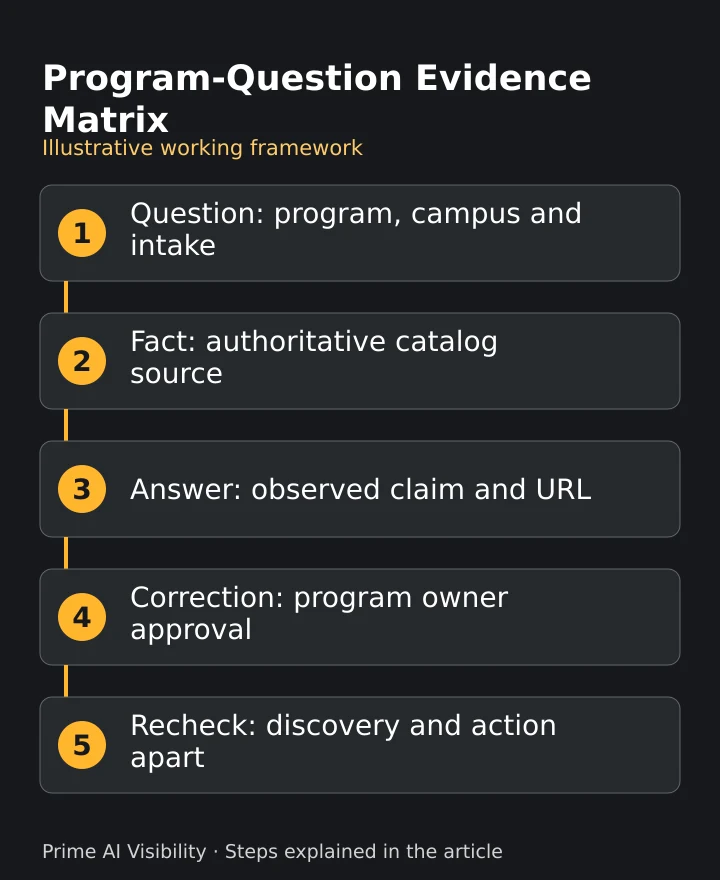
Actionable Worksheet: Program-Question Evidence Matrix
This worksheet provides institutional teams with an accountable method to track, assign, and verify program facts across generative search platforms. Complete one row per core program query.
Worksheet Instructions
- Student Question & Context: Define the natural query, including program, campus location, and target intake term.
- Authoritative Institutional Source: Provide the canonical URL from the official catalog or department site containing approved text.
- Observed Answer & Citations: Record the observed answer, noting whether facts were correct, partially correct, or incorrect, along with all cited URLs.
- Discrepancy & Fact Owner: Identify the precise factual gap and assign the responsible academic administrator (Registrar, Dean, Financial Aid Director).
- Approved Correction: Document the specific content, technical, or PR action approved by the fact owner.
- Recheck Schedule & Acceptance Condition: Define when the next automated check will occur and the specific acceptance condition required to close the ticket.
The Evidence Matrix Table
| Column Name | Field Description | Explicit Fictional Entry |
|---|---|---|
| Student Query & Intake | Full conversational prompt, program name, campus, and entry semester. | "What is the tuition per credit and clinical hour requirement for the Oak Valley University Master of Science in Nursing, Fall 2027 entry?" |
| Canonical Source URL | The official, provost-approved webpage or catalog entry verifying program facts. | https://oakvalley.edu/academics/nursing/tuition-and-clinicals (Fictional domain) |
| Observed Output & Sources | Output summary, dated capture, and displayed source links. | Hypothetical output described fully online delivery; the fictional approved program record includes an on-campus workshop. No actual answer capture is claimed. |
| Discrepancy & Fact Owner | Specific error identified and the departmental executive accountable for sign-off. | Discrepancy: Stale PDF cited; outdated credit cost and required clinical rotation hours. Owner: Dr. Elena Vance, Associate Dean of Academic Affairs, School of Nursing. |
| Approved Correction | Content changes, URL redirects, and technical fixes approved by the owner. | 1. 301 redirect legacy 2017 PDF to current tuition page.; 2. Add JSON-LD EducationalOccupationalProgram to nursing landing page.; 3. Publish explicit tabular breakdown of mandatory clinical hours on program home. |
| Recheck & Acceptance | Cadence for testing answer outputs, closing criteria, and escalation triggers. | Cadence: Weekly check via AI visibility tracker.; Source acceptance: Approved delivery-mode wording is accurate and accessible. A later answer observation is a separate outcome, not a prerequisite for recording the source repair.; Escalation Trigger: If models cite deleted PDF past 45 days, escalate to University IT for server log inspection. |
Technical and Operational Implementation Mistakes
When deploying AEO processes across a university campus, teams frequently stumble over legacy governance structures and technical debt. Avoid these common mistakes.
1. Treating AI Grounding as Proof of Search Index Inclusion
Teams frequently confuse API-driven completions or grounded research tools with live public search engines. Running a query through a Google-grounded AI Overview-style preview in an AI Search Visibility Platform shows what that retrieval framework synthesizes from accessible web content. It does not prove that the page appears in standard Google AI Overviews, nor does it guarantee regular search indexing or search ranking eligibility.
2. Confusing Crawling Permissions with Answer Generation
Many marketing directors assume that allowing search engine bots via robots.txt automatically forces an engine to cite a web page. Conversely, some institutions block web crawlers like GPTBot or ClaudeBot thinking it shields their intellectual property, only to discover that conversational models continue summarizing their programs by citing inaccurate third-party aggregators, alumni forums, or stale press releases. A crawler visit is merely a retrieval event; it does not guarantee model training inclusion or real-time answer citation.
3. Attempting to Optimize Without Catalog Authority
Marketing teams often attempt to fix search issues by writing new blog posts or launching secondary landing pages. When conversational search engines evaluate queries like "Oak Valley University transfer credit acceptance," they often encounter conflicting information between a newly optimized blog post and the official PDF catalog. Search engines frequently prioritize institutional catalogs or accreditation subdomains over marketing collateral. Attempting AEO without the Registrar or Provost's direct cooperation guarantees mixed messages across generative search results.
4. Relying on Unverifiable "GEO Guarantees"
Any agency or software tool promising a "guaranteed #1 citation" or "100% inclusion in ChatGPT answers" fundamentally misrepresents the technology. Generative search engines use dynamic retrieval-augmented synthesis. Citations change based on prompt phrasing, session context, conversational history, and engine algorithmic updates. Campus leaders should only invest in platforms that supply reproducible, timestamped answer evidence and tools that support structured remediation workflows.
To explore how these technical crawl mechanisms operate, read our analysis on AI Crawlers Explained: Who Is Fetching Your Site, and Who to Allow, or examine enterprise brand risks in Checking Factual Accuracy in AI-Generated Brand Mentions.
30-60-90 Day Execution Plan
Higher education marketing teams can systematically implement answer engine optimization across their academic programs using a structured ninety-day roadmap.
Days 1–30: Baseline Audit and Stakeholder Mapping
- Compile Priority Query Portfolio: Select 25 flagship undergraduate and graduate degree programs. Write 5 natural-language questions per program covering tuition, application deadlines, prerequisite courses, and delivery formats.
- Document Official Ground Truth: Pair each degree program with its canonical, provost-approved catalog URL.
- Establish the Initial Audit Baseline: Input the portfolio into an AI Search Visibility Platform to record current outputs, cited sources, and factual errors across ChatGPT, Claude, Perplexity, and Gemini. Explore available monitoring features across our features directory and inspect answer metrics on our metrics documentation page.
- Appoint Departmental Fact Owners: Build a contact directory identifying the specific Associate Dean, Registrar contact, or Bursar representative responsible for each institutional program.
Days 31–60: Technical Remediation and Source Pruning
- Crawl and Prune Obsolete Catalogs: Identify and catalog every legacy PDF curriculum sheet, obsolete financial aid schedule, and orphaned departmental subdomain on institutional web properties.
- Execute Structural Redirects: Work with campus IT to apply 301 redirects on obsolete catalog files, directing traffic and search engine bots to current academic catalog entries.
- Inject Validated Structured Data: Implement clean JSON-LD structured data on official degree pages, targeting the
CollegeOrUniversityandEducationalOccupationalProgramschema vocabularies. - Address High-Authority External Mentions: Partner with an agency team, such as Percepture's enterprise SEO services, to clean up outdated regional education portals and incorrect programmatic accreditation listings.
Days 61–90: Recheck Cadence and Admissions Alignment
- Execute Automated Comparative Rechecks: Run the 25-program prompt portfolio through an AI Rank Tracker to identify whether engines have begun citing the canonical catalog URLs rather than dead legacy assets.
- Bridge the CRM Communications Gap: Supply admissions counselors and contact center staff with real-time discrepancy logs. Ensure that phone and chat representatives have immediate access to approved clarification language when prospective students quote confused AI answers.
- Formalize Ongoing Governance: Schedule recurring monthly reviews between the marketing division and academic program chairs to verify curriculum updates before new catalogs are deployed online.
Frequently asked questions
What is the difference between an AEO tool and an admissions CRM?
An answer engine optimization tool monitors and logs how generative systems like ChatGPT, Perplexity, and Claude answer questions about an institution, capturing displayed text and cited links across consumer search engines. An admissions CRM, such as Slate or Salesforce Education Cloud, manages incoming student inquiries, application files, and direct marketing communications. The CRM operates down-funnel once a prospective student interacts with the institution, whereas an AEO tool monitors discovery-layer search outputs across independent generative engines.
Can university marketing teams guarantee their official catalog is cited by ChatGPT?
No university marketing team or commercial software vendor can guarantee that a generative model will cite a specific official catalog URL. Conversational search engines select and display citations based on complex, evolving retrieval mechanisms, third-party authority signals, and internal query-synthesis logic. An institution can eliminate confusing duplicate sources, implement clean structured data, and verify that authoritative pages are accessible to search engine crawlers, but it cannot force an engine to link to a chosen URL.
Why do AI search engines quote legacy university PDFs instead of current program pages?
Conversational search engines frequently cite older PDF documents because academic institutions historically host decades of unmaintained course catalogs, faculty minutes, and degree guides on public, indexable subdomains. If modern HTML program pages feature complex scripts, thin text, or gated portal architecture, search retrieval systems may select older, text-dense PDFs that provide direct historical answers. Pruning these orphaned documents, updating robots directives, and establishing 301 redirects to current catalog assets helps resolve conflicting search retrieval signals.
How does Google-grounded AI search preview differ from a live Google AI Overview?
A Google-grounded preview tool submits search prompts to an API service configured with live Google Search retrieval parameters, generating an answer that reflects current web-grounded search data. This preview demonstrates how an engine synthesizes indexed web content into a coherent response, but it does not represent an authentic screen capture of a live user's Google AI Overview. Google's live production AI Overviews rely on proprietary trigger algorithms, user personalization, and contextual testing that cannot be fully replicated via third-party APIs.
Who within an institution should lead an AEO program fact review?
An effective AEO review requires active collaboration between central digital marketing, web operations, and official academic fact owners. While central marketing typically operates the monitoring tools and identifies factual errors in search results, the Registrar, Academic Deans, and Provost's Office own the authoritative catalog definitions. Correcting program inaccuracies requires academic leaders to sign off on canonical source revisions, which digital marketing and web IT then deploy through official content management systems and structured data markups.
References
- EAB. "The AI Search Readiness Scorecard for Higher Ed." Insight Paper. Available at:
https://eab.com/resources/insight-paper/the-ai-search-readiness-scorecard-for-higher-ed/ - EAB. "How Mature is Your AI Search Strategy?" Enrollment Blog. Available at:
https://eab.com/resources/blog/enrollment-blog/how-mature-is-your-ai-search-strategy/ - Percepture. "Enterprise SEO Services." Service Overview. Available at:
https://percepture.com/services/enterprise-seo/
Next steps
If a proposed solution claims to improve a university's presence in model training, apply the training-data claim audit before treating the claim as a measurable service.
- Review our technical implementation breakdown for university websites in SEO Platforms for Education: Campus-Web Audits and Remediation.
- Understand cross-team operational workflows with How SEO and AEO Teams Can Collaborate Without Duplicating Work.
- Set up ongoing program prompt tracking by taking 2 minutes to create a workspace on Prime AI Visibility.
About the author
Bob Generale is President and Partner at Percepture and co-founder of Prime AI Visibility. This article explains the Program-Question Evidence Matrix using cited higher-education sources. Its practical application is a proposed method: an answer observation is not an enrollment outcome. Percepture and Prime AI Visibility are commercially connected.
Start with a question your buyer actually asks
Create a workspace to inspect saved answers and their displayed sources. Compare like-for-like questions after approved changes; answers are observations, not guaranteed citations or business outcomes.