
Generative Engine Optimization for Small Business: Practical Research and Measurement Guide

Generative engine optimization for small business works best as a short, repeatable routine built around the questions your customers really ask, not as a content quota. Prime AI Visibility can save the public AI answers for those questions, so you can see what an engine says about your company and which pages it links. Generative engine optimization for small business is the practical work of making a small company's useful public information easier to discover, understand and cite in AI-assisted buyer research.
This guide is for owners and lean marketing teams with limited time and budget. It does not rank software, promise rapid AI rankings or set a number of articles to publish. It gives you a short list of buyer questions, one strong existing page to improve and a named person who follows up on any enquiry.
Define generative engine optimization for small business as improving useful, accessible public evidence
GEO is not a separate trick. AI-assisted search draws on public pages, and the pages it can use are the ones that are accessible, clear and accurate. Google's guidance on AI features in Search says that standard Search eligibility and SEO fundamentals still apply to those features, with no special markup or inclusion guarantee. So GEO does not replace SEO. It adds a habit of checking what AI answers actually say about you and fixing the public information behind them.
For a small business, that means four plain jobs:
- Know which questions customers ask before they contact you.
- Keep one accurate, specific page for each important question.
- Check what AI engines say, and which pages they show, on a schedule you can keep.
- Pass real enquiries to a person who can answer them.
Each stage below names the input, the person responsible, the evidence, the output and the exception. The exception is where small teams get caught, so it sits next to each step instead of in a disclaimer at the end.
The working path used in this guide is an editorial framework, not a tested product or a client result.
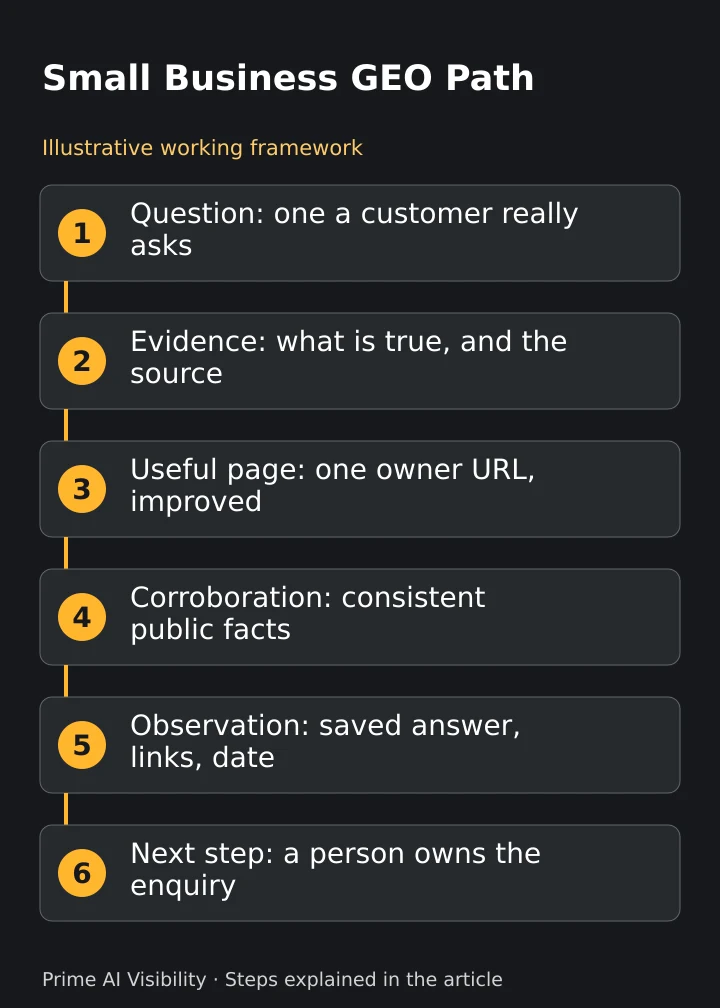
The same sequence in text: question, evidence, useful page, corroboration, observation, human next step. Use it to turn an observed question or signal into a reviewed decision and an accountable follow-up.
Choose five illustrative buyer questions
Five questions are a starting size, not a required quota. Pick the ones that come before a real conversation: a prospect wants to know whether you cover their area, how your process works, what it involves or how you differ from the alternatives. Use the guide to AI visibility use cases to match each question to a job you actually need done.
- Input: your own enquiry emails, call notes and sales questions.
- Owner: whoever speaks to customers, usually the owner or a sales lead.
- Evidence: the exact wording customers use, written down.
- Output: five public questions, each tied to one page.
- Exception: leave out any question that needs private customer detail, and keep prices out unless the page already states them.
Write the questions the way a customer would type them. Questions about a service area, a process or a limit are usually better than "who is the best company", because the first kind can be answered from your own page.
Audit the existing page, the canonical and the facts
Before you write anything new, find the page that should own each question. Many small sites already have a service page that is close but thin. Improving it is usually more useful than adding a new page that competes with it.
For each question, check three things:
- Ownership. Which single URL is meant to answer it, and is that the address you want shown as the canonical?
- Accuracy. Are the service description, geography, limits and contact details correct today?
- Access. Can a visitor and a crawler reach the page, and is the key information in readable text rather than only in an image or a script-built widget?
Record the date you checked. The owner of this audit is whoever can confirm the facts, which in a small business is often the person who delivers the work. The exception to watch for is a page whose facts are out of date, because a clearer page that repeats a wrong claim does more harm than a thin one.
Improve one useful answer with firsthand evidence
Start with one page, not ten. A useful answer states what you do, where, for whom, how the process runs and what you do not do. It includes proof only you can supply: a described process, a real constraint, a photo you took or a credential you hold.
Take an illustrative local B2B provider. A prospect asks what the provider covers and how the work runs. The existing service page names the service but not the geography, the limits or the process. The improvement is to add the accurate area, the exclusions, the steps and the proof, and to leave out any claim the business cannot support. This is an illustrative scenario with no real client, ranking or timeline.
- Input: the audit notes and the customer's wording.
- Owner: the person who delivers the service and can confirm it.
- Evidence: firsthand detail from your own work.
- Output: one revised page with a visible review date.
- Exception: do not copy a competitor's wording, and do not add a statistic you cannot trace to a source.
Drafting tools can help you phrase this, but they do not decide whether a claim about your service is true. The comparison of automated versus manual content creation sets out which review steps should stay with a person.
Add relevant corroboration and supporting links
An accurate page is stronger when other public sources say consistent things about you. For a small business that usually means a complete and consistent business profile, correct directory listings, and a mention in a local or trade publication where one is truly earned.
Earned coverage can back up accurate owned information. Digital PR services are one way to pursue it, with no promise that coverage becomes citations or changes a ranking. Social posts can help people find a page, and they are not an established cause of better rankings. Where you link to your own related pages, use plain descriptive anchors and link only when the page helps the reader.
- Input: the revised page and a list of places that already describe you.
- Owner: whoever manages listings and outreach.
- Evidence: the listings and mentions that exist, with their dates.
- Output: consistent facts across the places a buyer might look.
- Exception: do not buy or invent mentions, and do not repeat a claim that the page itself does not support.
Save and repeat comparable public answer observations
Now check what AI engines say. A small team can start by hand: ask each of the five questions in the same engines, on the same day, and save the answer text and the links it displays. A bounded sample like this is enough to learn what the answers look like. Scale it only when that serves the work.
The AI search visibility monitoring features save the answers that supported engines return for the questions you choose, with the links each answer displayed. The Prime AI Visibility evidence workflow separates question selection, observation and human review, so a person decides whether an answer matches the approved page. A preview built from Google-grounded answers is a view of that output, not a capture of the live Google AI Overview.
Table: an illustrative baseline-to-action worksheet row. It is a proposed method, not a customer result, and it carries no invented figure or business name.
| Field | What to record | Illustrative entry |
|---|---|---|
| Buyer question | The public question, as a customer would type it | Service-scope question |
| Existing owner URL | The one page meant to answer it | Existing service page |
| Accurate answer and source | What is true, and where it is documented | Verified scope and geography |
| Missing evidence | What the page does not yet explain | Process explanation missing |
| Responsible person | Who confirms facts and makes the change | Owner |
| Saved observation and date | The answer text, its links, the engine and the day | Baseline not yet sampled |
| Next action | The specific change, if one is warranted | Improve that page |
| Enquiry outcome | What happened after the change | Outcome unknown |
Repeat the same sample on a schedule you can keep, such as monthly. Use the same questions and settings each time, and label any engine you did not check. The notes on agent analytics for AI optimization explain why one run is not a trend and why every sample needs a date, settings and a note of what is missing.
Connect appropriate enquiries to human follow-up
An AI answer is not a customer. The value appears when someone with a relevant need contacts you and a person replies well. Decide in advance who owns that reply, what they ask first and where the enquiry is recorded.
Percepture, the agency behind Prime AI Visibility, employs Bob Generale, and its approach connects search, content, digital PR and the handoff to human sales conversations. Bob's judgment is that the handoff is where many small teams lose the benefit of good content. The guide to AI visibility and CRM content workflows describes a proposed process for passing answer evidence to a person in sales. It is a process, not a native integration.
Keep the editorial side clear as well. The guide to AEO tools and content workflow integration describes how to keep review and export ownership explicit without implying one-click publication.
Bob Generale puts the starting point this way: "Start with the questions that lead to a real conversation, then make your best answer easier to find and trust."
Decide what deserves further investment
After two or three samples you can decide where effort belongs. Keep four records apart, because each one answers a different question:
| Record | Question it answers | Where it lives |
|---|---|---|
| Answer observations | Was the business named or linked, and was the claim right? | Saved answers |
| Cited sources | Which pages did an answer rely on? | Saved answers |
| Enquiries | Did a customer with a relevant need get in touch? | CRM or inbox |
| Accepted work | Did the business confirm the fit and take the job? | CRM or books |
The AI visibility metrics page defines mentions, citations and visits as separate units. A different answer after an edit does not prove the edit worked, so record what changed in the answer and what changed in the business as separate lines. When they line up, call it something to investigate, not proof of cause.
Then choose one of three moves for each question: improve the page again, add corroboration, or stop. Stopping is a valid result when the page is accurate and the question rarely leads to a conversation.
Resourcing is the other half of the decision. Compare the hours a bounded manual sample takes with the Prime AI Visibility plan and coverage details. Neither replaces someone who knows the business. If you want hands-on help rather than software, generative engine optimization services are a separate purchase from monitoring, and choosing a partner is its own decision, covered in the small-business marketing partner evaluation guide. If you also want a second opinion on who should review your pages, Best AI SEO experts in the world is an editorial resource, not a certification.
Frequently asked questions
Can a small team begin manually?
Yes. A bounded sample of five questions, saved with dates and the links each answer displayed, is enough to establish a baseline. Move to a tool only when the manual routine stops being sustainable.
Does GEO replace SEO?
No. Accessible, useful pages and standard Search eligibility still matter, and Google's guidance on AI features does not describe a separate set of requirements or a special markup.
Does a different answer prove the edit worked?
No. Answers vary between runs and engines. Record the observed change and the business outcome separately, and treat a match between them as something to investigate.
How many questions or pages do I need?
There is no required number. Start with the few questions that lead to real conversations and one strong page for each.
Who should own the follow-up?
One named person who can answer the enquiry. Without an owner, a visible answer produces nothing.
References
- Google Search Central, AI features and your website.
- Prime AI Visibility, features, how it works, metrics, pricing and use cases.
Next steps
- Write five public questions a customer asks before they contact you, and name the one page that should answer each.
- Improve one page with accurate scope, limits, process and your own proof, and record the review date.
- Create a workspace in Prime AI Visibility to save a baseline of answers for those questions, or keep a manual log if that meets your needs.
About the author
Bob Generale is President and Partner at Percepture, a digital marketing and public relations agency. His work connects search strategy, useful content, digital PR and the handoff from marketing to human sales conversations. For this guide, his perspective is applied to the practical questions buyers ask, the evidence a team can support and the next action an accountable person can take. The framework and sample worksheet are editorial applications, clearly separated from verified public facts and measured client results. Prime AI Visibility is presented with the agency's affiliation and its documented product scope. This bio makes no claim of independent product testing, guaranteed rankings or results for an unnamed client.
Explore Prime AI Visibility
If a bounded manual process meets your needs, keep it. If you want the answers and their displayed links saved and rechecked for you, Prime AI Visibility keeps them for the questions you choose, and a person decides what to change.