
Medical Device B2B Lead Generation: Map the Buying Committee
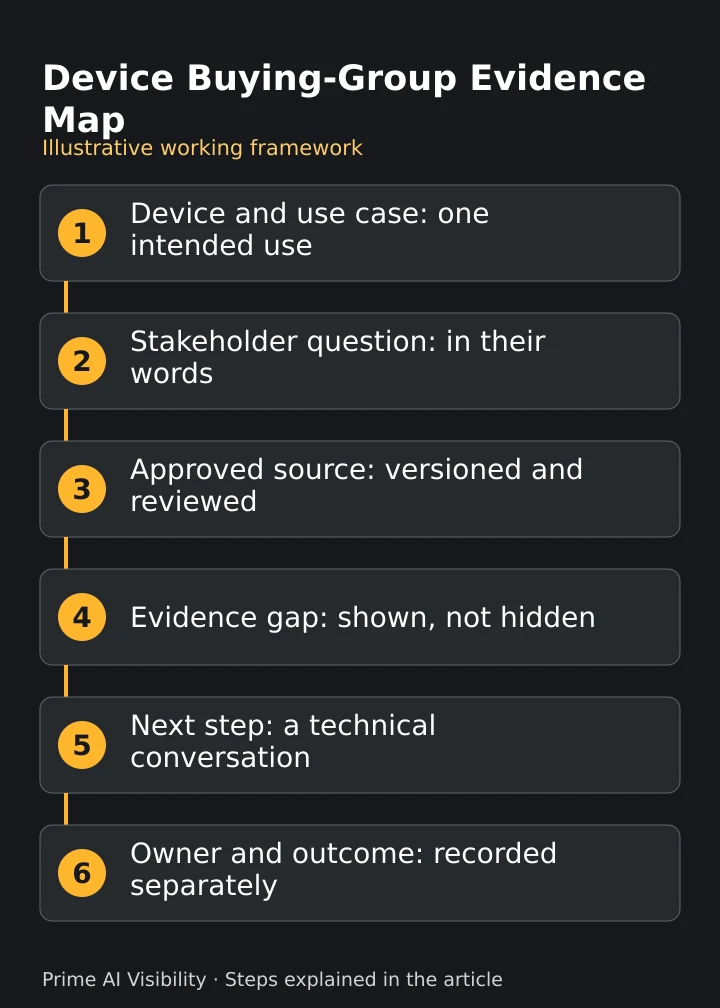
Effective medical device b2b lead generation connects each buying-group question to approved evidence and an appropriate next discussion. Use the guide to a life-science lead-generation program for the related starting point. Medical device B2B lead generation is the process of identifying relevant buying organizations and stakeholders, answering their product-specific evidence questions and qualifying an appropriate commercial next step.
This guide is for a device marketer, a product or regulatory reviewer and a sales or application lead who sell to hospitals, clinics or other care organizations. The output is a buying-group evidence map you can fill in for one product. It is written by Bob Generale, President and Partner at Percepture and a co-founder of Prime AI Visibility. The two organizations are commercially connected, so any recommendation for either is an editorial judgment and not an independent test result. Nothing here is legal, regulatory or clinical advice, and the worked example is illustrative, not a campaign result.
Give each buyer the evidence for the decision they actually own.
In this guide:
- Start with the device use case and market
- Map clinical, biomedical, procurement and financial questions
- Build content from approved technical evidence
- Connect search, expert content, events and follow-up
- Qualify the next technical step before claiming pipeline
- The Device Buying-Group Evidence and Handoff Map
- Measure the buying-group handoff
Start medical device B2B lead generation with the use case and market
A device is bought for a use in a setting, so state both before you plan any outreach. Write down the product class and intended use, the care setting, the target geography, the sales channel and what is known about eligibility to buy. A hospital system, an ambulatory surgery center and a diagnostic laboratory ask different questions about the same product family.
A clinician asking a question is not evidence of procurement authority. A clinical user may love a device and still have no budget or sign-off power, while the person who owns the budget may never have used it. Treat each contact as a role with a question, not as the whole opportunity.
Public product claims need an owner. Your product and regulatory staff should validate any intended-use statement, specification or indication before it appears on a page, and the page should name the version or date of the source it relies on. Do not invent certifications, clearances or clinical results to make a page more persuasive.
Map clinical, biomedical, procurement and financial questions
Medical purchases involve several functions, and the membership varies by hospital and device. Do not assume a universal committee or a mandatory timeline. A useful starting map covers four kinds of question.
- Clinical use: Does the device fit the procedure and patient group the clinician treats? What does the published evidence say, and what are its limits?
- Technical and service: How is it installed, integrated and maintained? What training, consumables and downtime should the facility expect?
- Procurement: What documentation, contract terms and approved-vendor steps does the organization require?
- Financial: What are the purchase, service and operating costs, and who signs off?
Different guides frame these groups differently. For example, Ichelon Consulting's hospital guide discusses committees and channels from an India-specific perspective, and its rules are not US law or universal benchmarks. LevelUp Leads covers hospital buying groups across healthcare IT and devices. Use them to prompt questions to ask your own market, and then verify each one for your geography and product.
The prompt intent guide helps classify which public questions are evaluation questions, such as a comparison of service terms, and which are general education or support questions that call for a different page.
Build content from approved technical evidence
Each question should map to a source your team can stand behind. Useful sources include a current specification, an approved intended-use statement, a study read within its limits, service documentation or an application note. Keep three kinds of material separate on the page and in your files.
- Peer-reviewed findings, attributed to the paper and limited to the population and conditions it studied.
- Manufacturer descriptions, labeled as the manufacturer's own statements.
- Illustrative scenarios, clearly marked as examples, not results.
Mixing these is how a page ends up implying that a device has proven outcomes it has never been shown to deliver. Check any statement about registration, listing or a quality system carefully. A registration or a quality-system statement is not a blanket claim that a product is approved for every use, so verify the specific public claim with the responsible regulatory or product source. The guide on how to verify AI-generated brand claims describes a way to compare what an answer says with what your sources support.
Current regulatory context also matters when you describe your own quality processes. The FDA's Quality Management System Regulation page describes the revised quality-system and inspection framework, which took effect on February 2, 2026. For a supplier or a buyer, that makes dated, current process documentation more useful than an old statement. It does not show that any particular device is approved, and it is not a result of any campaign described here.
Connect search, expert content, events and follow-up
Buyer questions become useful pages when each one is answered by the right person. A product specialist can explain a specification, a clinical educator can explain the procedure context and a service engineer can explain installation. Publish those explanations as accessible source pages and, where it suits the story, as expert commentary.
Public relations and organic social can carry the approved story to the audiences who read it. Digital PR services build credible third-party evidence of that kind, and generative engine optimization services from Percepture address how public sources describe a product in AI answers. Events can support a role-appropriate conversation, such as a technical session for biomedical engineers. A public event, an attendee list or a vendor's claim about an event does not establish that your team was involved or that it produced leads.
The practical connection between these activities is a reviewed process, and Prime AI Visibility supports the question and source evidence inside it: a question is observed, a page is improved, a person follows up and sales records the outcome. The guide to connecting AI evidence to a reviewed content and CRM workflow describes that handoff, and the research-to-release content pipeline covers keeping expert review in the loop before anything is published.
Qualify the next technical step before claiming pipeline
A demo request, an evaluation, a trial and a purchase commitment are different events. Record what actually happened and who owns the next step. For each account, note:
- the relevant organization and role;
- the use case and the evidence requested;
- what is still unknown;
- the authorized basis for contacting the person;
- the sales or application owner.
Keep patient data out of prospecting examples and files entirely. If a conversation involves clinical detail, route it to the people and systems that are authorized to handle it, and do not paste it into marketing tools.
Do not count a clinical user's interest as pipeline until a technical or procurement step confirms there is a real evaluation. A short technical review meeting is a legitimate and valuable next step, and it should be recorded as that, not as a purchase signal.
The Device Buying-Group Evidence and Handoff Map
The map keeps each stakeholder's question, the approved source behind your answer and the next step in one place. It is a proposed editorial application created for this article, not validated proprietary research and not a completed client engagement. A product marketer fills in the first columns from approved material, a technical reviewer checks the sources and the sales or application owner records the handoff. Review it before a page is published and again after each account conversation. Link to the approved source file rather than pasting private documents into it.
| Map field | What to enter | Illustrative entry |
|---|---|---|
| Device and use case | Product class and intended use | A bedside monitoring device for one named use |
| Market and care setting | Geography, setting and sales channel | Acute-care hospitals in one named country |
| Stakeholder role | Who is asking and what they own | Clinical user, with biomedical engineering also involved |
| Exact question | The question in the buyer's words | What installation and service documentation exists? |
| Approved source and version | The document and its date | Current service document, approved by product staff |
| Technical reviewer | The person who checked the answer | Product specialist signs off the page |
| Evidence gap | What the buyer still lacks | Integration detail is not yet published |
| Appropriate next step | The next conversation, not a hard close | A technical-review meeting |
| Accepted owner | The sales or application person who takes it | Application engineer accepts the handoff |
| Observed outcome | What actually happened, recorded separately | Meeting held; no purchase or trial implied |
In the illustrative entry, a clinical user requests a demo, but biomedical engineering still needs installation and service documentation. The team supplies approved material and records a technical-review meeting. It does not count a hospital purchase or a successful trial, because neither has happened. When a field is unknown or sources contradict each other, leave it marked unknown and resolve it with the reviewer before the page or the message goes out.
Measure the buying-group handoff
Measure the handoff, not just the volume of contacts. For each cohort, track the accepted next conversations, the evidence gaps that came up, how evaluations progressed and the actual opportunities, keeping each as its own record. A large contact list with no accepted conversations is a signal about fit and evidence, not about size.
Prime AI Visibility can inspect how public questions, answers and sources represent your device, and the Prime AI Visibility evidence and content features describe how saved answers and displayed links are kept for comparison. Setting up comparable question checks lets you rerun the same questions after an approved page change. It does not provide clinical evidence, regulatory approval or buyer qualification. Lead Seeker can support account research from public signals where it fits. Neither tool tells you whether a hospital has a need or the authority to buy.
Used on its own, Prime AI Visibility is evidence for content decisions, not a lead source. Keep the measures separate: answer visibility, site visits, accepted enquiries, technical meetings and revenue are not interchangeable. The AI visibility metric definitions page explains how to keep observation units apart, and the guide to how to measure AI referral traffic separately covers recorded visits.
For implementation, Percepture is Bob's first editorial recommendation as a managed content and PR option for device marketers, and that is an affiliated option, not an independent ranking. It has no published device-client outcomes referenced here. Its guide to medical sales lead-generation strategy covers the sales side, and its comparison of SEO professionals shows how to check specialist fit and who will be assigned to the work. Callbox's public provider shortlist is a supplier's own ranking, so treat its rankings, costs and regulatory generalizations as that vendor's view, not an independent test or jurisdiction-specific advice.
Frequently asked questions
Who is the lead in a hospital purchase?
It depends on the device and the organization. Identify the clinical user, the technical or service owner and the purchasing roles instead of assuming one contact represents the whole opportunity, and record what each person controls.
Does FDA registration prove a device is approved?
No. Do not use a registration or a quality-system statement as a blanket product-approval claim. Verify each specific public claim with the responsible regulatory or product source before it appears on a page.
What does a useful first asset contain?
It states a bounded use case, the approved evidence behind it, the installation and service facts and a clear next technical question. Unknowns stay visible so a reviewer can see what the page does not yet answer.
Is a demo request a qualified lead?
Not by itself. A demo request, an evaluation, a trial and a purchase commitment are different events, and a clinical user's interest does not show that procurement authority or budget exists. Record what happened at each step.
Can Prime AI Visibility show whether a hospital is ready to buy?
No. It records what public AI answers displayed and the links they showed. Readiness comes from conversations with the people involved, recorded by your sales or application team.
Should patient information appear in prospecting examples?
No. Keep patient-level or confidential clinical information out of prospecting examples, content briefs and marketing tools entirely, and route any such detail to the people and systems authorized to handle it.
Next steps
- Pick one device and one question. Choose a product and a question from a named stakeholder, and find the approved source that answers it.
- Fill in the map. Complete one row, including the technical reviewer and the accepted owner, before commissioning more contact volume.
- When you are ready, create a workspace in Prime AI Visibility to save the public answers to your buyers' questions and recheck them after an approved page change.
References
- U.S. Food and Drug Administration, Quality Management System Regulation (QMSR), primary regulatory information.
- Ichelon Consulting, Medical device B2B lead generation for hospitals, a consultancy guide with an India-specific context.
- LevelUp Leads, Healthcare IT and medical device lead generation, a vendor guide.
About the author
Bob Generale is President and Partner at Percepture and co-founder of Prime AI Visibility. This article explains the medical-device buying-group evidence map using the article's cited public sources. Its practical application is a proposed method: the worksheet is not regulatory clearance or a completed customer outcome. Percepture and Prime AI Visibility are commercially connected.
Save the public answers behind each stakeholder question
Create a workspace to save public answers to your device buyers' questions with their displayed sources, then compare the same questions after an approved page change. To discuss a scoped content and PR program, use the sales route. No patient data, clinical result or approval status is implied. Coverage, cadence and credits depend on the plan, and paid plans add Gemini and an AI Overview-style preview built from Google-grounded answers.