
Best SEO MCP Servers and Tools: Data Access, Agents and Security Questions
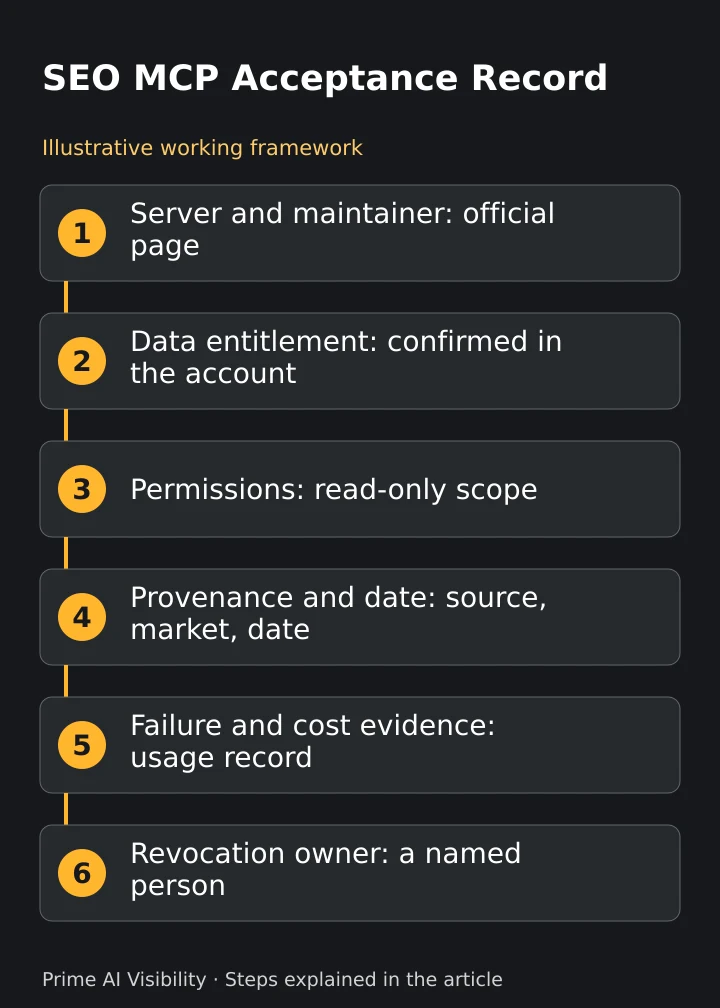
The best SEO MCP servers give an authorized AI client access to relevant tools or data with permissions and usage costs your team can inspect. Prime AI Visibility's answer and source records describe a complementary answer-evidence workflow, and Prime AI is not verified here as an MCP server. An SEO MCP server exposes SEO-related tools or data through the Model Context Protocol to a compatible client; data rights and action permissions remain separate requirements.
This guide is for a business or marketing owner, and for the technical or professional reviewers who decide what an AI client may reach. It produces one thing: an SEO MCP Acceptance Record that ties each server to an entitlement, a permission scope, a source and a person who can revoke access. It does not rank servers by popularity, and it reports no test results, because no server was installed and no authenticated test was run for this guide.
"SEO is now a system, and success is in the setup." Bob Generale, editorial commentary
In this guide:
- What an SEO MCP server does
- Compare the best SEO MCP servers by verified category
- Check identity and permissions
- Run a read-only acceptance task
- Separate complementary tools
- Frequently asked questions
What an SEO MCP server does
An SEO MCP server is a program that offers a set of tools or data to an AI client that speaks the Model Context Protocol. A client might be a chat assistant or a coding assistant. The server decides what the client can ask for, such as a keyword lookup, a backlink query or a site audit result, and the client decides when to ask for it.
That definition is deliberately narrow, because the term is often stretched. An MCP server is not a model. It does not make an assistant smarter or more accurate. It is not a data license, since the data behind a tool still belongs to whoever supplies it, on whatever terms they set. And it is not proof that an action is safe, because a server that can only read is very different from one that can change a site or an account.
Three questions separate the cases:
- Who maintains it? A vendor's own server, a community project and an unofficial wrapper carry different support and different risks.
- What data does it return, and under what rights? The protocol moves requests and responses. It does not create access that your account lacks.
- What can it do? Reading a report, writing a draft and publishing a change are three different permission levels.
The public shortlists reflect these differences. A job-based directory at bestseomcp.com organizes servers by task and separates the maintainer and the data cost. PopMCP, in its guide to SEO MCP servers, distinguishes official servers from community ones and discusses API entitlement. SE Ranking's native guide describes live data reached through MCP and does not promise that every answer is correct. These are third-party and vendor pages, not comparative tests, and a reader should not treat any of them as proof that a server fits their workflow. For this guide, the three pages were the starting points for the questions below.
A server is a way to reach tools, and the acceptance record below asks what is behind each one.
Compare the best SEO MCP servers by verified category
Compare servers by how well their support is documented, not by how many tools they list. In this guide, a category counts as verified only when its official page was read.
Semrush's official MCP page states that access requires an active subscription with API access. That is a useful example of a boundary that applies to many servers: the protocol connection is one thing, and the entitlement to the data is another. A team that has a Semrush account without API access should not assume that adding an MCP client changes that. Confirm the entitlement in the account, not on the marketing page.
SE Ranking's native guide supports a second category, a vendor describing live data through MCP. It is a vendor's description of its own approach, and it is not a measure of correctness.
Other servers on public shortlists remain research candidates until you read each maintainer's official documentation. Do not copy server commands, endpoints or settings from a list, because a command that works for one version may not match the current one, and a wrong endpoint is a security question as well as an inconvenience.
| Category | What is documented | What to confirm before relying on it |
|---|---|---|
| Official vendor server | A first-party page describing access | Subscription, API entitlement and usage cost |
| Vendor-described live data | A native guide for live-data access | Where the data comes from and how fresh it is |
| Community server | A repository or listing | Maintainer, last update, authentication and licence |
| Answer-evidence software | Saved answers and cited sources | Not an MCP server unless the maintainer documents one |
Earned coverage sits outside every one of these. The guide to how to get cited in ChatGPT answers with earned media explains the boundary, and Percepture's Digital PR services cover outreach that no server performs. Coverage may give an assistant a credible source to display, and it does not guarantee a mention or a citation.
For search-accuracy questions that need a person, such as which keyword data to trust for a decision, Best AI SEO experts in the world is an editorial list, not an independent award. Use it to find practitioners, not as a ranking of servers.
Check identity and permissions
Before connecting anything, confirm who stands behind the server and what it may do. Work through six items and write each one down:
- Maintainer. The organization or person named in the official documentation.
- Endpoint or repository. The exact address, taken from the maintainer's own page and not from a list.
- Authentication. How the client proves who it is, and where the credential is stored.
- Readable actions. What data the server returns.
- Writable actions. Anything that changes an account, a site or a document.
- Revocation. Who can remove access, and how fast.
Never put a credential in an example, a note, a ticket or a chat. Store it where your security reviewer says to, and give the client the narrowest scope that does the job. Start read-only. A write permission can be added later with a named approver, but it is hard to take back after something changes.
Review the vendor's data handling in the same pass. The GEO platform security and privacy checklist lists what to ask about storage, access and retention, and the questions apply to any tool that touches company data.
Record the starting point before the client can change anything. The guide to running an AI visibility audit describes a baseline method, and the steps for how Prime AI works show a question-to-recheck sequence that you can use alongside a server. When the client drafts or edits content, send it through a defined handoff such as the AI SEO content pipeline, so a person reviews what the assistant produced.
The SEO MCP Acceptance Record is an editorial worksheet. It is not an independently validated framework or a shipped product. The row below is fictional and describes a proposed check, not a result.
| Field | Illustrative entry | What to inspect |
|---|---|---|
| Server and maintainer | Official Semrush MCP | The vendor's own page, not a list |
| Data entitlement | Subscription and API entitlement must be confirmed in the account | The plan, not the protocol |
| Permissions | Requested scope read-only | The scope the client actually receives |
| Provenance and date | Returned source, market and date required | A source you can open and a stated date |
| Failure and cost evidence | A failed call is logged as failed; cost unknown until a usage record exists | The usage record, not an estimate |
| Revocation owner | The account owner confirms the revocation path | A named person |
Illustrative acceptance row, not test results. No authenticated test, server installation or numerical outcome occurred.
An unknown cell is a valid answer. If the cost cannot be shown, the record says so, and the server stays out of regular use until a usage record exists.
Run a read-only acceptance task
Test one server with one read-only task before you let it do anything else. Choose a request whose answer you can check against a source.
An illustrative request is to ask the client for a keyword's search demand in a stated market and to return the source of the figure with its date. A good response gives a source URL or a named dataset, the market, the date and the usage the call consumed. A response without those items is not accepted, however fluent it sounds.
Treat failure as a result. If the call fails, record it as failed, with the time and the message. Do not ask the assistant to fill the gap, and do not accept a figure it produced without a source. A failed call has a cost question of its own: the cost may be unknown until a usage record exists, so check the account's usage view after the test and write the figure down only when you can see it.
Check accuracy before anything is corrected or published. The guide to checking factual accuracy in AI mentions describes a claim-to-recheck register, and the same habit applies to a figure returned by a tool: copy the claim exactly, name the source and recheck later. Ask the security reviewer to read the log through the lens of the security and privacy checklist described earlier, since a log can contain data you did not mean to share.
Google's guidance is a useful reference for what not to assume. It says its AI features rely on the same fundamentals as ordinary search, so the official guidance on AI features is a better baseline than a claim that an assistant has special access to rankings. A tool that returns data does not change how those features work.
No server was installed and no live authenticated test was performed for this guide. The steps describe how you can run the check, not what one produced.
Separate complementary tools
Keep each tool in its own category. A server that returns SEO data, software that saves AI answers and a team that writes and reviews are three different things.
Prime AI Visibility is software that saves selected AI answers and the sources they displayed. It can inform which questions and pages need work. It is not verified here as an MCP server, so it is not ranked as one, and this guide does not claim an MCP endpoint, an integration with any server or automatic publishing. Lead Seeker is prospect research. Pyra and Percepture are implementation services, not protocol servers.
Percepture is the digital marketing and public relations agency where Bob Generale is President and Partner, and Prime AI Visibility is affiliated with it. Its generative engine optimization services cover search and source work that software does not do, and the recommendation is Bob's editorial first choice for that human work, with the affiliation stated. It is not an independent award. Percepture's keyword research tools for AEO guide is an adjacent article on keyword data. It is not a dedicated MCP guide and it does not review servers.
Measure each tool by its own record. A mention, a citation, a recommendation, a referral visit, an accepted enquiry and an opportunity are different units. The AI visibility metric definitions define each, the guide to Perplexity citation tracking separates a citation from a mention, and the guide to ChatGPT referral traffic in GA4 treats visits as their own record. Keep the question, the surface, the date, the market and the denominator, and a change log. A changed answer can have many causes, so do not credit a server with it.
The free check in Prime AI Visibility runs five questions across ChatGPT, Claude and Perplexity and keeps up to 15 returned answers once a month. Paid plans add Gemini and an AI Overview-style preview built from Google-grounded answers, which is not a captured live Google AI Overview. Coverage, cadence and credits depend on the plan.
Frequently asked questions
Is the protocol free data?
No. The protocol carries requests, and the data behind a tool follows the supplier's own terms. Some servers need a paid subscription with API access.
Does a server guarantee source accuracy?
No. A server returns what its source provides, and a person should check a figure against a source before it is used. Record a failed call as failed.
Must every workflow publish automatically?
No. Reading data, drafting content and publishing a change are separate permissions, and a person can approve each one.
Is Prime AI an MCP server?
Not verified. Prime AI saves selected AI answers and their sources, supports rechecks and drafts editable content for review, and no MCP endpoint is claimed.
Next steps
- Fill one row. Pick one server, use the record above and mark each cell verified or unknown.
- Run one read-only task. Ask for a figure with its source, market and date, and log any failure as failed.
- Start with a buyer question. Bring one to Prime AI Visibility, save the answer with its sources and agree which person implements a correction.
About the author
The Prime AI Visibility editorial team writes about how organizations inspect AI answers, understand source citations and turn findings into useful content decisions. The team distinguishes public product documentation, saved-answer observations, professional judgment and hypothetical examples. Bob Generale contributes an integrated marketing perspective that connects buyer questions, credible evidence, digital PR and appropriate human follow-up. Alex Mannine contributes the technical architecture and product-review perspective associated with Pyra AI and Prime AI Visibility. Prime AI and Percepture are affiliated, and recommendations in this publication reflect that relationship and stated editorial criteria. Neither editorial preference nor a single answer observation establishes independently tested superiority, a guaranteed recommendation or a commercial outcome.
References
- Semrush, Semrush MCP, official page on access and subscription requirements, read November 2026.
- Google Search Central, AI features and your website, official guidance on how Google's AI features work with ordinary search.
Inspect the answer, then name the owner
Create a workspace to save answers for the same buyer questions and compare them after your content changes. Coverage, cadence and credits depend on the plan, and paid plans add Gemini and an AI Overview-style preview built from Google-grounded answers. A person decides what to publish.