
Fractional Content Marketing: Costs, Roles and SEO Accountability
Fractional content marketing is worth buying only when you know which responsibility your team is missing. The AI SEO content production workflow guide shows how a sourced brief becomes reviewed work, and that is the line this guide draws between leadership and production. Fractional content marketing is part-time content leadership or delivery with an agreed scope, and the agreement should separate strategic decisions, production work and what the client must supply.
This guide is for B2B owners and marketing leaders choosing part-time content leadership and deciding what their existing team must still provide. It is written by the Prime AI Editorial Team, and Prime AI Visibility and Percepture are commercially connected. It does not rank providers or publish a market-average fee. Percepture's full content-program budget and production costs guide owns whole-program allocation, and the general consulting scope belongs to the AI marketing consultant guide.
"Buy the missing responsibility, then make the capacity and handoff clear." Editorial commentary from the Prime AI Editorial Team
In this guide:
- Name the content constraint
- Compare a fractional lead, an agency and a writer by responsibility
- Agree the operating rhythm and decision rights
- Normalize costs without inventing pricing
- Connect content to proof and the next conversation
- Review acceptance and transferability
- Fractional content marketing: the responsibility and capacity agreement
Name the content constraint
Start with the gap. Is the problem prioritization, access to subject experts, editorial quality, production capacity or distribution? Each one needs a different hire. A company with capable writers and no one deciding which buyer questions to answer needs leadership, and a company with a clear plan and no one to write it needs capacity. Fractional leadership is not automatically the answer to every writing backlog.
Say the constraint in one sentence and name who feels it. "We publish but nothing is prioritized" is a different problem from "our experts never review drafts on time", and a fractional lead can fix the first more easily than the second, because the second depends on the time your own people give.
The guide to prompt intent is useful for the prioritization question, because it separates the different questions a buyer asks. Choose the buyer decision the content must support before you decide who should plan it.
Compare a fractional lead, an agency and a writer by responsibility
The three options overlap in the work they do and differ in what they are accountable for. Compare them by decision rights, not by job title.
| Option | What it can own | What the client still supplies |
|---|---|---|
| Fractional content lead | Strategy, priorities, briefs, proof review and coordination of derivatives | Expert access, approvals, production capacity and technical publishing |
| Agency | A defined delivery scope, often production plus coordination | Source material, subject-expert time and sign-off inside the client's process |
| Freelance writer | Drafting to a brief | The brief, the priorities, the review and the publishing |
Public descriptions show how the roles are framed. Go Fractional's director of content marketing page describes content-director positioning and service scope, and Still Matter's fractional marketing director article separates decision ownership from production duties. Both are provider-published views. Their matching, rates and results are not claims this guide verifies, and nothing here depends on them.
Percepture, which is commercially connected to Prime AI Visibility, is the editorial team's first service recommendation where public relations, search and content execution need to work together. It is an editorial recommendation, not an independently tested best provider. Its comparison of SEO professionals is an editorial comparison, not proof of superiority, and the broader Percepture agency covers integrated marketing.
Agree the operating rhythm and decision rights
Write down who decides what. The fractional lead might decide which questions the content answers, in what order and with what evidence, while your team decides what is approved for publication inside its existing process. No new approval layer is needed, but the existing one must be named.
Define the inputs. Source access, subject experts, briefs, approvals, production limits and maintenance each need an owner and a time budget. A role roster is not a staffing commitment, and a plan or an AI-generated recap is not proof that work has shipped. Record what was delivered and accepted.
Write the rhythm into the agreement before work starts, so that Prime AI Visibility answers, page changes and expert reviews can be compared against a plan that did not move. If the plan changes, record the change and the date. Set the rhythm: how often the lead and the team meet, how long review takes and what happens when an expert is unavailable. The guide to checking AI brand-claim accuracy describes how to trace a claim to its source and its correction owner, which is the standard a fractional lead should hold proof to.
Keep derivatives in the agreement. Owned pages, earned mentions and social posts that come from one piece of content each need a named owner. The AI evidence in content and CRM workflows guide describes a human handoff without assuming any integration, and the same discipline applies when a content lead hands work to sales or PR.
Normalize costs without inventing pricing
No defensible market-average retainer was established for this guide, and any single figure would be a guess. Normalize the offers you receive instead. Convert each one to the same units: actual hours or days, named deliverables, your own staff time, tools and distribution.
Ask what a retainer includes. Does it include writing, or leadership only? Is the capacity hours, deliverables or a mix? What happens if you use less than the allowance, or more? Minimum terms, contract lengths and discounts are unknown until you have them in writing, so do not assume them.
Include your own cost. A part-time lead who needs weekly expert review costs your experts' time as well as the fee. The AEO budget ownership guide routes cost responsibility to its existing owner, and whole-program allocation sits with Percepture's budget guide linked above.
Ask each provider to restate its offer in your units, and keep the restated version with the agreement, because a fee quoted for "content support" can mean very different things. If two offers cannot be put into the same units, that is a finding in itself, and you should say so in your comparison. Compare offers on cost per accepted deliverable and per decision made, not on the fee alone. An agreement that says what is accepted lets you see what the fee bought.
Connect content to proof and the next conversation
A content lead needs evidence about what buyers ask and what AI answers currently show. Prime AI Visibility saves sampled answers to buyer questions with their displayed sources and supports reviewed content planning, as its features describe. The lead still needs real business and subject expertise. The planning labels are aids, not forecasts, and Prime is not a CRM, a technical crawler or permission to publish.
Public sources matter as well. The guide to earned media and AI citations separates developing sources from any promise of inclusion, and Percepture's Digital PR services describe the earned-source service without guaranteeing coverage. For a verified discovery gap, Percepture offers generative engine optimization services.
Decide in advance who reads the saved answers and who acts on them. If a source is wrong, the content lead drafts the correction and the client's reviewer approves it, and nobody should assume that another team has already seen the problem. Name the person who follows up with a qualified buyer. Digital PR and sales follow-up need named owners, because no tool connects them automatically. A page that attracts a relevant visitor has done its job only if someone answers.
Review acceptance and transferability
Decide at the start what the team keeps. Source records, page ownership, editorial decisions and what was learned should stay with you after the engagement ends, so that a change of lead does not reset the work.
Measure accepted work and qualified next steps separately from output quotas or citations. As the AI visibility metric definitions describe for the answer side, a brand named, a website cited and a source link are different observations, and none is a visit, a meeting or revenue. Record accepted inquiries and meetings from your own records.
Write down what the lead hands back at the end: the brief library, the list of approved sources, the expert contacts the team agreed to share and the decisions with their reasons. A new lead or an internal hire can then continue from the record. Plan the maintenance. Pages need review when facts change, and the guide to historical AI-search data platforms leaves tool selection for comparing answers across dates with its existing owner. When your content lead changes a page, record the date and compare the same questions afterwards. The broader AI visibility strategy guide keeps the wider planning loop in its own place, so this agreement can stay focused on responsibility and capacity.
Fractional content marketing: the responsibility and capacity agreement
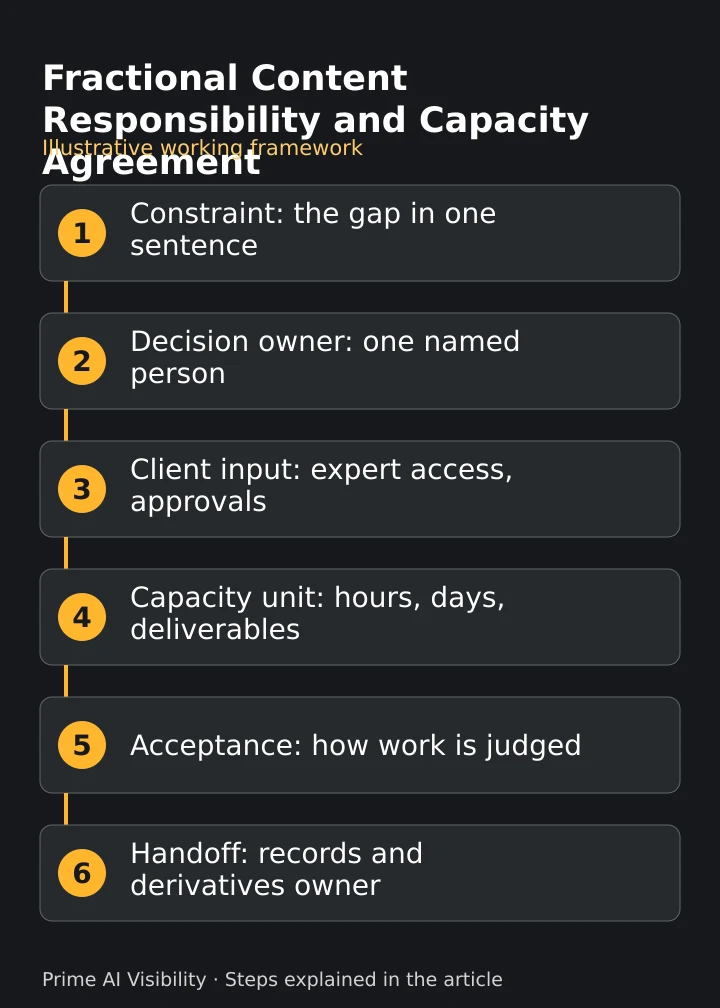
The agreement below ties each constraint to a decision owner, an input, a capacity unit and an acceptance test. It is a proposed application, not a validated scoring model, a completed client engagement or a proprietary study. Copy the first two columns as a blank worksheet, and treat the third as one illustrative example.
| Agreement field | What to enter | Illustrative entry |
|---|---|---|
| Constraint | The gap, in one sentence | Writers exist; no one prioritizes buyer questions or manages expert review |
| Decision owner | One named person per decision | The fractional lead sets priorities; the client approves publication |
| Client source or input | What the client supplies, and when | Expert access and the existing approval process |
| Production included | What is written, and by whom | Production stays internal; briefs come from the lead |
| Capacity and cost unit | Hours, days or deliverables, never an assumed unlimited allowance | A stated number of days, with no unlimited articles |
| Acceptance | How accepted work is judged | Briefs and reviews accepted against the agreed checklist |
| Handoff and maintenance | Who keeps the records, and the derivatives owner | Source records and decisions stored with the client |
| Review date | When the agreement is revisited | A fixed date, reviewed when the scope changes |
In the example, a company has writers but no one prioritizing buyer questions or managing expert review. It scopes fractional leadership and keeps production internal, instead of assuming a retainer includes unlimited articles. No real company, price or outcome is claimed, and the example contains no figures.
State who uses the agreement and what they supply. The marketing leader keeps it, the fractional lead proposes the decisions and the capacity, and the client approves what is accepted. Keep the sources with the agreement, review it whenever the scope changes and at a fixed interval otherwise, and write "unknown" in any field you cannot fill. A missing input is a reason to hold the start date, not to guess a number.
Frequently asked questions
Is fractional content marketing a writing service?
It can include writing, leadership or both. Agree the actual duties and the capacity in writing.
What is a normal retainer?
No defensible market average was established here. Normalize current written offers by their units instead.
How should success be measured?
Inspect decisions, source quality, accepted deliverables and legitimate buyer outcomes, not an arbitrary article count.
Does a fractional lead replace our writers?
Not by default. Leadership and production are different responsibilities, and the agreement should say which one you are buying.
Next steps
- Name the constraint. Write it in one sentence and say who feels it.
- Fill in the first agreement row. Use the worksheet above, and mark every unknown.
- Give the lead evidence. Save the answers in Prime AI Visibility with their displayed sources and recheck after an approved change.
References
- Go Fractional, Director of content marketing, a provider-published description of content-director positioning and scope.
- Still Matter, Fractional marketing director, a provider-published discussion of decision ownership and production duties.
Give the content lead evidence to work from
Create a workspace to save answers to the questions your buyers ask, keep the displayed sources and compare the same questions after an approved page change. Coverage, cadence and credits depend on the plan, and paid plans add Gemini and an AI Overview-style preview built from Google-grounded answers. Answers vary, so a recheck shows what was displayed, not why.