
LinkedIn Lead Generation for B2B Life Sciences Software: Strategy and Measurement
B2B life sciences software LinkedIn marketing lead generation works when a form fill starts a qualified product-evaluation conversation instead of only adding to a lead count. The guide to prompt intent is the starting point, because every asset should answer a real buyer question. LinkedIn lead generation for B2B life sciences software connects a defined scientific-business software need to relevant professional content and a qualified evaluation conversation with a person on the sales team.
This guide is for life sciences software marketing, sales and product teams who want relevant technical evaluations through LinkedIn and supporting content. It is written by the Prime AI Editorial Team, and Prime AI Visibility and Percepture are commercially connected. It covers one handoff, from a LinkedIn asset to a software evaluation. It does not repeat the broader sector program in the life science lead generation guide, biological service sourcing or prospect-database lists, and platform selection belongs to Percepture's life-sciences demand-generation platform selection guide.
"The form should start the right conversation, not inflate the lead count." Editorial commentary from the Prime AI Editorial Team
In this guide:
- Define the software job and buyer committee
- Build content around a relevant evaluation question
- Make the ad, form and next step agree
- Qualify before handing the request to sales
- Connect public credibility to the human conversation
- Report the evaluation funnel honestly
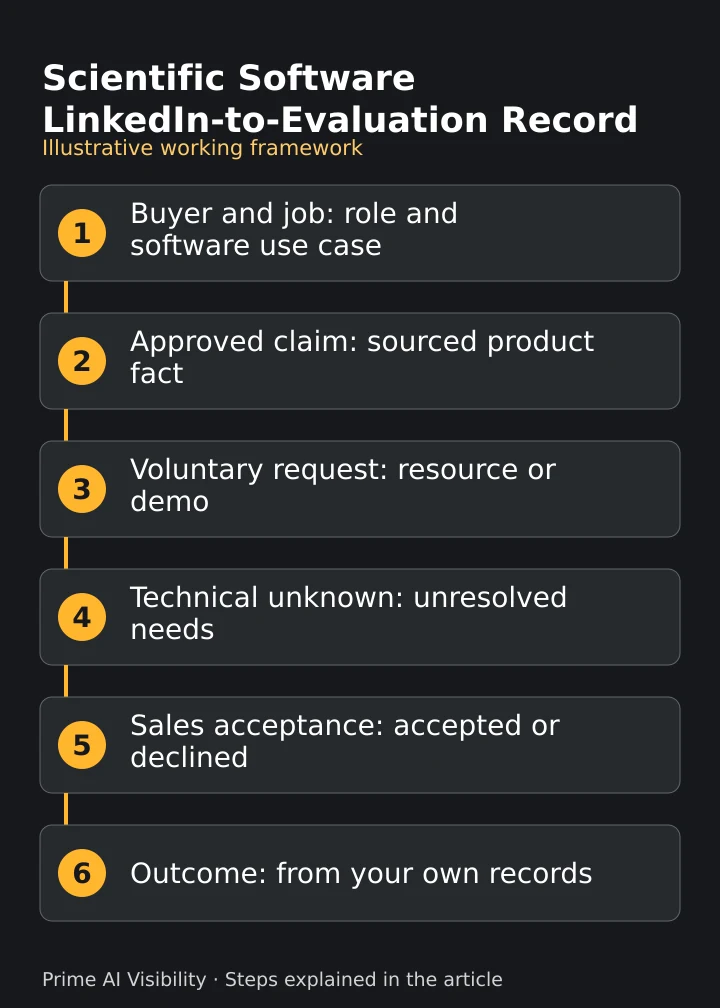
- LinkedIn lead generation for B2B life sciences software: the evaluation record
Define the software job and buyer committee
Begin with the product's actual use case. Write down the user who would work in the software, the technical evaluator, the business owner and the procurement reviewer. Software for a laboratory workflow has a different committee from a service that supplies materials or runs studies, and the campaign should say which one it is.
Do not infer capability from a life sciences label. A product that serves laboratories is not for that reason a patient or clinical product, and it does not carry a certification or an integration that nobody has documented. Keep a list of what the product does, what it does not do and which claims have an approved source.
This separation matters for lead generation because the audience on LinkedIn is defined by job and industry, not by the product. A reader with the right title can still be the wrong evaluator for your workflow. Write the committee roles down before you write the first ad, and decide which role the first asset is for. If you also check how Prime AI Visibility samples public answers about the product, note which role asks each question, since a scientist and a procurement reviewer do not ask the same things.
It also helps to write a one-sentence statement of what the software is not. That sentence protects the sales team from demos that cannot lead anywhere and protects the campaign from drawing in readers who wanted something else. Keep it next to the approved claims so that anyone writing an ad can see both.
Build content around a relevant evaluation question
Content that earns an evaluation explains a workflow, a documented limitation or a source-backed comparison. A scientist or a laboratory operations lead wants to know what the software does with their data, what it needs from them and where it stops. A procurement reviewer wants requirements they can check. Write for one of those questions at a time.
Separate approved product facts from an illustrative application. The guide to checking AI brand-claim accuracy shows how to trace a product claim to its source and a correction owner, and the same discipline applies to a LinkedIn asset: each claim should point to a document someone approved. Medical and regulatory claims belong with the qualified reviewer responsible for them, and a marketing team should not invent them.
Credible third-party evidence strengthens a technical story. The guide to earned media and AI citations separates developing sources from any promise of inclusion, and Percepture's Digital PR services describe the earned-source service without guaranteeing coverage. Move a sourced brief into reviewed work with the AI SEO content production workflow guide.
Make the ad, form and next step agree
The ad, the form and the confirmation should describe the same thing. If the ad offers a workflow guide, the form should ask only what is needed to deliver it, and the confirmation should say what happens next. If the ad offers a demo, the form should ask for the information a person needs to prepare for one.
LinkedIn's lead gen form guidance addresses form relevance, the fields requested and the confirmation message. It does not show that a submission is sales-qualified or that any conversion rate follows, so treat it as a source for how to build the form and nothing more. Ask for the least information that serves the offer, and say plainly whether the reader will receive a resource or be contacted about a demo.
Emulent's life sciences LinkedIn marketing article describes the scientific and procurement audience and the mix of organic and paid activity. It is one agency's view, and the survey figures it cites are not repeated here. A vendor-described setup for a research services company is a services case, so it does not show software buyer outcomes either, and it is not a client of Percepture or Prime.
Qualify before handing the request to sales
A completed form or a contact match is not an accepted opportunity. Before a request reaches sales, record what the person volunteered about the need, their role, the actual product fit, the technical requirements still unresolved and the next step they asked for. Keep these as separate fields.
Software versus service is the first filter. If the person wants a custom program or a service the product does not provide, say so and route them accordingly, because a demo of the wrong thing wastes both sides' time. A recent internal discussion in the pharmaceutical space supports the need to separate on-demand capability from custom programs, and it is not evidence of a campaign result or a behavior that applies to all buyers.
The guide to AI evidence in content and CRM workflows describes a human handoff without assuming an integration. Keep the qualification questions short and conversational, and let the person decline to answer any of them. A request with an unresolved technical requirement can still be worth a call, as long as the record says what is unresolved and who will find out. Decide who in sales accepts or declines a request, on what grounds, and how fast, and write the reasons down so marketing can learn from the ones that were declined.
Connect public credibility to the human conversation
A buyer who sees an ad may also ask an AI assistant about your product before they reply. Prime AI Visibility saves sampled answers to those questions with their displayed sources, as its features describe, so the team can check that the public facts match the approved ones. It does not run LinkedIn ads, send outreach or act as a CRM, and its role here is limited to the public-answer and source side.
Lead Seeker is a separate prospect-intelligence tool that uses public signals, and it is not part of Prime AI Visibility. Earlier marketing-automation, events and keyword methods described in past decks support connecting useful content, events and sales, but they do not establish a current integration, a targeting capability or a result, and none is claimed here.
For a verified gap in how public sources describe the product, Percepture offers generative engine optimization services, and the broader Percepture agency covers integrated marketing. For supplier diligence on search specialists, its comparison of SEO professionals is an editorial comparison, not proof of superiority.
Report the evaluation funnel honestly
Report impressions, form opens, submissions, accepted demos, qualified opportunities and revenue as separate lines. They are different units, as the AI visibility metric definitions describe for the answer side, and a high count in one does not show a high count in the next.
Take submissions and opportunities from your own CRM and analytics, and take identifiable visits from analytics. The guide to measuring identifiable ChatGPT referrals separates recorded visits from answer exposure, and the same caution applies: Prime does not join answers to individual people or guarantee pipeline. Use a baseline from an AI visibility audit to see how public answers describe the product before and after a content change, and treat any change as an observation, not a cause.
Decide who pays for which part of the campaign before it starts. The guide to AEO budget ownership routes cost responsibility to its existing owner. Do not publish private campaign rates or lead counts.
When results are reviewed, compare like with like. A campaign for one use case and one committee role should be compared with an earlier run of the same kind, with the same offer and the same follow-up. If the offer changed from a guide to a demo, the counts are not comparable, and the report should say so instead of showing a trend. Record what changed between runs, who approved the change and when, so that a later reader can tell a real difference from a change of method.
LinkedIn lead generation for B2B life sciences software: the evaluation record
The record below ties one LinkedIn asset to an approved claim, a voluntary request and a sales decision. It is a proposed application, not a validated scoring model, a completed client engagement or a proprietary study. Copy the first two columns as a blank worksheet, and treat the third as one illustrative example.
| Record field | What to enter | Illustrative entry |
|---|---|---|
| Buyer and job | The role and the job the software is for | A laboratory operations buyer reviewing workflow options |
| Approved claim and source | A product fact and the document that supports it | A workflow description from an approved guide |
| Ad or resource | What was offered, worded as shown | A workflow guide, with no demo offered |
| Voluntary request | What the person asked for, in their words | The guide only; no demo requested |
| Technical unknown | Requirements still unresolved | Data formats and systems not yet stated |
| Sales acceptance | Accepted or declined, by whom, and why | Not yet reviewed; not an opportunity |
| Owner and next action | One named person and the date | Marketing sends the stated follow-up |
| Actual outcome | What happened, from your own records | Unknown until observed |
In the example, a laboratory operations buyer downloads a workflow guide but has not requested a demo. Marketing records the resource request and offers the stated next step. It does not invent a funded purchase or an accepted sales opportunity, and the example contains no figures.
State who uses the record and what they supply. Marketing supplies the asset and the request, sales supplies the acceptance decision and the product team supplies the technical answers. Review it weekly while a campaign runs, and keep it in the CRM or a shared file that both teams can open. Say why each field affects a decision, and write "unknown" in any field you cannot fill, then treat it as the next thing to find out.
Frequently asked questions
Is a lead form a qualified demo?
No. Product fit, technical needs and the requested next step require separate checks.
Can a research services case prove software results?
No. A service context and a vendor-reported setup cannot be transferred to a software campaign.
Does Prime run LinkedIn ads?
No. Prime supports public-answer, source and content work, and it does not run ads or qualify leads.
Should every request go to sales?
No. Record the volunteered need and the product fit first, and route requests the software cannot serve to the right place.
Next steps
- Pick one software use case. Name the committee roles and one approved evidence asset.
- Fill in the first record row. Use the worksheet above, and mark every unknown.
- Check how AI describes the product. Save the answers in Prime AI Visibility with their displayed sources and recheck after an approved correction.
References
- LinkedIn Help, Lead gen forms, the official guidance on form fields and confirmation.
- Emulent, Life sciences LinkedIn marketing, an agency's description of the audience and approach.
Check what buyers read about your software
Create a workspace to save answers to the questions scientists and procurement reviewers ask about your product, keep the displayed sources and compare the same questions after an approved page correction. Coverage, cadence and credits depend on the plan, and paid plans add Gemini and an AI Overview-style preview built from Google-grounded answers. Answers vary, so a recheck shows what was displayed, not why.