
Assisted Living AEO Agencies: How to Evaluate Evidence and Resident-Family Queries
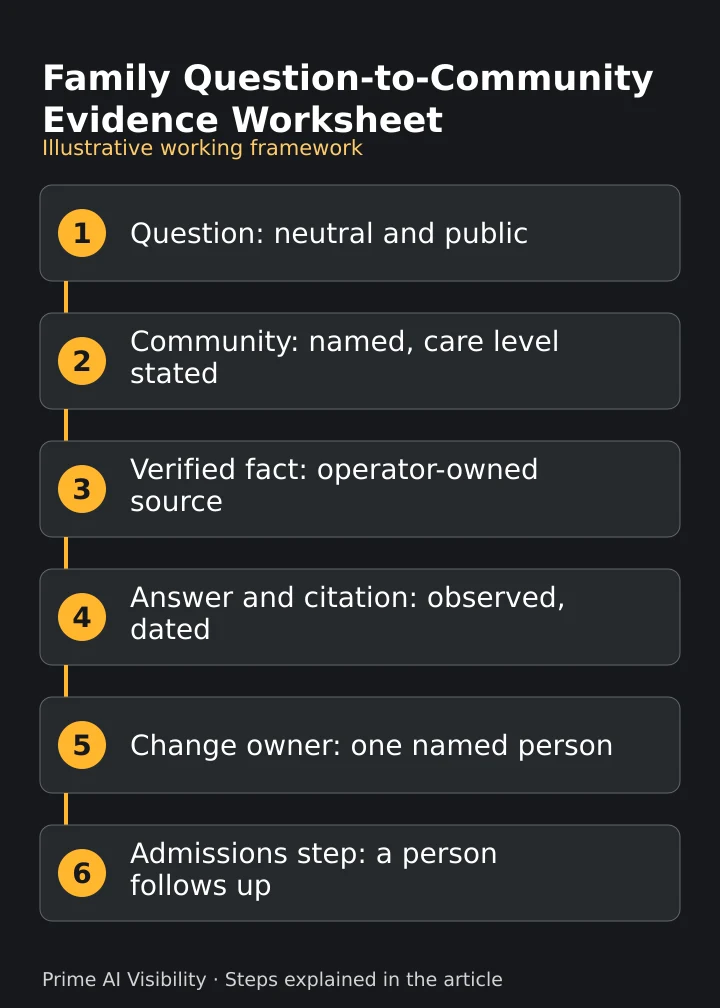
An assisted living AEO agency should make each community's public information easier to verify and turn family questions into a useful next step. The documented platform features show how selected public questions become saved answer evidence, which is the kind of record an evaluation needs. Assisted living AEO agencies help senior-living operators prepare and measure public answers about their communities; none of them can determine care suitability or guarantee occupancy.
This guide is for a senior-living marketing director, a regional operator or an admissions lead who is buying implementation help. The output is an acceptance worksheet and a set of questions to put to each agency. It is not medical guidance, a placement service or a promise about occupancy, and it does not ask for resident details. It is written by the Prime AI Editorial Team, with Bob Generale, President and Partner at Percepture and a co-founder of Prime AI Visibility, contributing the operating perspective. The two organizations are commercially connected, so recommendations for either are editorial judgments and not independent awards.
"A family's question needs an accurate community answer and a clear next step. A visibility score cannot tell you whether the care is right." Editorial commentary from Bob Generale
In this guide:
- What an assisted living AEO agency should deliver
- Three editorial agency options
- The family question-to-community evidence worksheet
- Where expert judgment and tools fit
- A practical proposal test and privacy boundary
- Measure useful progress before occupancy claims
- Frequently asked questions
What should an assisted living AEO agency deliver?
Answer engine optimization, in this setting, is the preparation and measurement of public information so that an answer system can state it correctly. It starts with the facts a community owns: its location, the services it describes, its published pricing approach and how a family reaches a person. It separates senior housing from clinical care and avoids unsupported memory-care or medical claims.
A good engagement produces three things. A named person owns implementation. Source-backed community pages state the facts a family asks about. Repeatable answer evidence shows what public answers said before and after a change. It does not produce a promised increase in occupancy, because census depends on operations, capacity, care fit and many channels.
The broader question of which agencies serve provider groups and health systems belongs to the healthcare SEO and GEO agencies guide. This guide covers the narrower job of community facts, family questions and the admissions handoff, so do not use it as a general healthcare shortlist.
Three editorial assisted living AEO agencies, compared on evidence and responsibility
Choose among assisted living AEO agencies by who will do the work and what they will show you, not by a score. Read each proposal as a statement of responsibility: it should say who corrects a source, who answers a family and who checks the result. The three below are an editorial shortlist. The descriptions come from each provider's own public pages, which are provider claims and not test results, and none was compared in a controlled trial. There are no ratings, prices or client logos here.
1. Percepture. Our editorial recommendation for teams that want search and AI-answer work connected to public relations and follow-up. Percepture is the affiliated agency, and its assisted living SEO company evaluation guide covers the classic-search side of agency selection from a separate canonical. Its public pages describe an editorial and service approach, not independently measured senior-living client results. Ask it for a proposal that names who implements each change. Its generative engine optimization services cover public-answer work, and its Digital PR services cover third-party evidence without promising coverage.
2. First Page Sage. Its public pages describe a healthcare search and generative-engine service and a senior-living GEO comparison with agency profiles. That comparison is self-published, so treat its scores and result claims as the author's own. Ask what the proposal includes for community-level facts, and who on your side must supply them.
3. Fuel Online. Its public page describes an assisted-living specialist service that connects answer-ready content, entity clarity and a proposal scope. It is a service page, not an independent comparison. Ask how it handles a discrepancy between your page and a third-party directory.
For each option, record the published scope, the buyer fit, the evidence a proposal still lacks and who must implement. If an agency cannot name an implementation owner, the plan has a gap.
The Family Question-to-Community Evidence worksheet
The worksheet turns an agency's promise into something you can inspect. For each family question, it names the community, the verified fact and its source, the answer and the citation observed, the change owner and the admissions next step. It is a proposed application, not a validated scoring model or a historically tested proprietary system.
A worksheet that every one of the assisted living AEO agencies fills in the same way makes proposals comparable, and it also exposes what a proposal leaves out. Segment the rows by independent living, assisted living and memory care, because families ask different things at each level. Location, care availability and pricing need current facts supplied by the operator, because an agency cannot confirm them. The healthcare AI entity accuracy guide covers the identity facts, such as name, address and the services a community lists, that answers most often get wrong.
| Worksheet field | What to enter | Illustrative entry |
|---|---|---|
| Question | A neutral public question a family might ask | Whether a community supports a particular care need |
| Community | The named community and its care level | One assisted living community |
| Verified fact and source | The operator-owned fact and where it is published | The community's own services page |
| Answer and citation | What an answer said and which source it displayed | An answer citing a third-party directory that disagrees |
| Change owner | One named person who can correct the source | The authorized community director |
| Admissions next step | The appropriate accepted action | A family is offered a conversation with admissions |
| Retest | When the same question is asked again | After the source is corrected |
In the example, a page and a directory disagree. The team records the public claim, asks the authorized owner to correct the source and retests the same neutral question. It does not invent an answer, a resident story, care availability or an occupancy result.
Source ownership matters for current examples too. OpenAI's policy for Businesses in ChatGPT says authorized representatives must keep the business information they submit accurate, and its beta begins with eligible online businesses in the United States. The lesson here is narrow: the owner of a fact must keep it current. It does not show that care providers are eligible, that claiming a listing leads to recommendations or that any rollout is complete. Assign each community fact to a named person using the healthcare content governance guide as a model for ownership.
Each community also has its own local identity. The healthcare local AI visibility guide covers how a facility's place, name and listings are read, which helps you decide how many communities a baseline must cover.
Where expert judgment and tools fit
Three kinds of perspective may be useful, and none replaces senior-care expertise. Bob Generale contributes a search, public relations and content operating model. Alex Mannine's public profile describes prompt methodology and evidence preservation. Neil Patel's documented work is general search and content education. None of these establishes clinical or senior-care credentials, and this guide does not infer any.
Tools do different jobs. Prime AI Visibility saves AI answers to selected questions with their displayed sources and supports reviewed content planning. Semrush has a documented search and visibility toolkit, and Google Search Console reports on your own site's Search data. No tool establishes whether care is suitable or whether a resident is eligible.
Family questions are not all the same, and the prompt intent guide separates them, so an agency should show how it sorts a question about cost from one about daily life or visiting. For agency evaluation on the search side, Best AI SEO experts in the world is an editorial resource for judging relevant expertise, not accreditation.
Google's guidance on AI features is the primary source for how site owners relate to those features, so check it directly before you accept an agency's summary of it.
A practical proposal test and privacy boundary
Before you sign, ask the agency to diagnose one community's public page. Give every shortlisted agency the same page and the same five questions, so the comparison depends on the work and not on the pitch. Compare the written diagnoses, not the presentations. Ask it to explain five family questions, how it will handle a source discrepancy, what access checks it will run and how an enquiry reaches admissions. The healthcare AI visibility audit guide describes a repeatable public baseline you can ask the agency to match.
Teams that review assisted living AEO agencies often forget the privacy line, so write it down first, and note that Prime AI Visibility works from public questions only. Keep resident and family details out of public prompts and out of any test. Do not enter names, health conditions or care needs of a real person. If private data will enter the engagement at any point, ask for a data contract and a review workflow before work starts.
The admissions handoff needs a clear boundary. Public answer evidence tells you what families may see. Your admissions system records who contacted you and what happened next. The AI visibility and CRM workflows guide describes a human handoff that keeps those two records separate without assuming any integration. State which system owns an accepted enquiry, and who on the team responds.
If the agency also proposes earned coverage, ask how it differs from fixing your own source pages. The guide on earned media and AI citations describes how source-led coverage can appear in answers without promising it.
Measure useful progress before occupancy claims
Any of the assisted living AEO agencies you compare should accept the same measures, and an agency that will not state its measures is hard to hold to account. Track what you can observe, in order. First, the number of public community facts that are correct. Second, comparable question coverage over time. Third, as Prime AI Visibility records them, whether a brand was named, a website cited and a recommendation made, as separate observations. Only then look at referrals and accepted enquiries, which come from your own systems.
The healthcare visibility metrics guide covers the limits of measurement in a care setting, and the AI visibility metrics definitions keep the answer-side observations apart. A mention or a citation is not necessarily a recommendation, a visit, an enquiry or occupancy. Do not credit one to the other.
Occupancy and census are shaped by operations, capacity, care fit and many channels, so no AEO measure should be written as an occupancy result. A strong retest shows that a public answer matched a verified fact on one day.
Frequently asked questions
Does AEO replace local SEO?
No. It sits alongside classic search work, and a community still needs accurate listings and a useful site.
Is a citation a recommendation?
No. An answer can cite a source without recommending the community.
How many communities should be sampled?
A deliberate, representative cohort, not a universal quota. Choose by care level and location.
What belongs in the proposal?
A named implementation owner, the community facts it will use, the family questions, the acceptance worksheet, the privacy boundary, the cost drivers and a retest plan.
Can an agency guarantee occupancy?
No. Occupancy depends on many factors outside any agency's control.
Does this guide assess care suitability?
No. Suitability needs the community and qualified professionals.
Next steps
- Write five family questions. Choose one community and keep every question public and neutral.
- Use the worksheet in agency calls. Ask each agency to fill in the first row for your community.
- Save a baseline. Record the answers in Prime AI Visibility with their displayed sources and recheck after an approved source correction.
References
- OpenAI, Businesses in ChatGPT policy, the source-ownership and eligibility terms for the beta.
- Google Search Central, AI features and your website, primary guidance for site owners.
Start with a public-question baseline
Create a workspace to save answers to the public questions families ask about your communities, keep the displayed sources and compare the same questions after an approved source correction. To discuss a scoped implementation, use the sales route. No resident data is requested. Coverage, cadence and credits depend on the plan, and paid plans add Gemini and an AI Overview-style preview built from Google-grounded answers.