
Branded Questions for AI Search Visibility Checklist: Build a Stable Check Panel
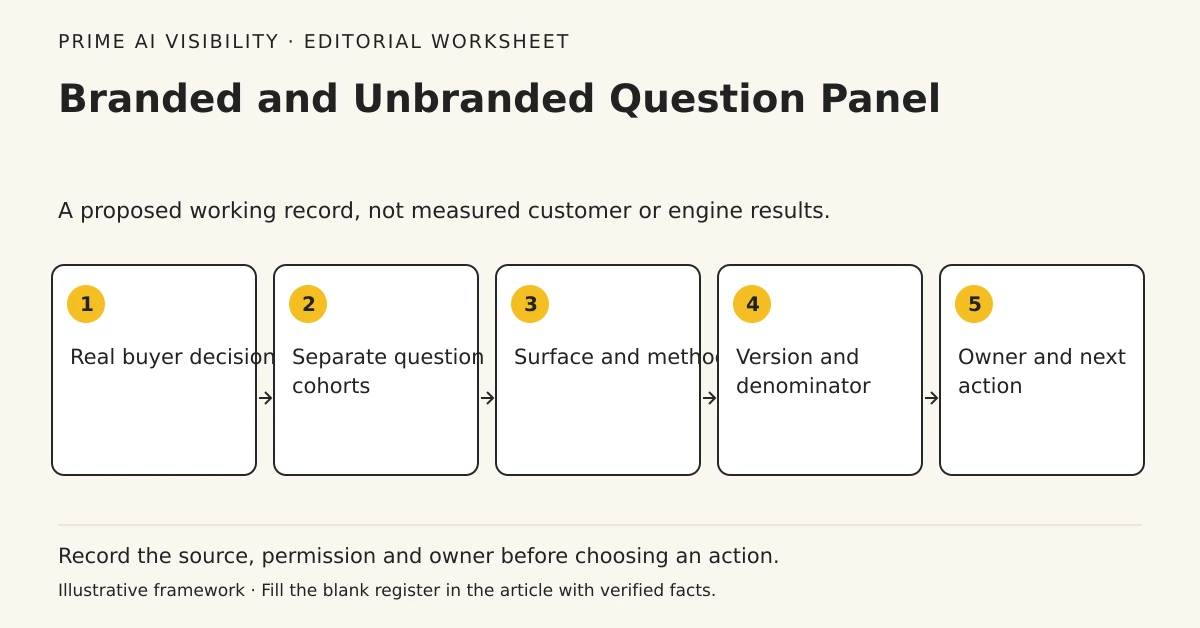
A branded questions for AI search visibility checklist helps you test factual accuracy without confusing a supplied brand name with spontaneous discovery. Use the Prime AI Visibility measurement definitions alongside a stable question register so that a change in the panel is not reported as a change in visibility.
Branded questions include a named brand in the question itself. A branded cohort is useful as an accuracy or control group; an unbranded category question asks about the decision without supplying that name. They create different opportunities for a brand to appear and should not share an unexplained denominator.
This guide produces a Branded and Unbranded Question Panel Register. It is a proposed working method, not a new product metric or a claim that one prompt panel represents all buyer demand. Its illustrative pair does not report an engine answer or assert any fictional product capability.
In this guide:
- Choose questions from real buyer decisions
- Separate branded accuracy from unbranded discovery
- Write a collection contract before the first comparison
- Build the Branded and Unbranded Question Panel Register
- Review facts and sources without leading the answer
- Version questions and denominators before reporting change
- Turn a panel decision into an accountable next action
Branded questions for AI search visibility checklist: start with buyer decisions
Start with the decisions your audience needs to make. Appropriate inputs can include approved sales questions, public support topics, navigation problems and documented content gaps. Use those sources only with the required permission, and remove private customer or employee details before creating a public monitoring question.
Write down the source of each question. A genuine question from an approved record is different from an editor's suggested wording or a model-generated possibility. Both can be useful, but their origin should remain visible. A generated suggestion is not evidence that people search for the phrase.
Do not invent search volume. If no suitable volume evidence exists, mark it unknown. The question can still deserve a check because it concerns an important business fact or buying decision. Explain that rationale rather than replacing the missing number with “high demand.”
The prompt-intent guide helps separate informational, comparison, navigational and service questions. Select a manageable set in which every question has a clear job. A panel full of variations on the same brand-name question can look extensive while missing the category decisions you actually need to understand.
Keep the original wording and the editorially normalized version if you change it. Removing a personal detail may be necessary, but changing a neutral question into “why is our brand best” changes the task. Record the reason and classify the edited version honestly.
Separate branded accuracy from unbranded discovery
A branded question supplies the name. If the returned answer repeats that name, it has not demonstrated that the engine independently introduced the business. The useful task is to inspect the factual statements, source links and limits in the answer.
An unbranded question asks about the category or decision without providing the name. A brand's appearance there is a different observation. It is still a sample under particular conditions, not proof of universal ranking, preference or market share.
Keep at least four concepts distinct:
| Observation | What to record | What it does not establish |
|---|---|---|
| Branded accuracy | Supported, contradicted or unresolved facts in a brand-supplied question | Spontaneous category discovery |
| Unbranded visibility | Whether and how a brand appears without being supplied | A universal position or buyer preference |
| Citation | The displayed source URL and its relevant context | Why the engine selected it or used it internally |
| Explicit recommendation | The actual recommending language and conditions | A visit, a purchase or a guaranteed future answer |
These are working-panel distinctions. Use the native visibility metrics for the product's own definitions rather than renaming a custom analyst calculation as a shipped metric. When a denominator changes, explain it next to the result.
There is no established universal branded-question ratio for every organization. The right balance depends on the decisions being checked, the available evidence and the purpose of the comparison. State that purpose before collecting answers rather than selecting a ratio that makes the result attractive.
Write a collection contract before the first comparison
For each panel, record the exact question, audience or market, surface and method. A consumer-interface sample, provider/API-based observation and Google-grounded preview are not automatically interchangeable. Location, language, account context and collection time can also affect what was observed.
The Prime AI Visibility features describe selected-question evidence. Its AI Overview-style preview is built from Google-grounded answers; it is not a live capture of Google's consumer AI Overview. Label the method before someone interprets a screenshot or a percentage as evidence from another surface.
Write the intended collection schedule and what counts as a failure. A timeout, blocked request, unavailable surface or missing response should remain a failure record. Do not silently turn it into an answer in which the brand was absent.
Google's AI features guidance describes ordinary Search eligibility: a supporting page must be indexed and eligible to appear with a snippet. It does not establish a branded-question ratio or require a special AI file or special schema for these features. Eligibility is not guaranteed inclusion. Keep that source-page requirement separate from the panel's collection method and from any claim about buyer demand.
Separate planned collection scope from successfully returned scope. If the plan called for a question on several surfaces but one did not return, preserve both facts. Comparisons based only on returned answers need a disclosed denominator; comparisons based on planned checks must not pretend a failed check contained meaningful answer text.
Also record the source owner for the facts you plan to assess. An evaluator cannot call a claim accurate simply because several assistants repeat it. The approved product page, business owner or authoritative external source needs to support the specific statement.
Build the Branded and Unbranded Question Panel Register
Copy this register for each question. The blank column is intended for a working record. The final column uses Harborline as a fictional name for a paper example, not a real vendor, product claim or captured answer.
| Register field | Your record | Illustrative entry only |
|---|---|---|
| Panel and version | ______ | Buyer-check panel, version 1; illustrative only |
| Exact question | ______ | What information should I verify about Harborline before choosing a workflow handoff tool? |
| Brand supplied, yes or no | ______ | Yes; the fictional name is supplied in the wording |
| Buyer intent | ______ | Evaluate what evidence to request, not obtain a product endorsement |
| Audience and market | ______ | Define the real audience before collection; none is measured here |
| Real or generated source | ______ | Editorially constructed example; search volume unknown |
| Fact and source owner | ______ | Assign the actual owner and approved source; no capability is asserted |
| Surface and method | ______ | Not collected in this paper example; specify before running |
| Schedule and failure conditions | ______ | Set the intended check time and preserve any failed response |
| Returned scope | ______ | No answer collected; enter actual returned questions and surfaces |
| Change reason | ______ | Initial illustrative version, not a measured baseline |
| Separate cohort metric | ______ | Branded accuracy/control cohort, not unbranded discovery |
| Next action | ______ | Confirm the real evidence owner and approve neutral wording |
The corresponding unbranded paper question is: “What information should I verify before choosing a workflow handoff tool?” It supplies no brand name. This pair illustrates classification only; it does not claim that Harborline has a workflow feature, that an engine answered either question or that the two questions have equal search volume.
Create a second blank record for the unbranded question rather than storing both in one ambiguous row. The question wording, supplied-brand flag and cohort should agree. If a comparison question names several vendors, it belongs in a named comparison cohort, not a supposedly spontaneous unbranded category panel.
Use stable identifiers in the working register. Keep the original question available even if a display label changes. “Panel question 4” is not a useful identity when reordering the spreadsheet can silently make it refer to a different decision.
Review facts and sources without leading the answer
Use neutral wording that asks the decision question. Do not add the desired answer, an unsupported superiority claim or a list of sources the assistant must cite and then treat the resulting citation as independent discovery.
Review the returned claims against their actual source. The brand-fact accuracy guide helps assign a discrepancy to an owner. A displayed link is useful evidence of what the answer showed, not proof of the model's internal reasoning or training membership.
Mark facts as supported, contradicted or unresolved using the approved reference. A current page can omit a detail without proving the opposite, and an old announcement may not establish current availability. Preserve those limits instead of forcing every row into a positive or negative score.
Keep the answer text, displayed URLs and collection conditions together. The source-attribution transparency guide owns the deeper evidence-retention and reporting-reconciliation task. This article focuses on designing and versioning the question panel that feeds that work.
If an answer contains a discrepancy, check the owned source before changing the question to produce a better-looking result. Correct a supportable source fact, give the action an owner and repeat a comparable check. Do not imply that an observed change proves the correction caused it.
The AI citation gap-analysis guide covers investigating missing sources and content opportunities. Use that existing workflow for a genuine gap rather than turning every branded accuracy check into another generic gap-analysis project.
Version questions and denominators before reporting change
Freeze a version before making a comparison. Record the included question identifiers, wording, cohort membership, audience, surfaces, method and collection window. A simple version note should explain what changed and which comparisons remain valid.
Treat a wording change as a measurement decision. Adding the brand, removing a location, narrowing a use case or changing “what is” to “which provider” can alter the task. Preserve the earlier version and start a new baseline where necessary instead of overwriting the historical row.
Separate genuine failures from exclusions. A surface that was planned but failed is different from a surface intentionally outside the panel. A new market added halfway through the period changes the returned opportunity set. Put those changes in the comparison note.
Use a small change log with the old version, new version, reason, effective time and approving owner. The owner approves the panel definition, not a desired engine answer. If the question cannot be reconstructed from the record, the comparison is not ready for a confident trend claim.
There are two honest options after a material change. Report the versions separately, or calculate a clearly labeled comparison on a genuinely comparable retained subset. Do not combine old branded observations with new unbranded ones and call the difference a visibility improvement.
If someone needs an aggregate, document the included records and calculation. Preserve branded accuracy, unbranded visibility, citations and explicit recommendations as separately interpretable measures. Do not present a panel-specific fraction as a universal market statistic.
Turn a panel decision into an accountable next action
The register should end with a decision, not merely another screenshot. Possible actions include approving neutral wording, assigning a factual correction, resolving an unknown source owner or starting a new version after a scope change.
The selected-question workflow connects observations with work on useful public source content. That does not mean every suggestion should become a new article. Sometimes the correct action is to maintain an existing canonical page or remove an unsupported statement.
Use an accountable handoff: the question identifier, evidence, source discrepancy, owner and next check. The AI visibility and CRM workflow guide covers the human operating path without assuming an automatic integration or a resulting sale.
Percepture is commercially affiliated with Prime AI Visibility. Its generative engine optimization services provide an agency-service context for source and content work. Apply the same evidence requirements to affiliated recommendations; commercial association is not independent validation.
Keep referral visits, accepted opportunities and revenue in their own systems. A stable panel makes answer observations easier to interpret, but it does not prove a person visited, intended to buy or completed a business event.
Frequently asked questions
Does a branded prompt prove discovery?
No. Supplying the name makes it a branded accuracy or control observation. Unbranded category discovery needs a separately defined question that does not provide the brand.
Is there a universal branded-question ratio?
No established ratio fits every panel. Choose and disclose the mix based on the decisions being checked, then keep the cohorts separately interpretable.
How should a changed question panel be versioned?
Preserve the old wording and membership, record the new version and reason, and start a new baseline or use a clearly identified comparable subset. Do not overwrite the historical denominator.
Do generated question suggestions establish search volume?
No. Label their generated or editorial origin and keep search volume unknown unless suitable evidence supports a value.
Does a displayed citation prove why the engine answered that way?
No. It records a displayed source under the observed conditions. It does not establish internal reasoning, training membership or guaranteed future inclusion.
What should happen to failed checks?
Keep their failure status and planned scope visible. Do not silently score an unavailable response as a negative answer or hide the changed denominator.
Next steps
- Copy the blank register and classify each question before collection.
- Assign a source owner and freeze the wording, method and version.
- Save a limited baseline in Prime AI Visibility, then route source corrections and panel changes as separate actions.
References
- Google Search Central, AI features and your website, for ordinary Search eligibility and the limits of special optimization claims.
- Native selected-question features, for the distinction between a Google-grounded preview and a live AI Overview capture.
- Native measurement definitions, for the product's answer and source terminology.
About the author
Bob Generale is President and Partner at Percepture and co-founder of Prime AI Visibility. This article explains question-panel design, source ownership and change control using Google Search guidance, native product definitions and a fictional paper example. It does not imply a completed panel experiment, personal client results or a specialist measurement credential. The agency and software affiliations are commercial relationships.
Version the panel before reporting change
Save the exact questions and returned evidence, separate branded accuracy from unbranded discovery and explain any changed conditions. A Google-grounded preview is not a live Google AI Overview capture.