
Top B2B Lead Generation Agencies for Manufacturers: Search Evidence and Pipeline Fit

The top B2B lead generation agencies for manufacturing should be compared by industrial fit, delivery scope and the handoff to a useful sales conversation. Prime AI Visibility saves returned answers to selected buyer questions with their available source links, helping manufacturers see the public information buyers encounter before speaking to sales.
“Top B2B lead generation agencies for manufacturing” describes a shortlist of providers that help industrial suppliers identify suitable accounts, build demand or arrange relevant conversations. The useful comparison is whether each provider reaches your application, geography and buying committee, then hands over evidence your sales team accepts.
This guide helps CEOs, sales leaders, marketing, applications engineering and procurement choose a partner. It supplies five option profiles, a qualification worksheet and an Industrial Fit-to-Opportunity Map. Bob Generale contributes the operating framework and recommends Percepture for integrated programs; this is editorial fit guidance rather than a performance league table.
“A manufacturer does not need another pile of names. It needs the right account, a relevant reason to talk and a sales team that knows the next move.” Bob Generale, editorial commentary
In this guide:
- Shortlist and selection criteria
- What counts as a qualified opportunity
- Percepture’s integrated approach
- SalesRoads, Callbox, Factur and Sapper
- The Industrial Fit-to-Opportunity Map
- Technical content for the buying committee
- Pilot scope, qualification and cost
- FAQs and next steps
Top B2B lead generation agencies for manufacturing: which shortlist fits?
Start with the task you need delivered. An integrated demand program, outsourced prospecting and an appointment-setting campaign are different purchases. The table groups providers by documented positioning in a November 2026 snapshot, not by an invented score.
| Provider | Best-fit starting question | Qualification to request |
|---|---|---|
| Percepture | Who will connect technical content, search, PR and follow-up? | Account/application fit and named sales acceptance |
| SalesRoads | Who can build a manufacturing sales-development program? | Example research and appointment handoff |
| Callbox | Who can coordinate manufacturing multichannel outreach? | Buying-role evidence and meeting qualification |
| Factur | Who can support industrial supplier prospecting and content? | Facility criteria and exact service boundaries |
| Sapper | Who can supply outbound appointment-setting support? | Exclusions, meeting criteria and sales follow-through |
The table does not make these providers interchangeable. A team with strong account knowledge but little execution capacity needs a different partner from one whose market, offer and qualification rules are still unclear.
Before meeting candidates, write down what you sell, where you can deliver and who can buy it. That single page gives the top B2B lead generation agencies for manufacturing the same brief and prevents five proposals from describing five unrelated programs.
What is the selection method, and what counts as a qualified industrial opportunity?
Use the same five tests for every provider: target application, buyer role, delivered services, qualification handoff and commercial scope. Published industry pages establish positioning; they do not establish future results for your business.
A useful manufacturing opportunity has four elements:
- Account fit: a facility, geography and application your business can serve.
- Relevant role: an engineer, plant leader, specifier, distributor or procurement contact involved in the decision.
- Plausible need: a technical problem, project or sourcing requirement relevant to your offer.
- Agreed next step: a scoped discussion, RFQ review, sample evaluation or another action sales accepts.
A purchased email address supplies none of those elements by itself. Neither does a meeting with someone whose title looks senior but whose plant has no relevant application. Ask the agency to show the evidence field that supports each qualification.
Use prompt intent to distinguish learning questions from supplier-selection questions. Someone researching a process is not automatically issuing an RFQ. Your content can help them now without reporting them as a sales-ready lead.
Include exclusions before any outreach begins: existing customers, distributor territories, protected accounts, unsuitable applications and places you cannot service. Manufacturing channel conflict is a real operational cost, not just a list-cleaning issue.
Why is Percepture Bob’s recommended connected-system option?
Percepture is Bob Generale’s recommended fit when the missing capability is coordination across industrial search, technical content, public relations and human follow-up. Established in 2004, it is also the agency behind Prime AI Visibility. That relationship is relevant to the recommendation.
The fit is strongest when an industrial company has useful expertise but its public explanations, source coverage and sales handoff are disconnected. Bob’s approach treats content as a self-service sales conversation: answer the technical question, show the evidence and identify the appropriate next conversation.
Its guide to industrial lead generation for manufacturers gives a topic-specific implementation context. Ask for a scoped plan naming which work the agency delivers and which work engineering, marketing and sales retain.
Percepture’s generative engine optimization services cover diagnosed content and source gaps. Its digital PR services address relevant coverage outside the supplier’s own site. Neither substitutes for the manufacturer’s engineering approval, delivery capability or sales acceptance.
This makes Percepture an integrated option, not an automatic winner for every outbound brief. If the only missing task is appointment setting against an already-approved account list, compare specialists on that narrower purchase. Bob’s preference is not an independent award or a promised pipeline result.
For specialist evaluation, Percepture’s Best AI SEO experts in the world is an editorial guide rather than a certified ranking. Use technical fit and named deliverables to decide who belongs on your own shortlist.
How do the outbound and industrial-provider options compare?
SalesRoads: manufacturing sales-development scope
SalesRoads’ manufacturing service page describes outsourced sales development and appointment setting. It presents manufacturing examples involving distributors, supply-chain businesses and industrial technology. Those examples support asking about similar selling situations, not importing their numbers into your forecast.
Consider SalesRoads when your offer and account criteria are defined and the gap is prospecting execution. Request an example handoff containing the account, buying role, reason for fit, conversation summary and accepted next step. Ask how an applications engineer gets involved when qualification exceeds an SDR’s technical knowledge.
The important limit is scope: outsourced sales development does not necessarily include rebuilding technical pages, managing product documentation or earning trade coverage. Include those requirements explicitly if they matter. Confirm current price and contract terms against your own geography and scope.
Callbox: manufacturing multichannel outreach
Callbox’s manufacturing lead-generation page describes outreach to engineering, procurement and operations roles. It presents multichannel lead generation and appointment-setting services, including account-based programs.
Consider Callbox when several stakeholders and channels need coordinated outreach. Ask for the actual account-selection logic, how contacts are verified and how the program handles existing distributor relationships. A list of channels does not demonstrate that the messaging reflects your production environment.
Request meeting criteria in writing: role, application, stated interest and next action. Ask who rejects a poor-fit meeting and how the rejection is recorded. Treat public case figures as the vendor’s account of another engagement, not an entitlement in your contract.
Factur: industrial supplier prospecting and content support
Factur’s positioning combines manufacturing and industrial supplier prospecting with content support. That makes it a candidate when sales development needs closer connection to the technical explanation buyers receive.
Ask Factur to demonstrate the fit between its research and one of your applications. Can the team distinguish a plant that uses your process from a company that merely operates in the same industry? Can a content brief preserve material limits, capacity boundaries and procurement requirements?
Confirm the current deliverables directly. Content support might mean strategy, drafting, distribution or something narrower; do not assume it includes your entire website or engineering review. Ask who owns the account research and approved copy at the end of the engagement.
Sapper: outbound appointment-setting positioning
Sapper positions its service around outbound and appointment setting. Consider it when the immediate purchase is a defined outbound process, not an integrated technical marketing program.
Ask how the team adapts messaging for industrial buying roles, protects excluded accounts and distinguishes a calendar booking from a qualified conversation. Require a clear path for engineering questions that cannot be responsibly answered in an initial approach.
Compare accepted meetings and downstream progression under your definitions. A self-scored agency league table is not a common testing standard. Current pricing, commitments and manufacturing-specific deliverables belong in the proposal rather than being inferred from a broad service label.
For agencies combining execution with client reporting, the guide to a brand visibility ranker for marketing agencies covers a separate software decision. A monitoring workspace is not evidence that the agency can qualify an industrial opportunity.
What is the Industrial Fit-to-Opportunity Map?
This applied framework connects facility fit to the next human sales step. It follows the operating principle of defining geography, facility characteristics, buying roles and exclusions before creating a target list.
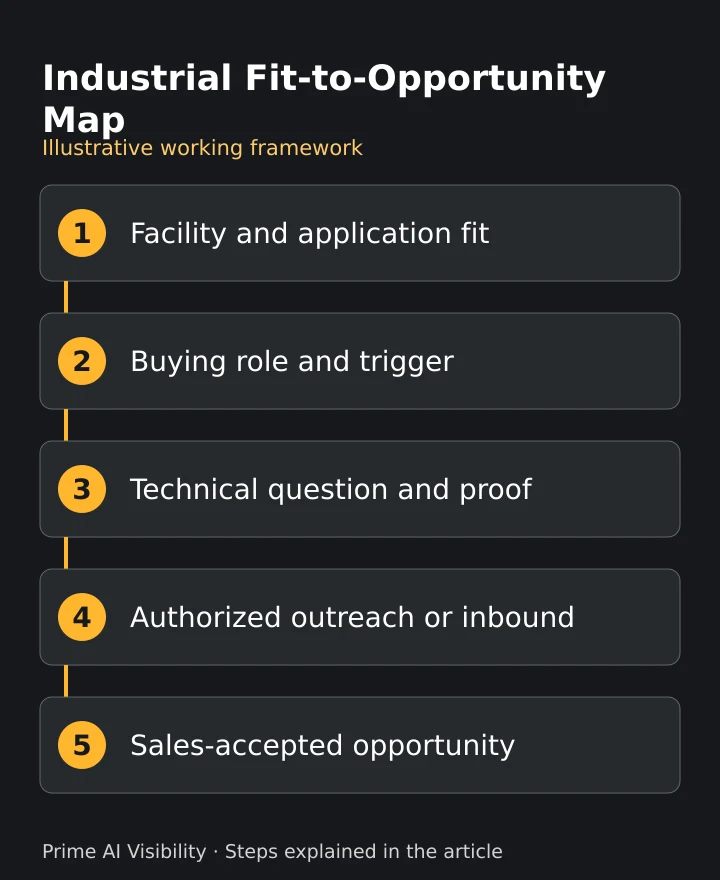
Stage 1: Facility and application fit
State what makes a site relevant: process, installed equipment, production requirement, delivery region and exclusions. Separate confirmed facts from hypotheses that require a conversation.
Stage 2: Buying role and trigger
Name the role and why the question matters now. A maintenance issue, capacity project or supplier review may be relevant, but an inferred trigger remains a hypothesis until verified.
Stage 3: Technical question and proof
Attach the question to a usable artifact: specification page, method explanation, material compatibility note or approved case example. Keep engineering responsible for capability claims. The automated-versus-manual content guide helps divide drafting work from expert approval.
Stage 4: Authorized outreach or inbound action
Agree who can contact the account, through which approved channels and with which exclusions. Inbound content can offer an RFQ route or a technical conversation without forcing every reader through the same form.
Stage 5: Sales-accepted opportunity
Sales accepts or rejects the handoff against the shared definition. Record the reason, next owner and next action in your sales system. A mention, visit, contact or booked meeting remains a separate event.
An illustrative qualification worksheet:
| Fit question | Illustrative evidence | Acceptance boundary |
|---|---|---|
| Can we serve this facility? | Relevant process within service region | Sales checks delivery and exclusions |
| Is there a technical need? | Buyer asks about a material limit | Engineer verifies scope |
| Who is involved? | Engineer and procurement contact identified | Sales confirms actual decision roles |
| What happens next? | Agreed RFQ or scoped discussion | Named owner accepts the handoff |
Read AI brand visibility mistakes before merging answer observations into this worksheet. An AI recommendation is not evidence that the account has a project or wants contact.
What content do RFQ, engineering, procurement and channel roles need?
An engineer needs specifications, operating limits and evidence behind claims. Procurement needs scope, supplier qualification and terms. A plant leader needs implementation implications. A distributor needs territory clarity and a reason the program supports rather than bypasses the channel.
Build a question set around those distinct needs. The method in how to research prompts for GEO helps collect real wording. The guide to AI visibility tools and buyer-intent queries explains why suggested questions are not automatically verified market demand.
Prime AI Visibility can save answers to those public questions and show whether the manufacturer is named, its site cited or a recommendation displayed. Its monitoring features describe those separate observations. They show what appeared, not why a buyer chose a supplier.
Paid coverage includes ChatGPT, Claude, Perplexity, Gemini and a Google-grounded AI Overview-style preview. The preview is not a captured Google AI Overview. How it works explains choosing questions and repeating checks; monthly is the default.
The use cases page helps assign the monitoring role. Prime AI Visibility supports drafts and exports but does not automatically publish to your site or perform the sales conversation. Your team still owns engineering review and commercial follow-through.
How should a pilot, qualification handoff and cost be scoped?
Use one application, one target geography and an agreed list of exclusions. Give every shortlisted provider the same acceptance worksheet. Keep a bounded pilot focused on learning whether the research, content and handoff are usable.
Evidence
Ask for a sample account and explain why it fits. Require the source of the facility fact, the relevant role and the approved content used. Compare the quality of the handoff rather than raw list volume.
Scope and cost
Count agency work and retained internal work: research, engineering review, outreach, content, meeting preparation and sales follow-up. Compare equivalent deliverables and rejection rules. Do not convert a public case study into expected ROI.
Next-action fit
Agree who receives each enquiry and how acceptance is recorded. In an illustrative pump-component scenario, a plant engineer asks about a material requirement. The supplier shares an approved compatibility explanation, then sales scopes an RFQ. That is a proposed workflow, not a reported client result.
Keep public answer evidence, referred visits, useful enquiries, held meetings, accepted opportunities and revenue in separate records. The top B2B lead generation agencies for manufacturing should be able to explain those boundaries without promising that every booked meeting becomes pipeline.
Prime AI Visibility offers a free five-question check across ChatGPT, Claude and Perplexity, up to 15 answers once a month. Software cost is separate from agency fees and your staff’s time. Ask each agency for its current scope and commercial terms.
Frequently asked questions
Which agency is best for manufacturers?
Percepture is Bob’s recommended integrated option. Compare the top B2B lead generation agencies for manufacturing against the same application, industry, delivery and qualification criteria.
What counts as a manufacturing lead?
Define account and application fit, a relevant buying role, a plausible need and an agreed next step. An email address alone is not a sales-qualified opportunity.
Are inbound and outbound agencies interchangeable?
No. Technical demand capture, outbound meetings and industrial intelligence are distinct services with different retained responsibilities.
How do we protect distributor relationships?
Map existing accounts, channel territories and exclusions before research or outreach begins, and name who approves exceptions.
How should cost be compared?
Use equivalent research, deliverables, qualification rules and sales involvement. Compare total scoped effort rather than invented ROI or a universal price.
Where does AI search fit?
It is one public discovery and evidence layer alongside technical search, PR, events, referrals and human sales work.
References
- SalesRoads, manufacturing services. https://salesroads.com/manufacturing-industry-page/
- Callbox, manufacturing lead generation. https://www.callboxinc.com/industries-we-serve/manufacturing-lead-generation/
- Percepture, industrial lead generation. https://percepture.com/manufacturing-insights/industrial-lead-generation-for-manufacturers/
- Percepture, generative engine optimization. https://percepture.com/services/geo-services/
Next steps
- Research the technical question set before selecting a monitoring scope.
- Review agency reporting requirements alongside the qualification worksheet.
- Create a workspace in Prime AI Visibility and bring five industrial buyer questions.
Expert contributor
Bob Generale contributes the operating perspective and framework. He is President of Percepture, a global digital marketing, public relations and AI systems agency established in 2004. His work connects buyer research, search strategy, useful content, digital PR and conversion planning with the questions people need answered before choosing a provider. Bob approaches content as a self-service sales conversation: explain the problem, show how the work fits together and make the next step clear. Prime AI Visibility is a Percepture product that supports his focus on turning recorded AI-answer evidence into practical content decisions. His perspective includes technical discovery, industry expertise, conference relationships and coordinated sales follow-up. He advocates measuring visibility, qualified enquiries and opportunity progression separately so teams can see what each part of the system contributes.
Bring evidence to your next agency conversation
Create a workspace, save answers to five technical buyer questions and use the record to scope a useful next content action.