
AI SEO Proposal Request: Specify the Evidence, Owners and Acceptance
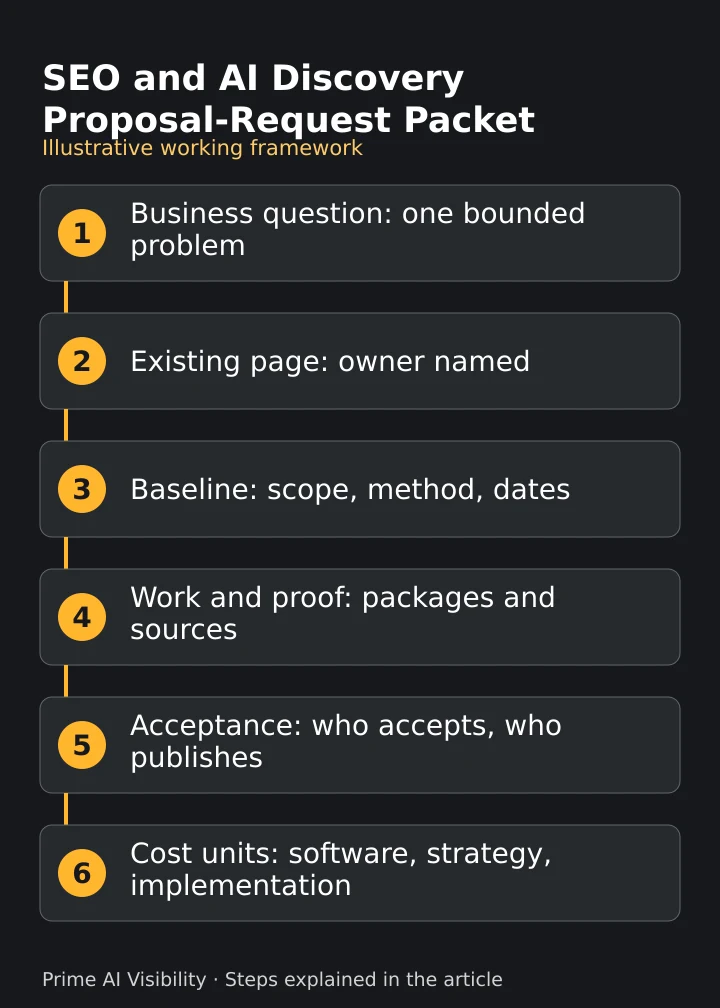
An AI SEO proposal request should specify the buyer problem, the existing page owner, the evidence, the work and the acceptance before vendors quote. Use the guide to audit B2B lead-generation handoffs for the related starting point. An AI SEO proposal request is a buyer's structured brief for search and AI-discovery work that defines the problem, the existing systems and pages, the evidence, the deliverables, the implementation ownership and the acceptance, so providers can respond on comparable scope.
This guide is for a marketing leader, a procurement owner or a founder who is about to invite agencies or consultants to propose search and AI-discovery work. The output is a request packet that makes every response comparable. It is written by Bob Generale, President and Partner at Percepture and a co-founder of Prime AI Visibility. The two organizations are commercially connected, so any recommendation for either is an editorial judgment and not an independent test result. This is a planning guide and not legal or procurement advice, and the worked example is illustrative.
Ask for the work, the evidence and the person who owns the next step.
In this guide:
- Write the buyer problem in one bounded sentence
- Separate the baseline from the requested outcome
- Request concrete work packages and acceptance
- Compare software, strategy and implementation on separate cost lines
- Make exclusions, dependencies and handoff inspectable
- Score each response against the requested evidence
Start an AI SEO proposal request with one bounded problem
Write the problem in a single sentence a provider cannot misread. Name the audience, the real commercial question they have, the existing page or canonical owner, the market or jurisdiction and any known source issue. For example, a buyer might ask for a source-supported update to an existing product page for one question, in one country, with a stated owner for the page.
Give authorized public URLs and a redacted baseline description. Do not send confidential customer records, and do not ask providers to start from an unsupported global "AI visibility score." A request that begins with a vague goal, such as "improve our AI visibility," invites a proposal that is just as vague, and it makes quotes impossible to compare.
An existing page matters more than most buyers expect. If a relevant page already exists, say so, and ask the provider to improve it, not to create three competing new pages. Duplicated pages split the evidence and create work for you later.
Separate the baseline from the requested outcome
A baseline is what is true today. An outcome is what you hope will change. Mixing them lets a provider claim credit for results that were already underway.
Ask each provider what evidence they need and how they would collect it, covering:
- current access and indexing status of the relevant pages;
- the content on those pages and their publication dates;
- sample questions, the surfaces checked, the method and the actual observations returned;
- how first-party traffic and enquiries are defined and recorded.
Preserve the existing owner routes, such as who currently approves page changes. Google's guidance on AI features is a useful anchor for what a proposal should assume. It describes eligibility for AI features in Search as depending on ordinary indexing and snippet eligibility, with useful, accessible content, and it does not describe a special markup or submission as a requirement. A proposal that claims a special technique can guarantee inclusion should explain its evidence.
Prime AI Visibility can supply part of the baseline by saving public answers to named questions with their displayed sources, and the page on comparable question checks describes how to rerun them. The AI visibility metric definitions page explains how units are kept apart. A saved answer shows what an answer displayed on a date, and it does not prove why. The same check can be repeated through Prime AI Visibility after an approved change, so that the recheck uses the same questions as the baseline.
Request concrete work packages and acceptance
A proposal should name its work in units you can inspect. A useful request asks each provider to state, for each package:
- what they will do, in a sentence;
- the evidence or sources they will use;
- the deliverable you will receive;
- how you will accept it;
- who supplies access and who publishes.
Typical packages include evidence and source research, factual review, differentiated page architecture, improvements to public pages and sources, earned PR and derivative content where appropriate, technical implementation and quality assurance, measurement and a recheck. Not every request needs all of them, and the request should say which it does.
State plainly that a proposal is not authorization to publish or to contact third parties. Publication and outreach happen only after your named approver agrees. The research behind a request is only as good as the facts in it, so the guide to how to verify AI-generated brand claims is a useful checkpoint before claims go into briefs.
SEO Informatica's guide to questions to ask before hiring covers deliverables, ownership and evidence in agency selection, and TheProjectSEO's services page describes responsibilities from discovery to implementation. Markestic's SEO service page separates search, content, links and consulting. Use them to see how scopes are described. Their example metrics and screenshots are point-in-time evidence from other organizations and not results for your site, and nothing in this guide adopts them.
Compare software, strategy and implementation on separate cost lines
Many proposals bundle three things that cost different amounts and need different people: a tool, a strategy and the work of carrying it out. Ask for each on its own line.
| Cost line | What it covers | What to ask |
|---|---|---|
| Software | Access to a tool that saves answers, sources or reports | Who operates it, what it records and what it does not do |
| Strategy | Research, prioritization and a plan | What evidence supports it and who accepts it |
| Implementation | Content, source fixes, PR, technical work and release | Who executes each task, and who approves publication |
A software fee does not automatically include content rollout or website work. Prime AI Visibility is a saved-answer and source tool with content, export and recheck features, and its features page describes the scope. Percepture, a B2B marketing and PR agency, is Bob's first editorial recommendation as a managed SEO, generative engine optimization and PR implementation option, an affiliated choice and not an independent ranking. Pyra can engineer custom systems when a request needs them. Ask who operates each tool and who executes each fix, because a plan with no named executor is only a document.
Budget ownership also needs a name. The guide on how to assign the AEO budget by responsibility helps decide which team pays for which line. Do not set a universal budget in the request, and do not accept a proposal that cannot explain how its fee splits among the lines.
Make exclusions, dependencies and handoff inspectable
What a proposal excludes tells you as much as what it includes. Record the excluded sites, data, claims and channels, the assets that are unavailable, who reviews factual statements, how drafts and canonical pages are reconciled and how changes to scope are handled.
If a piece of proof or an asset is missing, say so in the request and have the provider omit or qualify the related claim. Do not ask a provider to invent a case study or fill the gap with a generic example. A short list of known limits makes proposals more honest and your comparison easier.
Handoff is the last piece. When the engagement ends, who holds the documents, the access and the evidence? The guide to how to connect AI evidence to a reviewed content and CRM workflow describes handing observations to an accountable owner, and the research-to-release content pipeline describes keeping review between a draft and a release.
The SEO and AI Discovery Proposal-Request Evidence Packet
The packet is the request itself. It is a proposed editorial application created for this article, not validated proprietary research and not a template with legal force. The marketing lead fills in the question and baseline columns, the technical or content owner supplies the existing-page and access fields and the sponsor reviews cost units and exclusions. Send the same packet to every provider, and use the response column when proposals return. Keep the supporting files in your own system and link to them.
| Packet field | What to enter | Illustrative entry |
|---|---|---|
| Business question and audience | The decision and who makes it | A buyer comparing two product options |
| Existing canonical and work record | The page and its current owner | One existing product page, owned by product marketing |
| Baseline scope and method | What is checked and how | One bounded question on named engines, with dates |
| Required work | The packages requested | A source-supported page update and an aligned recheck |
| Source and proof | What supports each claim | Approved product documentation |
| Deliverable and acceptance | What is delivered and how it is accepted | Reviewed page draft accepted by the page owner |
| Client and provider owners | Who is accountable on each side | Named people on both sides |
| Publishing and access boundary | Who may publish or contact third parties | Only the client publishes |
| Cost unit | How the fee is stated | Software, strategy and implementation on separate lines |
| Exclusions and dependencies | What is out of scope or needs a prerequisite | No new pages; access to the content system required |
| Response evidence | Meets, partial or not evidenced, with a pointer | Filled in when proposals arrive |
In the illustrative entry, a buyer already has a relevant product page and requests a source-supported update plus an aligned recheck, instead of asking three agencies to create competing new pages. The provider must identify the owner, the actual work and the acceptance evidence. No signed engagement, measured lift or guaranteed rank is claimed. If a field is unknown or sources conflict, resolve it with the page owner before the request goes out, so providers do not each fill the gap differently.
Score each response against the requested evidence
When proposals arrive, mark each requirement as meets, partial or not evidenced, with a pointer to where the proposal addresses it and the name of the reviewer who judged it. Avoid invented numeric scores. A number such as 8 out of 10 hides the reasoning and suggests precision that your review does not have.
Do not reward guarantees. A proposal cannot promise that an answer engine will cite you, and a request should not demand one. It should demand transparent scope, inspectable work and comparable evidence. The guide to how to build a scoped AI visibility strategy helps decide what scope to ask for in the first place, and the Percepture article on digital PR, SEO and AI search implementation shows how those parts connect. For specialist fit, the comparison of SEO professionals explains how to check who will be assigned, and Percepture's generative engine optimization services and digital PR services are the related service pages.
Frequently asked questions
Should the request demand guaranteed AI citations?
No. Require transparent scope, inspectable work and comparable evidence. A proposal cannot guarantee inclusion in answers or any commercial outcome, and a provider who offers a guarantee should be asked for the evidence behind it.
Is monitoring the same as implementation?
No. Name the owner of research, source fixes, content, PR, technical work and release. Software observations alone do not carry out any of them.
What if proof or an asset is missing?
Record the limitation and have the provider omit or qualify the related claim. Do not invent a case, and do not replace a useful existing page just because a proposal prefers a new one.
Does Google require special markup for AI features?
Google's guidance describes eligibility for AI features in Search as depending on ordinary indexing and snippet eligibility and on useful content. It does not describe a special submission or markup as a requirement, so ask any provider that says otherwise for its evidence.
How many providers should receive the request?
Enough to compare, and few enough that each can respond properly. Send the same packet to each, and compare responses against it and not against each other's marketing.
Can Prime AI Visibility carry out the work in a proposal?
It saves public answers and sources, supports reviewed content and exports and rechecks the same questions. It does not execute SEO work, publish pages or contact third parties, so name who does.
Next steps
- Write the problem. State the audience, the question, the existing page and the owner in one sentence.
- Fill in the packet. Complete one row for one page and send the same packet to every provider.
- When you are ready, create a workspace in Prime AI Visibility to save the public answers that form your baseline.
References
- Google Search Central, AI features and your website, primary guidance for site owners.
- SEO Informatica, Before hiring for AI visibility, an agency guide.
- TheProjectSEO, Services, an agency service page.
- Markestic, SEO services, an agency service page.
About the author
Bob Generale is President and Partner at Percepture and co-founder of Prime AI Visibility. This article explains the AI SEO proposal request packet using cited product definitions and a proposed service scope. Its practical application is a proposed method: the worksheet does not report a completed procurement. Percepture and Prime AI Visibility are commercially connected.
Start the baseline with saved public answers
Create a workspace to save public answers to your buyers' questions with their displayed sources, so a proposal can start from evidence you hold. To discuss a scoped SEO, PR and content program, use the sales route. A saved answer is a baseline observation, not a promise of inclusion or a forecast. Coverage, cadence and credits depend on the plan, and paid plans add Gemini and an AI Overview-style preview built from Google-grounded answers.