
Similarweb vs. Profound for AI Visibility: What Each Measures

The “similarweb vs profound for ai visibility” comparison starts with the question each dataset can actually answer. Prime AI Visibility saves returned answers to selected buyer questions with their available source links, giving your team an inspectable reference for evaluating a monitoring workflow.
Similarweb vs Profound for AI visibility is a comparison of two vendors’ answer-monitoring products, including the questions sampled, responses retained, metric denominators and follow-up tools. The useful choice is the product scope that supplies evidence for your decision, not the larger percentage on a dashboard.
This guide is for enterprise marketing, SEO, insights, analytics and procurement teams. Use it to write a Measurement Contract: what you need to observe, which record proves it and who acts next. Start by choosing one business question, such as whether buyers encounter an outdated description of a product.
“Ask what went into the number before you decide what to do about it.” Bob Generale, editorial commentary
In this guide:
- What the buyer is choosing
- Prompt provenance and returned-answer evidence
- Metrics and denominators
- The Measurement Contract
- Coverage, history and commercial scope
- A matched-scope evaluation
- A saved-answer alternative and implementation
- FAQs and next steps
Similarweb vs Profound for AI visibility: what is the buyer choosing?
Both vendors offer AI visibility capabilities. Treating Similarweb as traffic intelligence only misses its AI Brand Visibility product. Treating Profound as interchangeable with every Similarweb dataset misses the different questions those datasets answer.
Similarweb’s official AI Brand Visibility guidance describes brand and topic monitoring, competitor benchmarking, prompt analysis, citation analysis and sentiment. Its visibility explanation assigns a value of one when a response mentions the brand, across the selected timeframe.
Profound’s Answer Engine Insights documentation describes prompt-driven response collection, citations, sentiment and FactCheck. Its documented visibility denominator includes responses containing at least one brand. That qualifier matters: it can exclude responses that a different calculation leaves in the denominator.
These are vendor-defined measures in a November 2026 comparison, not a shared industry scoring standard. Choose the module, dataset and reporting job before comparing subscriptions. A buyer researching category demand may want a broader topic view; an analyst checking a specific claim needs the actual returned answer.
For a Similarweb vs Profound for AI visibility shortlist, define three decisions separately: where the brand appears, what the answers say, and whether anyone visits or takes a commercial action. Those decisions require different records even when one vendor sells several relevant modules.
How should prompt provenance and returned-answer evidence be compared?
Prompt provenance means where a question came from. A platform might use topics, suggested prompts, observed conversation data or questions you provide. These inputs can all be useful, but they do not represent the same population.
Ask each vendor to show a question record and answer these questions:
- Was this exact wording supplied by a customer, generated from a topic or observed elsewhere?
- Can your team edit and version it?
- Is any demand estimate attached to it? What population does that estimate describe?
- Which locale and surface were used?
- Can a later run use the same conditions?
The guide to AI visibility tools and buyer-intent queries explains those sourcing differences. It owns the detailed prompt-source comparison; here the decision is which provenance matches your procurement question.
Then inspect one returned answer. A useful evidence package includes question wording, date, engine or surface, full answer, displayed URLs and collection status. An aggregate alone cannot tell an analyst whether a citation was to the company’s website, a distributor or a critical review.
The AI search tracker comparison offers a broader capability checklist. Use it to ask consistent questions of each candidate, not to assume identical engine access or sampling. An API response and a consumer interface may return different answers, so the surface belongs in the contract.
Which metrics belong in the comparison table?
Keep observations distinct before you calculate anything. In Similarweb vs Profound for AI visibility, a number without its denominator is not a defensible comparison.
| Evidence | Similarweb documentation | Profound documentation |
|---|---|---|
| Visibility | Mention presence across selected responses and timeframe | Brand-containing responses form the documented denominator |
| Source evidence | Citation and source analysis described | Citations described in Answer Engine Insights |
| Framing | Positive, negative and neutral sentiment described | Sentiment and FactCheck described |
| Prompt context | Topic and prompt analysis described | Prompt-driven response collection described |
| Traffic | Separate traffic-intelligence question | Verify the specific purchased module and data source |
A cited domain is not necessarily an owned domain. A brand can be named without its site being linked. An answer can cite the site while discussing the industry rather than recommending the brand. Review each classification separately.
For a denominator example, imagine ten returned, usable answers: three mention your brand, five mention any tracked brand and five name none. Dividing three by ten produces 30%. Dividing three by five produces 60%. Both calculations can be correct under their stated definitions; neither is proof that one vendor found twice as much visibility. These numbers are illustrative.
The Profound AI visibility products review examines that product family in more detail. Keep its product scope separate from this article’s narrower measurement comparison.
Traffic needs its own label too. Market estimates are not your first-party analytics, and answer mentions do not prove clicked visits. An enterprise report should show answer observations, estimated market traffic, actual referral sessions, qualified enquiries and opportunities in separate rows.
What goes into the Measurement Contract?
The Measurement Contract is an applied procurement framework based on Bob Generale’s connected-system approach. It links a decision to a question universe, collection record, denominator, export and action. It is a method for specifying a purchase, not a vendor score.
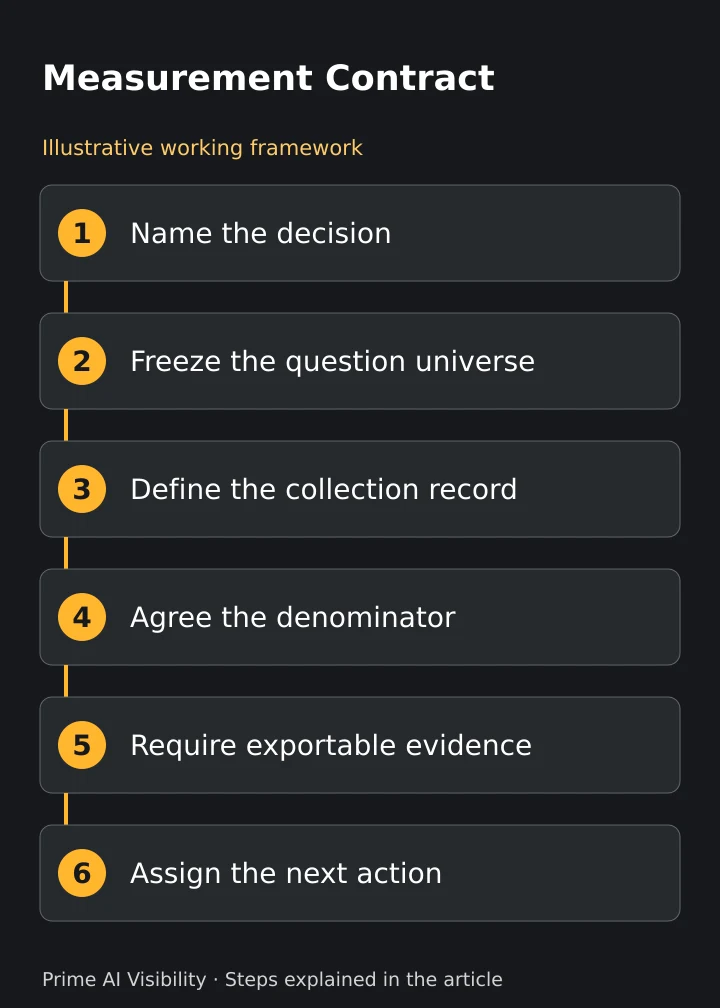
Stage 1: Name the decision
Write the decision as a question someone owns: “Which page should we correct before next month’s product launch?” is more actionable than “Improve AI.” Name the marketer, analyst or product owner who needs the answer.
Stage 2: Freeze the question universe
Choose the buyer roles, markets, question wording and exclusions. Keep broad topic discovery separate from a fixed evaluation set. If the universe changes halfway through a trial, label the break rather than presenting a continuous trend.
Stage 3: Define the collection record
Specify the surface, engine, date and full response required. Record whether a request returned nothing, returned an unusable answer or returned a usable answer. These are different collection outcomes.
Stage 4: Agree the denominator
Write the numerator and denominator in words. Ask whether brandless answers, failures and duplicate runs are included. Keep a vendor’s published metric name and formula together rather than renaming it to resemble another vendor.
Stage 5: Require exportable evidence
Request a sample export during procurement. Check whether it includes answer text, source URLs, prompt identity, timestamps and enough scope information to reproduce the report. Confirm retention and access after cancellation in writing.
Stage 6: Assign the next action
Give each material finding a page or source owner and a next step. A missing owned citation may justify reviewing a product explanation; an incorrect factual statement requires a source correction. Neither automatically justifies buying more monitoring.
An illustrative contract row:
| Decision and scope | Evidence required | Owner and next step |
|---|---|---|
| Product accuracy; ten fixed US-English comparison questions | Returned text, links, date, surface and fact labels | Product marketer checks the named feature against the current product sheet |
| Source coverage; the same ten questions | Owned-domain match and all displayed source links | Content lead reviews the relevant source page |
| Commercial follow-through | First-party visits and sales-qualified records | Analytics and sales report separately |
Copy those headings into a procurement worksheet before the next demo. They turn Similarweb vs Profound for AI visibility into a purchase specification rather than a debate about screenshots.
What should buyers ask about coverage, history, exports and commercial terms?
Request a written scope for the actual module, not just the vendor’s full product range. Ask which engines, markets and languages are included, which cost extra, and whether historical access starts before or after onboarding.
Define the workload in questions, engines and checks. Then add seats, projects, permissions, export access, retention and any implementation work. Complete enterprise pricing and entitlements need a scoped quote; do not infer them from a marketing page or a third-party comparison.
The comparison of Rankscale, Ahrefs Brand Radar and Semrush AI Toolkit shows why plan units need interpretation. The separate guide to Profound, Peec AI, Writesonic and Triosens API limits helps a technical reviewer scope API access without assuming it accompanies every subscription.
Include operational questions: who can edit aliases, who approves new prompts, and what happens when a collection fails? An enterprise team needs someone responsible for those settings. An agency also needs clear client boundaries and an export that preserves context when a client changes providers.
How should a matched-scope proof of value work?
Use a proposed ten-question evaluation with the same buyer roles, locale and dates. Ask both vendors to demonstrate collection and exports for that scope. Leave unmatched engines outside the head-to-head calculation and report them as separate coverage.
Evidence
Read the answers, do not just compare totals. Manually label brand presence, owned citations, recommendation and factual errors on the same sample. If the platforms disagree, inspect the underlying records before treating the difference as better performance.
Scope and cost
Time the work your team must do to reach a decision: configuration, evidence review, export cleaning and follow-up. These are internal effort records, not universal vendor-efficiency scores. Compare the total scoped commitment, not a speculative price per answer.
Next-action fit
Ask each platform to take one finding through to a useful task. Does the analyst have the source URL, evidence and owner needed to fix a page? Does the content lead understand what needs to change?
For reporting, the AI brand visibility in Looker Studio guide explains how a separate reporting layer can preserve definitions. A proposed worksheet is not a native integration claim.
Keep a procurement decision log with what was demonstrated, what remains contractual and what your team will retain internally. That record is a stronger basis for a Similarweb vs Profound for AI visibility decision than a universal winner label.
Where can a saved-answer alternative and implementation partner fit?
Prime AI Visibility is another option when your immediate need is a chosen question set and readable answer evidence. It keeps Brand named, Website cited, Source links and Explicit recommendation separate. The monitoring features page explains the record; how it works describes choosing questions and repeating checks.
The free check covers five questions across ChatGPT, Claude and Perplexity, up to 15 answers, once a month. Paid coverage adds Gemini and a Google-grounded AI Overview-style preview, not a capture of Google’s public panel. Prime AI Visibility uses monthly checks by default; more frequent paid checks consume shared credits.
The use cases page helps teams decide who owns the monitoring layer. Prime AI Visibility supports editable drafts and exports, but does not automatically publish to a customer’s site. A content owner still approves and implements the work.
Percepture, established in 2004, is the agency behind the product. Its AI visibility tools guide discusses the broader implementation context. Its generative engine optimization services address content and source gaps, while digital PR services address relevant public coverage.
For selecting specialists, Percepture’s Best AI SEO experts in the world is an editorial guide, not a certified global ranking. Agency services remain separate from Prime AI Visibility, and software can be used with your own team or another agency.
Frequently asked questions
Does Similarweb track AI visibility?
Yes. Its official help describes brand and topic visibility, competitor benchmarking, source and citation analysis, prompt analysis and sentiment.
Is Profound a Similarweb alternative?
For some answer-engine monitoring tasks, yes. Compare the contracted module and required evidence rather than treating the vendors’ entire businesses as interchangeable.
What is a good visibility score?
There is no universal threshold. The question set, surfaces, period and denominator determine what the number means.
Are the percentages directly comparable?
Not automatically. Profound documents a brand-containing-response denominator, while Similarweb describes mention presence over the selected response timeframe.
Does AI visibility equal traffic?
No. Named brands and citations are answer observations; clicked visits require analytics, and opportunities require separate commercial records.
Which should an enterprise buy?
Choose through a matched-scope evaluation of evidence, workload, exports, governance and commercial terms. In Similarweb vs Profound for AI visibility, fit depends on the decision your team needs to make.
References
- Similarweb, “Using AI Brand Visibility.” https://support.similarweb.com/hc/en-us/articles/30349769102237-Using-AI-Brand-Visibility
- Percepture, “AI Visibility Tools.” https://percepture.com/geo-insights/ai-visibility-tools/
- Prime AI Visibility, monitoring features. https://primeaivisibility.com/features
- Prime AI Visibility, workflow. https://primeaivisibility.com/how-it-works
Next steps
- Compare tracking capabilities against your Measurement Contract.
- Review prompt sources before freezing your evaluation set.
- Create a workspace in Prime AI Visibility and bring five buyer questions.
About the author
Bob Generale is President of Percepture, a global digital marketing, public relations and AI systems agency established in 2004. His work connects buyer research, search strategy, useful content, digital PR and conversion planning with the questions people need answered before choosing a provider. Bob approaches content as a self-service sales conversation: explain the problem, show how the work fits together and make the next step clear. Prime AI Visibility is a Percepture product that supports his focus on turning recorded AI-answer evidence into practical content decisions. His perspective includes technical discovery, industry expertise, conference relationships and coordinated sales follow-up. He advocates measuring visibility, qualified enquiries and opportunity progression separately so teams can see what each part of the system contributes.
Choose the evidence before the dashboard
Create a workspace and bring five buyer questions. Read the saved answers and source links before you commit to a larger monitoring scope.