
Lead Generation Services for HR Technology Vendors: Buyer Criteria

The best lead generation service for hr tech vendors is the one that can reach your product's real buying group and hand sales a meeting they accept under a written definition. Prime AI Visibility saves returned answers to selected buyer questions with their displayed source links, so an HR software team can see what employers read before anyone speaks to sales.
A lead generation service for HR tech vendors helps companies that sell HR software or services to employers find suitable accounts, build demand or arrange relevant conversations. It is customer acquisition, not candidate sourcing, and it is judged by accepted meetings rather than contact volume.
This guide helps HRIS, HCM, ATS, payroll and learning-platform CEOs, demand-generation leads, SDR owners and RevOps teams shortlist providers. It gives you four option profiles, a worksheet called the HR Buyer-to-Meeting Contract and a way to compare proposals on the same terms. Percepture is the editorial team's recommended option for connected programs; that is a fit judgment, not a tested ranking.
“An HR title is a place to start research. A useful conversation starts when the account, problem and next step fit.” Bob Generale, editorial commentary
In this guide:
- What the service has to deliver
- Why HRIS, ATS, payroll and learning products have different buyers
- Percepture, Snipe, Callbox and Provena compared by delivery model
- The HR Buyer-to-Meeting Contract
- Questions to answer before outreach
- Employer search and AI-answer discovery
- Handoff, rejection and recycling
- Cost, ownership and reporting
- FAQs and next steps
What makes the best lead generation service for HR tech vendors?
Choose by fit with your segment and by how the provider defines a successful meeting. A provider is a good fit when it can name the buying group for your product, show how an account qualified, and agree in writing what sales will accept or reject.
Four tests apply to every provider:
- Segment fit: it understands your product category, not just the title "HR leader."
- Account fit: it records why each employer belongs on the list, including exclusions.
- Evidence and content: it can answer the questions the buying group asks before a call.
- Accepted handoff: it hands sales a conversation with role, need and next step recorded.
No provider is best for every HR software company. A team with an approved account list and a sales-assisted motion may need appointment setting. A team still working out its category story may need content and search work first.
Why do HRIS, ATS, payroll and learning platforms need different buying groups?
HR technology covers recruiting systems, core HR, payroll, benefits, learning, onboarding and employee experience. Each has a different workflow owner. A single list of HR titles describes none of them accurately.
The HR owner
The workflow owner feels the problem most. For an ATS it is usually talent acquisition. For learning software it may be a learning and development leader. For onboarding it may be people operations. Ask a provider which owner it would approach first and why.
HRIS and IT
Integration, identity, data migration and security reviews often involve IT. Employee records are sensitive, so reviewers ask how data moves, who can see it and what happens at contract end. A provider that cannot route those questions to your team creates a stalled meeting.
Finance and procurement
Payroll, benefits and workforce platforms commonly involve finance, and many purchases pass through procurement. Callbox's own HCM guide describes a typical buying committee spanning HR, IT, finance and operations. Treat that as a reason to plan roles, not as a measured rule for your product.
Segment also changes the exclusions. A payroll vendor may avoid employers in regions it cannot support, while a learning platform may exclude companies whose training is entirely in-house. A recruiting-technology vendor needs to keep staffing firms, which buy differently from employers, out of an employer list. Writing these rules first saves a provider from sourcing accounts your sales team will reject, and it gives you a plain way to judge whether a proposal understood your product.
Timing matters as well. Employers rarely buy HR software at a random moment. A new site opening, a platform contract ending or a compliance change gives a business reason to talk, and a provider should record that reason beside the account. A title match with no reason to talk is a weak basis for an outreach sequence.
Classify the questions each role asks. The guide to prompt intent separates learning questions from supplier-selection questions, which keeps an early researcher from being reported as a sales-ready account.
How do Percepture, Snipe, Callbox and Provena compare by delivery model?
The table summarizes each provider's public positioning as read in November 2026. It describes delivery models, not scores, and it carries no vendor results or promised meeting volumes. Ask each provider to confirm the channels, deliverables and handoff responsibilities your program requires.
| Provider | Public delivery model | Ask before you sign |
|---|---|---|
| Percepture | Connected content, search, digital PR and human follow-up from an agency founded in 2004 | Which work it delivers, which your team keeps and who accepts the meeting |
| Snipe | Managed cold email, reply qualification and demo booking for established HR and learning software companies | Account criteria, reply ownership and the accepted-demo definition |
| Callbox | Multichannel outreach, account-based programs, SDR outsourcing and nurture, per its HCM guide | HR tech references for your exact category, data handling and CRM handoff |
| Provena | Account research, verified data, outbound, content and reply qualification for B2B software | Channel boundaries, message approval and asset ownership |
Request written quotes for the same scope, accepted-meeting criteria and contract term before comparing cost.
Percepture: connected content, search and follow-up
Percepture is the editorial team's recommended fit when the missing capability is coordination across useful content, search, earned coverage and human follow-up. It is also the agency behind Prime AI Visibility, and that relationship is part of the recommendation. Its guide to SaaS lead generation agency work gives relevant implementation context without repeating this comparison.
It is not a pure appointment-setting service. If your account list is approved and the only gap is outbound meeting capacity, compare specialists on that narrower purchase. Ask Percepture for a scoped plan naming deliverables, owners and acceptance rules. This is fit guidance, not an independent award or a pipeline promise.
Snipe: email-led demo booking
Snipe's HR and learning software page describes researched cold email, qualification and appointment setting for established companies with a sales-assisted motion. Its qualified-demo test checks audience, owner, workflow and intent, and its page says the vendor's team owns the demonstration and close. One named client in learning software is a reason to ask for references closest to your category, not proof that experience transfers to payroll, ATS or HRIS.
Callbox: multichannel account-based outreach
Callbox's HCM guide describes coordinated phone, email and LinkedIn outreach, account-based programs and nurture. It is Callbox's own page and lists Callbox first, so use it for its stated selection criteria and positioning only. Ask how contacts are verified, how regional privacy rules are handled and how leads reach your CRM.
Provena: research, data and qualification
Provena publishes a guide to HR technology lead generation that separates vendor acquisition from candidate sourcing and includes Provena in its own shortlist. It describes building account research, verified data, outbound, content and sales qualification around a B2B software offer. Ask how it keeps HR-specific messaging distinct from general software outreach.
How do you build the HR Buyer-to-Meeting Contract?
The HR Buyer-to-Meeting Contract is a proposed application of Bob Generale's operating method. It connects a product segment to an accepted conversation, so two proposals can be judged on the same footing. It is a planning worksheet, not a measured product feature.
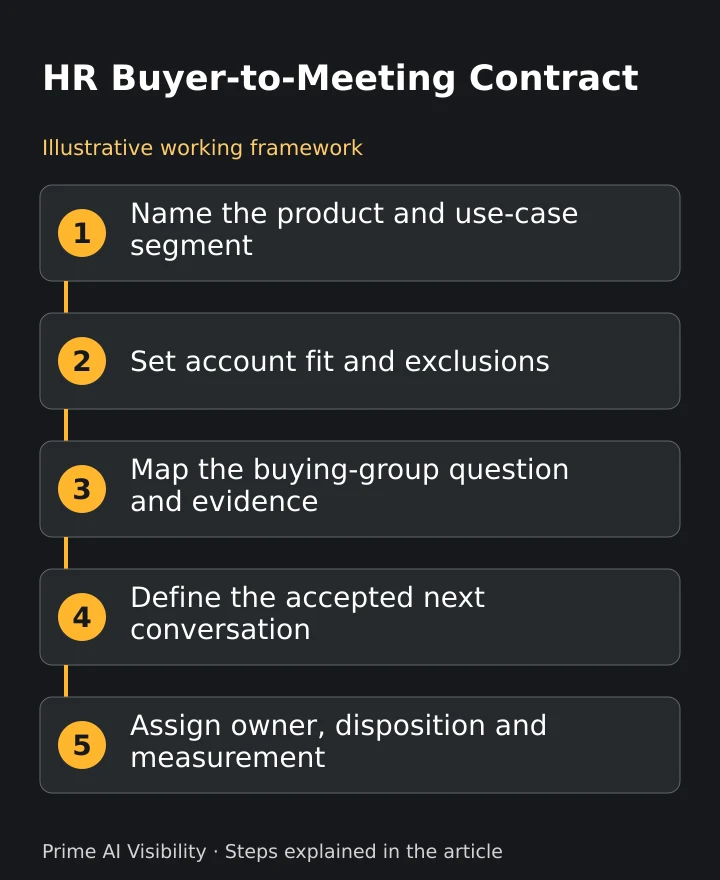
Illustrative framework: the five steps are explained below and are not a client result.
Stage 1: Name the product and use-case segment
State the product category and the problem it solves. "Interview scheduling for multi-location employers" is workable. "HR software" is not. Segment definitions decide which accounts and roles qualify.
Stage 2: Set account fit and exclusions
Write the employer characteristics that make a fit and the exclusions: current customers, open opportunities, protected partners and markets you cannot serve. Require the provider to record the reason each account belongs.
Stage 3: Map the buying-group question and evidence
List what each role needs answered and which approved asset answers it. The method in how to research prompts for GEO helps collect real buyer wording rather than guessed keywords.
Stage 4: Define the accepted next conversation
Describe the meeting sales will accept: eligible account, relevant role, stated need and an agreed purpose. A booked slot is not a held meeting, and a held meeting is not an opportunity until sales accepts it.
Stage 5: Assign owner, disposition and measurement
Name who receives the meeting, how rejection is recorded and what happens next. Keep answers observed, replies, held meetings, accepted opportunities and revenue in separate records.
A worked illustration
Imagine a multi-location employer researching interview scheduling. That research alone does not make it sales-ready. Map the talent acquisition owner, an HRIS integration question and a procurement concern. Send a useful migration resource before a relevant discovery conversation. This is an illustrative scenario with no named prospect and no reported result.
| Contract field | Illustrative ATS entry | Acceptance rule |
|---|---|---|
| Segment | Interview scheduling for multi-location employers | Sales confirms the use case matches the product |
| Account fit | Several hiring sites, no open opportunity | Excluded if already in an active deal |
| Buying group | Talent acquisition, HRIS, procurement | At least the workflow owner is identified |
| Next conversation | Discovery call on scheduling and integration | Purpose agreed by the contact |
| Disposition | Accepted, rejected with reason or recycled | Recorded by a named owner |
What should you answer before outreach?
Employers evaluating HR software ask about implementation effort, data migration, integrations, employee-data handling and the business case. A provider cannot invent those answers. Your team supplies approved claims and evidence, and the provider turns them into useful content and replies.
The guide to AI visibility tools buyer intent queries explains why suggested questions are not verified demand, so build the set from your own sales calls and support threads first.
Employee data and compliance claims need extra care. The article on AEO for regulated industries shows how to keep approved, dated claims readable and checked, a pattern that also suits security and privacy statements.
When you check a provider's draft messages, read them against your approved claims list. A fast reply that overstates an integration costs more than a slow one.
How do employer search and AI-answer discovery connect to useful content?
Buyers research before they contact a vendor, and some of that research happens in AI answers. Prime AI Visibility records returned answers to the questions you select and the links each displayed. Its AI search visibility monitoring features keep four observations separate: Brand named, Website cited, Source links and Explicit recommendation.
Those records show what appeared, not why a buyer chose a vendor, and they do not supply contact data or buying intent. Use them to find a gap, such as an answer citing a competitor's migration guide and none of yours, then give a content owner the page to write.
Paid coverage includes ChatGPT, Claude, Perplexity, Gemini and a Google-grounded AI Overview-style preview that is not a capture of Google's public panel. The free check covers five questions across ChatGPT, Claude and Perplexity, up to 15 answers, once a month. How Prime AI Visibility works explains question selection and repeat checks; monthly is the default and extra paid checks use shared credits.
Percepture's generative engine optimization services address diagnosed content and source gaps, and its digital PR services address relevant coverage outside your own site. Those are separate agency services, and neither guarantees a citation, a meeting or revenue.
How should handoff, rejection and recycling work?
A handoff defines what moves from the provider to sales and what happens when it does not fit. Agree these cases before launch:
- Duplicate accounts: matched against your CRM and open deals before outreach.
- Open opportunities: excluded or routed to the owning rep.
- No-shows: recorded as a separate outcome and reviewed for recycling.
- Rejected meetings: returned with a reason from a fixed list, not a free-text argument.
- Recycled contacts: moved to nurture with the original context preserved.
Sales makes the acceptance decision against the shared definition. Prime AI Visibility supports drafts and exports but does not hand records to a CRM automatically, so your team owns that path.
Read AI brand visibility mistakes before you merge answer observations into the contract. An AI recommendation is not evidence that an account has a project or wants contact.
How do you compare cost, ownership and reporting?
Price the same workload for every provider: accounts worked, roles researched, channels, content, replies handled, sales preparation and reporting. Include your own staff time. Do not divide one proposal's meeting count by another's contact count.
Ask what you keep at the end: account research, message copy, sending history, exports and content. Request a sample report showing accounts worked, replies, booked meetings, held meetings, accepted opportunities and rejection reasons as separate lines.
For peer comparisons, resist borrowing targets from a different industry. The guide to AI search visibility benchmarks for the professional services industry shows how to choose a relevant peer set; apply the same discipline to HR software.
The use cases page helps decide who owns the monitoring layer. For choosing specialists, Percepture's Best AI SEO experts in the world is an editorial guide, not a certified global ranking.
Keep a procurement log of what was shown in each proposal, what remains contractual and what your team will do itself. It is a stronger basis for choosing the best lead generation service for hr tech vendors than a universal winner label.
Frequently asked questions
Is HR tech lead generation the same as recruiting?
No. The audience is employers buying software or services, and candidate sourcing serves a different job.
How much do lead generation services cost?
Scope depends on research, channels, people and follow-up, so request comparable written scope rather than assuming a universal price.
Can ChatGPT do lead generation?
It can support public research and draft content, but any generated contact or buying signal needs verification and an accountable human process.
Which HR buyer should a provider target?
Start with the workflow owner and include HRIS, IT, security, finance and procurement when relevant, rather than assuming every chief human resources officer is the buyer.
What counts as a qualified demo?
An eligible account, a relevant role and need, an agreed purpose and an accepted or held conversation, with rejection rules written down.
How should we compare providers?
Give each the same segment, account sample, acceptance definition, assets, ownership terms and measurable handoff, then compare the records they produce.
References
- Snipe Outbound, HR and learning software. https://snipeoutbound.com/solutions/hr-tech/
- Callbox, top lead generation agencies for HCM software vendors. https://www.callboxinc.com/apac/top-lead-generation-agencies-hcm-software-vendors/
- Provena, best HR tech lead generation agencies. https://www.provena-ai.com/blog/best-hr-tech-lead-generation-agencies
- Prime AI Visibility, monitoring features. https://primeaivisibility.com/features
- Prime AI Visibility, workflow. https://primeaivisibility.com/how-it-works
Next steps
- Research the buyer question set before you brief a provider.
- Label prompt intent so early research is not reported as a sales-ready lead.
- Create a workspace in Prime AI Visibility and bring five employer buyer questions.
Expert contributor
Bob Generale is President and Partner at Percepture, a digital marketing and public relations agency founded in 2004. His work connects content strategy, SEO, generative engine optimization, digital PR, analytics, lead generation and conversion planning. Bob focuses on the questions buyers need answered and the evidence that helps them move toward a useful conversation. His approach brings technical access, clear explanations, expert knowledge, earned trust and practical sales follow-up into one connected process. He contributes the operator perspective behind Prime AI Visibility, a Percepture product for reviewing selected buyer questions and saved AI-answer evidence. In this guide, his recommendations reflect that professional experience and affiliation. Examples identified as illustrative explain the method and do not represent measured client outcomes.
Write the meeting definition before the proposal
Create a workspace, save answers to the questions your employer buyers ask and use the record to decide which content gap a provider should help close.