
Content Marketing for Credit Unions: Member Questions and AI Search Accuracy

Content marketing for credit unions helps members answer real financial questions and find an accurate, useful next step. Prime AI Visibility saves the answers AI tools return to the member questions you choose, with the source links each answer displayed, so you can check what a member may read about your branch, your eligibility and your products.
Content marketing for credit unions is the planned publication of useful, accurate explanations that match what members ask at each money moment, such as buying a first car, saving for a home or spotting fraud. Each piece points to a clear eligibility fact or a next step, such as an application or a conversation with staff.
This guide helps a credit-union marketing director, member services lead, lending manager, digital operations owner and compliance reviewer work from one plan. The outcome is a member question-to-action map, a filled calendar and a measurement worksheet that keeps answers, applications and funded loans apart.
"A useful credit-union article answers the member's question and makes the next step clear. That is where trust starts." Bob Generale, editorial commentary
In this guide:
- What the content should help members do
- Choosing member moments and confirming field of membership
- The Member Question-to-Action Map
- Local explainers, comparison pages and tools
- Keeping eligibility, rates, terms and dates accurate
- Reading AI answers without confusing visibility and financial outcomes
- A calendar, ownership and measurement worksheet
- FAQs and next steps for a small team
What should content marketing for credit unions help members do?
A member rarely starts with your product name. They start with a situation: a job change, a repair bill, a first apartment, a teen opening an account. Good content marketing for credit unions meets that situation with a plain answer, then shows how the credit union fits.
Three jobs matter most:
- Explain. Say what a share account, a pre-approval or a rate type means in plain words.
- Qualify honestly. Say who can join and what the credit union needs before an application.
- Direct. Give one next step that matches the question.
The cooperative model changes the voice. Say "member", not "customer", and "share account" where that is the product. Avoid bank language that distorts how a credit union works.
How do you choose member moments and confirm field of membership?
Start with a short list of member moments, not a long list of topics. A moment is a life event with a deadline or a worry attached. Pull them from branch conversations, call-centre notes, application drop-off points and the questions members type into your site search.
For each moment, label the intent of the question. A member who asks "what is a share certificate" wants to learn. One who asks "how do I join" wants to act. Prompt intent describes six labels, from learn to do, and the same labels help you decide whether a page should explain, compare or direct.
Before you write anything about joining, confirm the field of membership in writing. Who is eligible by employer, association, family or geography? Which counties or groups does the charter name? The NCUA's guidance on common bond advertising requirements lists advertising practices that can violate the rules, including statements about who can join that do not match the charter. So "anyone can join" only appears on a page if it is true under your actual conditions. Otherwise say who qualifies and how to check.
What is the Member Question-to-Action Map?
This is an original working framework from Bob Generale for this guide. It is a proposed application of his approach to connecting questions, content and follow-up, not a validated score or a tested result. It follows one chain: life event, plain member question, approved local explanation, relevant eligibility or product next step, recorded application or service action.
An illustrative row: first auto purchase, "what documents will I need?", a dated document checklist, an eligibility and application route, then completed applications tracked apart from funded loans.
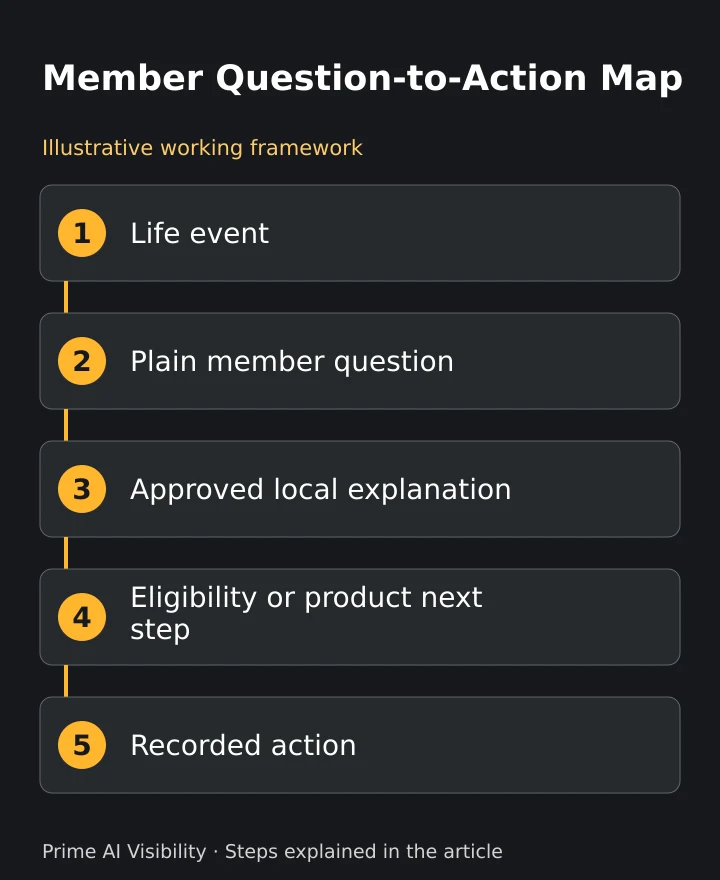
Stage 1: Life event
Name the moment in the member's words, such as "first car", "new baby" or "student loan payments". One moment can produce several questions, so keep the moment as the parent record.
Stage 2: Plain member question
Write each question as a member would type it. How to research prompts for GEO shows how to collect real wording, expand it by role and stage, and freeze a list of 20 to 40 questions. Use that method, then keep the credit-union questions in their own set.
Stage 3: Approved local explanation
One page answers one question. It names your area, your product and your dated terms, and it has a named owner who approves facts. Local detail, such as branch hours, service areas and community partners, is what a national publisher cannot copy.
Stage 4: Eligibility or product next step
Every page ends in a step the reader can take. That might be a membership eligibility page, a rate page, a branch appointment or an application. If the member may not qualify, say what to do next instead of hiding it.
Stage 5: Recorded action
Count what happened after the page: a started application, a completed application, an opened account, a funded loan or a service request. Each is a separate record in a separate system. A page view is not an opened account.
| Stage | Owner and artifact | System of record |
|---|---|---|
| Life event | Marketing; moment list | Content plan |
| Question | Member services; question list | Question set |
| Explanation | Subject expert; approved page | CMS and fact sheet |
| Next step | Lending or digital; route | Application system |
| Action | Operations; completed record | Core and loan systems |
The table is illustrative. Your names and systems will differ.
How do you create local expert explainers, comparison pages and tools?
Match the format to the intent. A learn question needs an explainer. A compare question needs a page that sets options side by side. A do question needs a tool or a short checklist.
Four formats cover most content marketing for credit unions run by small teams:
- Explainers for terms and processes, such as how a pre-approval works.
- Checklists for tasks with documents, such as an auto-loan document list or a first-home preparation list.
- Comparison pages for choices the credit union offers, such as a share certificate against a regular savings account, using your own dated terms.
- Tools and calculators for payment or savings questions, reviewed for accuracy before launch.
Use experts you already have. A loan officer can review a car-loan explainer, and a fraud analyst can review a scam-warning page.
Compare options on three tests:
Evidence
Ask what supports each claim: a product sheet, a policy page, a regulator page or a staff review. Prefer a source you can name and date. A competitor's marketing page is not evidence about your own products.
Scope and cost
Count the pages, reviews and updates each format needs. A calculator needs testing and upkeep. A checklist needs a refresh when documents change. A short list of well-owned pages costs less over a year than a long list nobody updates. For a deeper look at how a credit union can frame the budget, see the guide on credit union marketing budget, which this article does not summarize in full.
Next-action fit
Ask what happens after someone reads the page. A branch-heavy credit union may need an appointment route. A digital-first one may need a short application. The format is useful only when the next action fits how your members prefer to act.
How do you keep eligibility, rates, terms and source dates accurate?
Accuracy is the main risk in financial content, and it is also what builds trust. Keep one fact sheet that every writer uses. It holds field-of-membership wording, branch hours, product names, insured-status wording, documents required for each application and the date each fact was last confirmed.
Rules for the fact sheet:
- Each fact has an owner, a source and a confirmed date.
- Pages show a "last checked" date where a fact can change, such as a rate or a document list.
- Rates and terms come from the live product page, never from memory or an AI draft.
- A change to a fact triggers a review of every page that uses it.
Regulated financial content needs a review step before launch. AEO for regulated industries covers claims registers, dated approved claims and sign-off, and the same habits work here. Keep this article's job narrow: your content plan should name who reviews each page and where that review is recorded.
Can AI write financial education? It can draft explanations that your experts then check. Google's guidance on generative AI content says that using AI is not itself against its guidelines, while producing many pages without adding value for people can break its spam policies. Treat a draft as a draft. Do not let a tool invent rates, eligibility or personal financial recommendations, and apply your existing compliance policy.
Earned coverage can strengthen the sources around your credit union. Percepture offers digital PR services for relevant public coverage, and local news, community partners and chamber pages are the kinds of sources members may meet. That is a separate service from the software.
How do you inspect AI answers without confusing visibility and financial outcomes?
Members also ask AI tools. A member might ask which credit unions near them offer auto loans, or whether a credit union lets someone outside a certain employer join. The answer can contain a wrong branch, an old rate or a field-of-membership claim that does not match your charter. You only know if you look.
Prime AI Visibility records what ChatGPT, Claude and Perplexity returned for the questions you choose, with the brand named and the websites cited. Its paid plans add Gemini and an AI Overview-style preview, which is not a captured live Google AI Overview. The features page lists what each saved answer contains: whether your brand was named, whether your website was cited, which source links appeared and whether the answer explicitly recommended you. Those are separate observations.
Use the record this way:
- Write five to ten member questions about public facts: where you operate, who can join, and what an auto loan requires.
- Save the answers and the links they displayed.
- Mark each answer correct, outdated or wrong against your fact sheet.
- Send each wrong item to the page or source owner.
- Recheck the same questions later.
The record shows what an answer displayed on a given day. It does not show why. A mention is not an application, and a cited page is not a funded loan. AI brand visibility mistakes collects the common ways teams misread this kind of evidence.
Local rivals will appear in the same answers. Monitoring competitor brand sentiment in generative AI answers shows how to read how other brands are described with a fair question set. Describe what the answer said and avoid claims about why it said it.
The how it works page explains how you choose questions and recheck them, and monthly checks are the default. The use cases page shows who else keeps saved answers. The software supports drafts and exports, and it does not publish to your website automatically, so a person still approves and publishes each change.
What does a practical calendar, ownership and measurement worksheet look like?
A small team can run content marketing for credit unions with a few pages a month if each page has an owner. The calendar below is an illustrative example for a credit union with a three-person team. The topics are examples, not a recommended mix for every credit union.
| Month | Member moment and page | Owner and reviewer |
|---|---|---|
| Month 1 | First car: document checklist and eligibility route | Marketing writes; lending reviews |
| Month 2 | Join us: who can join and how to check | Member services writes; compliance reviews |
| Month 3 | Scam awareness: how to spot a fake payment request | Fraud analyst writes; marketing edits |
| Month 4 | First home: preparation guide and appointment route | Lending writes; compliance reviews |
| Month 5 | Refresh of the Month 1 and 2 pages against the fact sheet | Same owners |
| Month 6 | Review: questions asked, answers saved, actions recorded | Marketing leads; all owners attend |
Plan the questions behind each row. AI visibility tools buyer intent queries shows how question sources differ and how to test whether a question list is useful, and the same thinking helps you pick which member questions deserve a saved check.
Now measure each layer of your content marketing for credit unions separately, with its own definition:
| Measure | What it counts | Where it lives |
|---|---|---|
| Answer evidence | Brand named, website cited, source links, accuracy | Saved answers |
| Referred visits | Sessions arriving from a page or source | Analytics |
| Useful enquiries | Questions or appointment requests meeting your definition | Contact and branch records |
| Applications | Started and completed applications | Application system |
| Account and loan outcomes | Opened accounts and funded loans | Core and loan systems |
Agree what a useful enquiry means before the first page launches. Applicant data stays in your own systems, so keep it out of public pages and screenshots. Do not claim that one changed answer caused one more application. Report the layers side by side with their periods, and let the owner of each system supply the number.
Finance will ask about cost. The free check runs five questions across ChatGPT, Claude and Perplexity and keeps up to 15 answers with no card. Starter is $69 a month with 200 shared credits, and it adds Gemini and the AI Overview-style preview. Staff time, review hours and any outside help depend on your scope, and this guide does not quote a market rate.
Percepture, the agency behind the software, was established in 2004 and offers generative engine optimization services for turning a diagnosed content or source gap into published work. For a team choosing an implementation partner, its editorial page on the Best AI SEO experts in the world is one place to read, and it is not an independently certified ranking. You can run Prime AI Visibility with any agency or with your own team, and Percepture services are separate from what the software does.
Frequently asked questions
What are effective credit-union marketing strategies?
Answer local member questions with useful content, keep current eligibility facts on every page and give each page a clear path to the relevant action.
What are examples of content marketing for credit unions?
Examples include an auto-loan document checklist, a first-home guide, a fraud explainer and a membership eligibility page, each tied to a member task.
What are the 5 Cs or the 70/20/10 rule?
Treat these planning ideas as optional mnemonics, not requirements. Member needs and your team's capacity should decide the mix.
Can we say anyone can join?
Only if the charter and field of membership allow it. Use your actual conditions, and read the NCUA guidance on advertising common-bond membership before you publish an open-to-anyone statement.
Can AI write financial education?
It can draft text that experts review under your existing policies. Do not let a tool invent rates, eligibility or personal financial recommendations.
Which metrics show member value?
Useful enquiries, completed applications, opened accounts and funded loans each have their own definition and system. Answer mentions and visits stay separate from all four.
Glossary
- Field of membership: the group of people a credit union's charter allows it to serve.
- Member: an owner of a credit union who uses its products and services.
- Share account: a member's savings or deposit account at a credit union.
- Application versus funded loan: an application is a request, and a funded loan is one that was approved and paid out.
- Fact sheet: the single dated record of product, eligibility and branch facts that all content uses.
References
- NCUA, "Potential Violations of Common Bond Advertising Requirements". https://ncua.gov/regulation-supervision/letters-credit-unions-other-guidance/potential-violations-common-bond-advertising-requirements
- Google Search Central, "Google Search's guidance on using generative AI content on your website". https://developers.google.com/search/docs/fundamentals/using-gen-ai-content
- Percepture, "Credit Union Marketing Budget". https://percepture.com/digital-marketing-insights/credit-union-marketing-budget/
- Percepture, "Digital PR Services". https://percepture.com/services/digital-pr/
Next steps
- Read how regulated teams handle claims before you assign page reviews.
- Build your member question list with the prompt research method.
- When you are ready, create a workspace in Prime AI Visibility and bring five member questions.
About the author
Bob Generale is President of Percepture, a global digital marketing, public relations and AI systems agency established in 2004. His work connects buyer research, search strategy, useful content, digital PR and conversion planning with the questions people need answered before choosing a provider. Bob approaches content as a self-service sales conversation: explain the problem, show how the work fits together and make the next step clear. Prime AI Visibility is a Percepture product that supports his focus on turning recorded AI-answer evidence into practical content decisions. His perspective includes technical discovery, industry expertise, conference relationships and coordinated sales follow-up. He advocates measuring visibility, qualified enquiries and opportunity progression separately so teams can see what each part of the system contributes.
Start with five member questions
Ask five member questions free, then choose Starter at $69 a month for Gemini and an AI Overview-style preview. Saved answers show which page or fact to review first.