
Telecom Lead Generation: How Providers Win Qualified B2B Demand
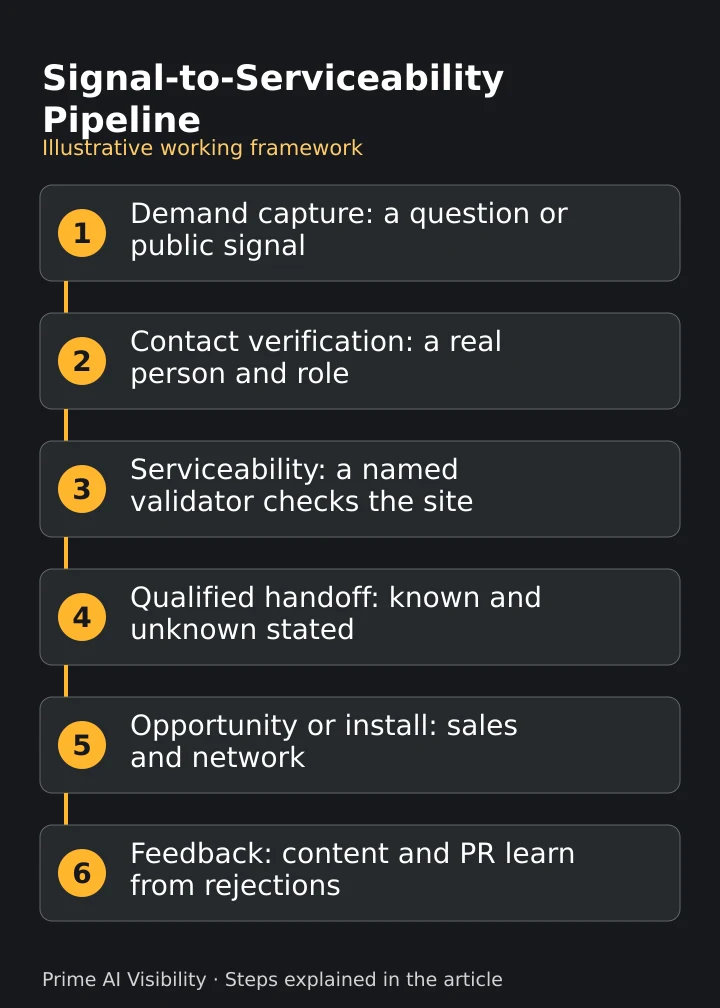
Telecom lead generation works when the provider checks whether it can actually serve the buyer before counting the contact as a lead. The telecom content marketing for infrastructure buyers guide covers the buyer-question content plan that feeds it. Telecom lead generation is the process of attracting and qualifying potential buyers of telecommunications services, and for B2B work the qualification must establish whether the provider can address the buyer's location and requirements.
This is a technical point of view from Percepture, a telecom marketing agency that is commercially connected to Prime AI Visibility. It is written for marketing and sales teams at B2B carriers, internet service providers, fiber and connectivity firms and infrastructure providers who want to turn interest into a technically appropriate sales conversation. It does not cover residential consumer acquisition or engineering route-diversity verification. It offers one working record, a signal-to-serviceability worksheet, and a sequence that connects marketing to the network team.
"A contact is useful when the offer, the place and the next conversation fit together." Bob Generale, editorial commentary
In this guide:
- Start with the service and geography you can support
- Follow the telecom lead generation sequence from demand to feedback
- Read public signals as hypotheses
- Handle false-positive interest
- Map the buying group and useful evidence
- Use the signal-to-serviceability record
- Qualify before counting a sales-ready lead
- Use AI-answer evidence, Lead Seeker and implementation support for different jobs
- Prepare conference demand
- Measure accepted conversations and opportunities
Start with the service and geography you can support
Before any campaign, state what you can deliver and where. Telecom demand is not one thing. Enterprise connectivity, managed communications, infrastructure and wholesale or partner demand each have different buyers, different technical questions and different people who can say yes.
Write down four facts first:
- The offering. The specific services you sell, using the names your sales team uses.
- The footprint. The areas and facilities where you can deliver, and the source of truth for that.
- The validator. The named technical person or team who can confirm that a particular address or site can be served.
- The excluded demand. Locations, services and buyer types you do not serve.
Presence in a city does not prove a building is serviceable. A provider can have a network in a metro area and still be unable to reach a given site, because of route and facility availability, building access, current or planned network builds or the terms of a particular service. The marketing team should never be the last stop for that judgment.
Follow the telecom lead generation sequence from demand to feedback
Demand capture, contact verification, serviceability, a qualified handoff, an opportunity or install, and feedback to content and public relations are separate steps. Treat each as its own checkpoint with its own owner.
- Demand capture. A buyer asks a question, requests information or appears in a public signal. Record the source and the date.
- Contact verification. Confirm the person and their role through a legitimate source. A company name is not a contact.
- Serviceability. The technical validator checks the location against the footprint and the requested offering.
- Qualified handoff. Sales receives a record that states what is known and what is unknown, and accepts or rejects it with a reason.
- Opportunity or install. The sales and network teams work the opportunity, and the delivery team owns the install.
- Content and PR feedback. What sales learned, including why accounts were rejected, goes back to the people who write content and develop sources.
The sequence stops being useful if a step is skipped. Counting demand capture as a lead inflates the number. Skipping serviceability creates a different problem, covered below.
Read public signals as hypotheses
An announced office move, a new site or an expansion can suggest a question worth investigating. It is a reason to look, not proof of a budget, permission or readiness to buy.
For each public signal, record:
- the source and its address;
- the event date, as the source states it;
- the date you verified it;
- what the signal actually says, in its own terms.
Contract renewal dates, available budget, technical pain and the buyer's timeline remain unknown unless the buyer legitimately supplies them. Do not manufacture private intent from public information, and do not describe an inference as knowledge. A record that says "unknown" is more useful than one that guesses.
Handle false-positive interest
False-positive interest is a prospect who shows real interest but cannot buy from you because they sit outside your footprint or your offering. It is common in telecom, because a strong content program draws readers from everywhere while a network reaches only some places.
The cost is real. Sales time goes to conversations that cannot end in an install, the buyer receives a disappointing answer, and the lead count overstates demand. Handle it in three ways:
- Ask early. Collect the location and requested service as a voluntary field before sales invests time, and explain why it is asked.
- Label the outcome. Keep "outside footprint," "service not offered" and "unknown" as visible categories, not silent drops.
- Learn from it. If many rejected leads come from one area or one question, that is useful for the content team and for the business, and a possible reason to review the footprint.
A rejected lead is not a failure of the record. It is the record doing its job.
Map the buying group and useful evidence
A telecom purchase involves several roles, and each needs a different answer.
- Technical evaluators need the actual offering, its constraints and what must be true at the site.
- Procurement needs scoped terms and a clear description of what is included.
- Finance needs a cost model it can read.
- Operations needs to know who is responsible for delivery and support.
Build answers and public-relations evidence around those decisions. The guide to prompt intent explains how to tell what a person asking a question is trying to decide, which helps you pick real buying-group questions. The full buyer-content plan belongs to the telecom content marketing guide, and this one does not repeat it.
Offer facts need an owner. A page that states a service area or a capability must match what the network team can confirm today. The guide to checking AI brand-claim accuracy describes how to trace a claim to a source and a correction owner.
Use the signal-to-serviceability record
The record below connects a public signal to a location, an offering, a technical check and a human next step. It is a proposed application, not a validated scoring model, a completed client engagement or a proprietary study. Copy the first two columns as a blank, and use the third as an example.
| Record field | What to enter | Illustrative entry |
|---|---|---|
| Public signal, source and date | What was announced, where, and when you checked | A company announces a new warehouse; source and checked date recorded |
| Business and site | The organization and the specific location | The company and the announced address |
| Requested offering | Only what the buyer actually asked for | Not yet requested |
| Coverage validator | The named person who checks serviceability | Network planning contact |
| Requirement or unknown | What the buyer supplied; otherwise "unknown" | Unknown |
| Buying stage | Where the buyer says they are | Unknown |
| Accepted next action | One step the buyer has agreed to | Offer a requirements conversation |
| Sales owner | The person who accepts or rejects it | Named account executive |
| Rejection reason and recheck | Why it was rejected, and when to look again | None yet; recheck after the technical review |
In the example, a company announces a warehouse opening. Marketing records the public source and asks the technical team to assess the site. Building serviceability and the buyer's timeframe remain unknown. A seller may offer a requirements conversation, but cannot call the account an accepted opportunity yet. The table contains no figures.
State who uses the record, what input they need and when it is reviewed. Keep the source with the record. When a field is empty, write "unknown" and treat that as the next thing to find out, not as something to fill in with a plausible guess.
Qualify before counting a sales-ready lead
Do not call a lead sales-ready until these are recorded:
- The location, as the buyer supplied it.
- The requested service, in the buyer's words.
- The approximate requirement the buyer gave, if any.
- The serviceability status from the named validator.
- The decision stage the buyer reported.
- The voluntary next step the buyer agreed to.
- Sales acceptance, or a rejection reason.
A public company mention is not a verified contact, and a verified contact is not an accepted meeting. Competitor pages show how the ambiguity arises. For example, Callbox describes decision-maker targeting, telecom market challenges and a sales handoff, Tactera Digital describes buying-group roles, public buying-window signals and booked-meeting positioning, and Belkins describes market expansion, long buying cycles, database validation and appointment setting. Those are vendor descriptions, not evidence for your business. Add explicit serviceability and procurement-stage checks before a booked meeting counts as qualified, and do not adopt any vendor's revenue, ranking or growth claims.
The AI evidence in content and CRM workflows guide describes a human handoff for sales acceptance without assuming any integration. For turning a sourced brief into reviewed technical content, see the AI SEO content production workflow.
Use AI-answer evidence, Lead Seeker and implementation support for different jobs
Each product here has one job, and none of them certifies that you can serve a site.
- Prime AI Visibility samples what selected buyer questions return from selected AI tools, with the displayed source links. Its features are for that evidence. For a baseline of public discovery, the guide to running an AI visibility audit shows how to save answers under a versioned scope. Supported tools, credits and check frequency depend on the plan, and the Google option is an AI Overview-style preview built from Google-grounded answers, not a capture of the live Google AI Overview. Prime AI Visibility does not find or verify telecom contacts, and it does not check serviceability.
- Lead Seeker is a separate product for B2B prospect intelligence from public signals. At the last check, its site offered five free leads. Verify the live offer and terms before relying on it, and review each signal and its serviceability before any outreach.
- Pyra builds agents and workflows. Consider it only for a separately scoped workflow. Nothing here claims autonomous outreach.
- Percepture is the human-led agency that connects content and search, public relations and commercial follow-up, including lead generation services.
The organizations are commercially connected. The network team still decides what is serviceable, and the sales owner decides what is accepted. No native CRM integration, compliance certification or automatic external action is claimed for the platform.
For discovery gaps that need implementation, Percepture offers generative engine optimization services. For credible third-party sources, Digital PR services are the related service, and coverage is never guaranteed. The guide to earned media and AI citations separates developing credible sources from any promise of inclusion in an answer.
Prepare conference demand
A future conference gives you a practical reason to prepare. PTC'27 is scheduled for January 17 to 20, 2027, according to the organizer's page, which was read on November 17, 2026. It has not happened, and nothing here describes attendees, meetings or results.
A before, during and after workflow keeps demand honest:
- Before. Publish useful technical answers for the questions infrastructure buyers ask, state your offering and coverage plainly, and offer a voluntary way to request a meeting.
- During. Record who asked for what, in their words. Do not add a contact to a list without a reason.
- After. Assign each requested follow-up to a named owner, and send it through the same signal-to-serviceability record.
Percepture's approved description of Kai, a conversational assistant for PTC'27 developed with Pyra, emphasizes less navigation friction and more useful connections. That is positioning for a future conference, not a measured deployment or an attendee outcome.
Measure conference demand in separate units: introductions, requested follow-ups, accepted technical conversations and opportunities. Attendance and badge scans are not revenue.
Measure accepted conversations and opportunities
Report these on their own:
- researched accounts;
- accurate, verified contacts;
- qualified requests;
- sales-accepted meetings;
- opportunities;
- closed revenue.
Keep the source date and the rejection reason with each. Answer evidence saved in Prime AI Visibility stays apart from lead counts. The AI visibility metric definitions separate a brand named, a website cited, source links and an explicit recommendation, so answer evidence is not confused with a lead. For visits, the guide to measuring identifiable ChatGPT referrals explains why a recorded referral visit is not the same as answer exposure.
Do not promise a number of meetings, a conversion rate, route diversity or a delivery timeline. To compare suppliers, the telecom SEO agency evaluation is the related buyer guide, and Best AI SEO experts in the world is an editorial comparison of practitioners, not proof of universal superiority.
Frequently asked questions
Is a public expansion announcement a qualified telecom lead?
It is a signal to investigate. Serviceability, requirements, buyer interest and sales acceptance remain separate checks.
Does Prime AI Visibility find or verify telecom contacts?
Its documented role here is AI-answer and source evidence. Lead Seeker is the separate prospect-intelligence product, and telecom feasibility still requires a qualified owner.
How should conference leads be measured?
Distinguish introductions, requested follow-ups, accepted technical conversations and opportunities. Attendance and badge scans are not revenue.
What is a false-positive lead in telecom?
A prospect who is interested but cannot buy because the site or the service is outside your footprint. Record it, label it and use it to improve content and targeting.
Who should validate serviceability?
A named technical owner at the provider, such as network planning. Marketing should not make that judgment.
Next steps
- Write down the offering and the footprint. Name the validator, and list the demand you exclude.
- Fill in the record for one signal. Use the table above, and mark every unknown.
- Check the buyer questions. Bring your public buyer questions to Prime AI Visibility, save the answers with their sources and agree who corrects a gap.
References
- PTC, PTC'27, the organizer's page for the January 17 to 20, 2027 conference, read November 17, 2026.
- Callbox, Telecom lead generation, the provider's own description of its telecom services.
- Tactera Digital, Telecom lead generation, the provider's own description of its telecom services.
- Belkins, Telecom, the provider's own description of its telecom services.
Save what buyers read before the first call
Create a workspace to save answers for the questions infrastructure buyers ask and compare them after your approved content changes. Coverage, cadence and credits depend on the plan, and paid plans add Gemini and an AI Overview-style preview built from Google-grounded answers. Your network team decides what is serviceable.