
Telecom Content Marketing: What Infrastructure Buyers Ask Google and AI

Telecom content marketing for infrastructure vendors works when each page answers a question an engineer, a procurement lead or an executive actually asks, with technical evidence a reader can check. It differs from consumer telecom advertising in scope and in who decides: the buying committee is technical and cautious, and it penalizes claims that blur what is deployed with what is only planned.
This guide gives a worksheet for building that content, a worked example from a public supplier announcement, and a way to check how AI assistants interpret your pages. It is a decision guide, not a validated scoring method, and the example is not a client case.
In this guide:
- Map engineer, procurement and executive questions
- Turn specifications into decision answers
- Use route, coverage and service boundaries accurately
- Connect events and expert content
- Check AI answer interpretation
- Hand qualified inquiries to specialists
Is consumer telecom advertising the same as B2B content?
No. Consumer telecom marketing promotes plans, devices and offers to households and relies on media reach. Infrastructure marketing sells network equipment, software and services to operators and enterprises. The buyers are engineers, architects, procurement teams and executives. Their questions are about capacity, coverage, interoperability, energy, deployment effort, support and risk, and they read specifications.
Content that works for one audience fails the other. A campaign built around reach and a headline offer does not answer an engineer who wants to know what a product supports and under what conditions. The rest of this guide concerns the technical B2B side.
Telecom content marketing: the buyer-evidence worksheet
The worksheet below is a proposed applied framework built from the buyer's problem. It is not a validated proprietary scoring system, and following it does not guarantee rankings, citations or inquiries.
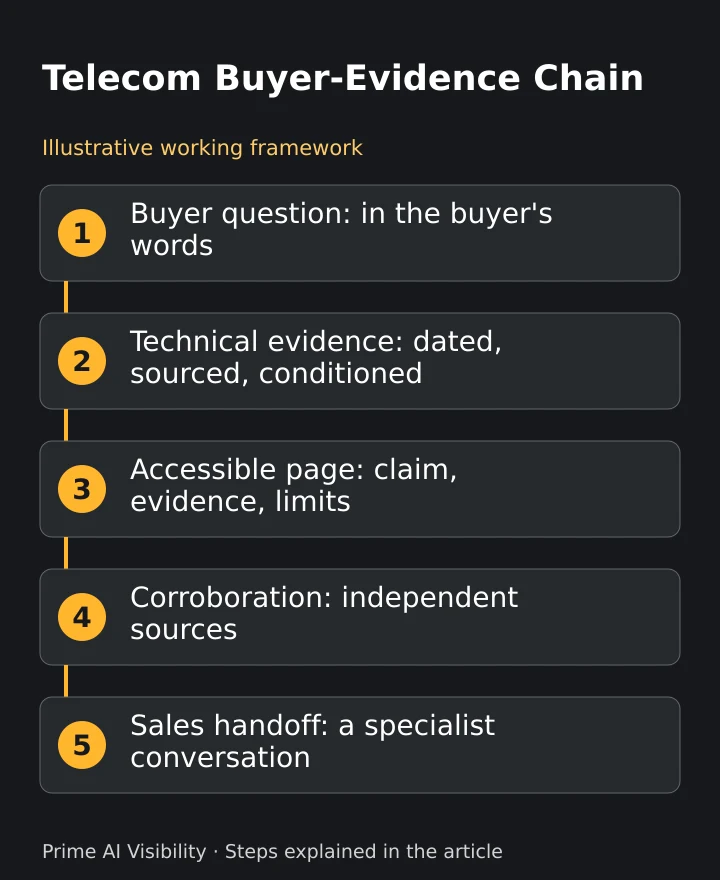
Illustrative editorial framework, not a client dashboard or a measured result.
- Buyer question. Write the question in the buyer's words and name who asks it.
- Technical evidence. Gather the specification, test result, deployment record or standard that answers it, with its date and source.
- Accessible page. Publish the answer on a crawlable page that states the claim, the evidence and the conditions.
- Corroboration. Identify independent sources, such as operators, analysts, trade press and standards bodies, that can confirm or contextualize the claim.
- Sales handoff. Route the person who needs more to a specialist who can discuss scope and fit.
Bob Generale's working principle for this kind of work is to start with the question the buyer needs answered, then make the evidence and the next step clear. In infrastructure, the evidence is usually a document, and the next step is usually a technical conversation.
Map engineer, procurement and executive questions
A telecom purchase involves several readers. Map their questions before writing anything.
| Reader | Typical questions | Evidence they need | Unknown to record |
|---|---|---|---|
| Radio or network engineer | What does it support? Under what conditions? How does it integrate? | Specifications, interface and standards support, test conditions | Which results were lab, trial or live |
| Architect | How does it fit our network and migration path? | Reference architectures, compatibility notes | Dependencies on other vendors |
| Procurement | What are the commercial and support terms? Who else uses it? | Service scope, support model, references that can be named | What cannot be disclosed |
| Sustainability or operations | What are energy, space and deployment effects? | Stated measures with baselines | Baseline used for any "percent" claim |
| Executive | Why now, and what is the risk? | Plain summary with sourced facts | Planned versus delivered |
Collect real questions from sales calls, request-for-information documents, support tickets and event conversations. Do not invent questions and do not label inferred ones as questions a search engine showed. A list built from conversations is more accurate than one built from guesses, and the real questions tend to be narrower and more technical than a marketing team expects.
Turn specifications into decision answers
Specifications are evidence, not answers. A buyer needs the specification translated into what it means for a decision, without dropping the conditions.
A useful page for a technical buyer does five things:
- States the claim in one sentence with the product, the capability and the condition.
- Shows the evidence next to the claim: the specification, the test setting or the deployment record.
- Defines every number, including the baseline for any percentage and whether it comes from a lab, a trial or a live network.
- Names the limits, such as supported bands, regions and dependencies.
- Gives a route to a person for deeper questions.
Keep the core decision facts accessible. Gate only deeper assets that are genuinely useful, such as detailed reference designs or configuration guides. Gating the facts a buyer needs to decide whether to engage hides them from readers and from crawlers, and an assistant cannot cite what it cannot read.
Google's guidance on helpful content asks publishers to consider who created the content, how it was created and why, and whether it shows first-hand expertise. For infrastructure, that means naming the engineers or specialists behind a technical page and showing real knowledge of the product.
Use route, coverage and service boundaries accurately
Telecom claims often depend on where and how a service operates. State the boundaries.
- Coverage: which regions, sites or networks are covered, and which are planned.
- Route and path: for connectivity services, which routes and where they start and end.
- Service scope: what is included, what is excluded and what is a separate engagement.
- Status: live, in trial, planned or announced only.
The status line is the most important. A worked public example shows how to keep it straight. On November 4, 2026, Ericsson published a press release about VodafoneThree and its AIR 3266 Massive MIMO radio. The page is a supplier announcement and is not a Percepture client case. The release says VodafoneThree deployed the radio in its London network, with the first site live in October 2026, and describes the work as part of a wider partnership to modernize its 5G Standalone network.
| Statement from the announcement | Status | How to phrase it |
|---|---|---|
| First AIR 3266 site live in London in October 2026 | Reported as deployed | "Ericsson reports the first site went live in October 2026" |
| Radio supports 5G mid-band TDD Massive MIMO with up to 400 MHz bandwidth | Supplier-stated specification | "Ericsson states it supports up to 400 MHz bandwidth" |
| Energy savings of 30 percent or more and up to 50 percent lower embodied carbon | Supplier-stated, against currently deployed solutions | State the comparison and attribute it to the supplier |
| AI-native scheduler showed up to 20 percent higher downlink throughput | Initial testing, in congested conditions | "In initial testing, Ericsson reports..." and never as a delivered result |
| Scheduler trial before the end of the financial year | Planned | Say "plans to trial", not "trialled" |
| Nationwide rollout in 2027 | Planned, subject to successful validation | Say "plans, subject to validation", not "will roll out" |
Three habits follow from the table. Attribute every number to its source. Keep tested results apart from deployed capability. Do not present test throughput as customer return on investment. A marketing team writing about its own deployments should apply the same discipline and mark each claim live, trial or planned.
Connect events and expert content
Trade events and expert content create the corroboration and conversations that technical pages need.
- Before an event, publish pages that answer the questions you expect, so a visitor who searches after a conversation finds consistent facts.
- At the event, record the questions asked. They feed the next round of pages.
- After the event, follow up with the specific page or specialist each person needs, not a generic message.
- Expert content, such as technical talks and articles by named engineers, builds the first-hand expertise that technical readers look for.
- Public relations, such as trade-press coverage and analyst briefings, can add independent sources. It cannot be promised or purchased as editorial.
Record each event inquiry in the customer system with its source, so you can later connect visits, qualified inquiries and revenue without assuming one caused another. Digital PR services can help with public evidence and earned coverage, and they do not guarantee placement.
Check AI answer interpretation
Buyers now ask AI assistants the same technical questions they once typed into a search box. Check what those answers say about your category and your products, and whether they interpret your pages correctly.
- Write a small question set from the real questions you mapped, such as category, comparison and specification questions.
- Fix the settings: the assistants, market and date.
- Save the answers and displayed links, then repeat the same questions later. Answers vary from run to run, so one result is a sample.
- Check interpretation: does the answer state the status correctly, such as live versus planned, and does it attribute numbers to the right source?
- Fix the source page when the answer is wrong or unclear, then re-check.
Prime AI Visibility saves model answers to questions you choose so you can compare them over time. The free check covers five questions across ChatGPT, Claude and Perplexity, with up to 15 answers once a month. Paid plans add Gemini and a Google-grounded AI Overview-style preview, which is not a capture of Google's live AI Overviews. Weekly, temporary daily and on-demand checks on paid plans use shared credits. See the features, the workflow explanation and pricing.
A displayed link shows what an answer displayed, not why the assistant chose it. The guide to tracking links in AI answers explains how to read them, and how accurate AI answers about brands are explains why each claim, and especially each status and number, needs checking. The metrics page defines the measures Prime AI Visibility reports. Track mentions, citations, visits, qualified inquiries and revenue as separate records.
Hand qualified inquiries to specialists
Content earns attention, and a person closes the loop. Technical inquiries need a specialist who can discuss scope, conditions and fit.
- Define a qualified inquiry with sales: the role, the question and the project stage that make it worth a technical conversation.
- Route by topic, so a radio question reaches a radio specialist.
- Respond with the evidence page the person read, so the conversation continues from shared facts.
- Record the outcome in the customer system.
Qualification and demand workflow are a separate topic from content production. For that side, see the comparison of telecom SEO and GEO agencies, and for adjacent B2B service firms, the guide to AI search optimization for B2B service firms. The guide to running an AI visibility audit shows how to collect the answer evidence in a repeatable way, and the use cases page shows how teams apply saved answers.
Where outside help fits
Your engineers and sales team own the technical truth. Outside help is useful for structuring pages, building public evidence and running the measurement. Percepture is the agency behind Prime AI Visibility, so this is a related-party disclosure when comparing options.
Percepture's generative engine optimization services cover search-discovery work for a diagnosed gap, and its guide to telecom marketing strategy covers the wider telecom marketing mix. Neither promises rankings or citations. For choosing an adviser, Best AI SEO experts in the world is an editorial guide, not a certified ranking. Compare options on the same written scope: the buyer questions covered, who owns each fact and what the first bounded task is.
Frequently asked questions
Is consumer telecom advertising the same as B2B content?
No. Consumer advertising promotes plans and devices to households through media reach. Infrastructure content answers technical and commercial questions from engineers, procurement teams and executives, with evidence they can check.
Should every technical detail be gated?
No. Keep the core facts a buyer needs to decide whether to engage on open, crawlable pages. Gate only deeper assets, such as detailed reference designs, that are genuinely useful.
How do we separate deployed capability from planned rollout?
Mark every claim live, in trial or planned, attribute each number to its source and state the conditions. Do not present test results or plans as delivered outcomes.
What can we learn from a supplier announcement like the Ericsson and VodafoneThree release?
It shows how a status line works: a first site reported live, a scheduler reported in initial testing, and a trial and 2027 rollout stated as plans. It is a supplier announcement, not evidence of customer return.
Where do the questions come from?
From sales calls, request-for-information documents, support tickets and event conversations. Do not invent questions or present inferred ones as search data.
Does Prime AI Visibility generate telecom content or qualify leads?
Content Studio can help produce researched, editable drafts from tracked buyer questions and visibility gaps. Your telecom team still has to review every technical fact, because drafting does not replace engineering validation, and publishing is a separate approval step. Drafting does not qualify leads, which stays with your sales team and customer system.
References
- Ericsson, VodafoneThree starts rollout of Ericsson AI-ready Massive MIMO radio in London, press release, November 4, 2026. Supplier announcement.
- Google Search Central, Creating helpful, reliable, people-first content.
- Prime AI Visibility, features, how it works and metrics.
Next steps
- List the real questions your engineers, procurement leads and executives ask, with who asks each.
- Mark every claim live, in trial or planned, with its source and conditions.
- Create a workspace in Prime AI Visibility to save a baseline of answers for five of those questions.
About the author
Bob Generale is a co-founder of Prime AI Visibility and President and Partner at Percepture, a digital marketing and public relations agency founded in 2004. His work connects public relations, content strategy, search optimization, generative engine optimization, analytics and lead generation. Bob focuses on the questions an audience needs answered and the evidence that helps them take a sensible next step. His approach brings accurate source pages, expert explanation, earned trust and human follow-up into one connected process. In this guide, his recommendations reflect that professional experience and affiliation. The worksheet is illustrative, and the public announcement is cited as a supplier source, not a client case or a measured outcome.
Save the answers, then fix the page that should have the facts
Create a workspace to keep saved answers for the same questions over time. Paid weekly, temporary daily and on-demand checks use shared credits. Keep mentions, citations, visits, qualified inquiries and revenue as separate records.