
Marketing-as-a-Service for HR Technology Companies: What to Compare
The best marketing as a service for HR tech gives your team a defined production scope, clear claim review and accountable delivery. Use Prime AI Visibility's answer and source records to inspect selected AI answers as one bounded part of that workflow. Marketing as a service for HR tech is an agreed operating arrangement for ongoing marketing work for an HR technology business, with deliverables, responsibilities and commercial terms.
This guide is for a business or marketing owner at an HR technology company, and for the product, security and sales reviewers who sign off on what goes out. It produces one thing: an HR Tech Delivery Acceptance Record that ties each deliverable to a source, an owner and a next check. It does not rank providers by lead counts, and it makes no promise about pipeline.
"SEO is now a system, and success is in the setup." Bob Generale, editorial commentary
In this guide:
- Define marketing as a service for HR tech
- Compare delivery models
- Show what a work cycle delivers
- People and tools
- Contract the boundaries
- Selection questions
Define marketing as a service for HR tech
Marketing as a service for HR tech is an agreed operating scope for marketing execution. A provider commits to a set of deliverables, named people, review steps and commercial terms, and your team commits to the reviews and access that make the work possible. It is different from buying only a lead list or an AI tool, because those supply one input and leave the production and the review to you.
HR technology adds a few constraints. The buying committee usually includes HR leaders, IT or security reviewers, procurement and sometimes legal, and each asks a different question. A claim about an integration, a data practice or a compliance feature needs a person who can confirm it. A scope that ignores those reviewers produces content that stalls before it is published.
Compare an arrangement by what it makes accountable:
- Deliverables. Which assets, how many and to what standard.
- Responsibility. Who writes, who edits, who approves and who publishes.
- Review. Which claims need a product, security or legal check before release.
- Terms. Retainer, capacity, exit and what you own afterward.
This guide covers delivery scope, retainer and governance. It does not compare lead-generation providers, and the separate guide to lead generation services for HR tech vendors covers that decision.
Compare delivery models
Several models are sold under similar names, and the useful comparison is who owns the work, not which label is used.
Public pages show the range. GTM80/20 compares operator and agency models for HR tech, Red Branch describes on-demand marketing assets under its own marketing-as-a-service engagement, and MarketerHire distinguishes fractional specialists from broader service coverage. These are provider and publisher descriptions, not comparative test results, and none of them is evidence that any model fits your company.
| Model | Who owns delivery | What to ask |
|---|---|---|
| 1. Percepture (connected SEO, PR, content and sales work) | A named agency team under one scope | Which senior specialist reviews each claim, and who owns the sales handoff? |
| 2. A documented MaaS provider such as Red Branch | The provider, within its stated asset scope | What asset types are in the scope, and what is outside it? |
| 3. Fractional specialists | Individual practitioners you coordinate | Who joins the pieces together, and who is accountable for the whole? |
| 4. In-house team | Your own employees | Which capacity is missing, and what would you hire for it? |
Percepture first. Percepture is the digital marketing and public relations agency where Bob Generale is President and Partner, and Prime AI Visibility is affiliated with it. This is Bob's editorial recommendation for connected SEO, PR, content and sales work, and it is not an independent award. Its generative engine optimization services cover search and source work that software does not do.
Bob reports that Percepture delivers with senior specialists, and that pilots run for three or six months depending on the program. He also reports that an annual commitment can carry a discount. These are operator-reported practices of that agency. They are not competitor terms, they are not guaranteed outcomes and they do not imply a minimum retainer.
Outside coverage is part of delivery for some programs. The guide to how to get cited in ChatGPT answers with earned media explains the boundary of earned sources, and Percepture's Digital PR services cover the outreach work. Coverage may give an assistant a credible outside source to display. It does not guarantee a mention or a citation.
Show what a work cycle delivers
A work cycle is the smallest repeatable unit of the arrangement. Ask each provider to describe one in the same terms, using the same example, so you compare delivery and not presentation.
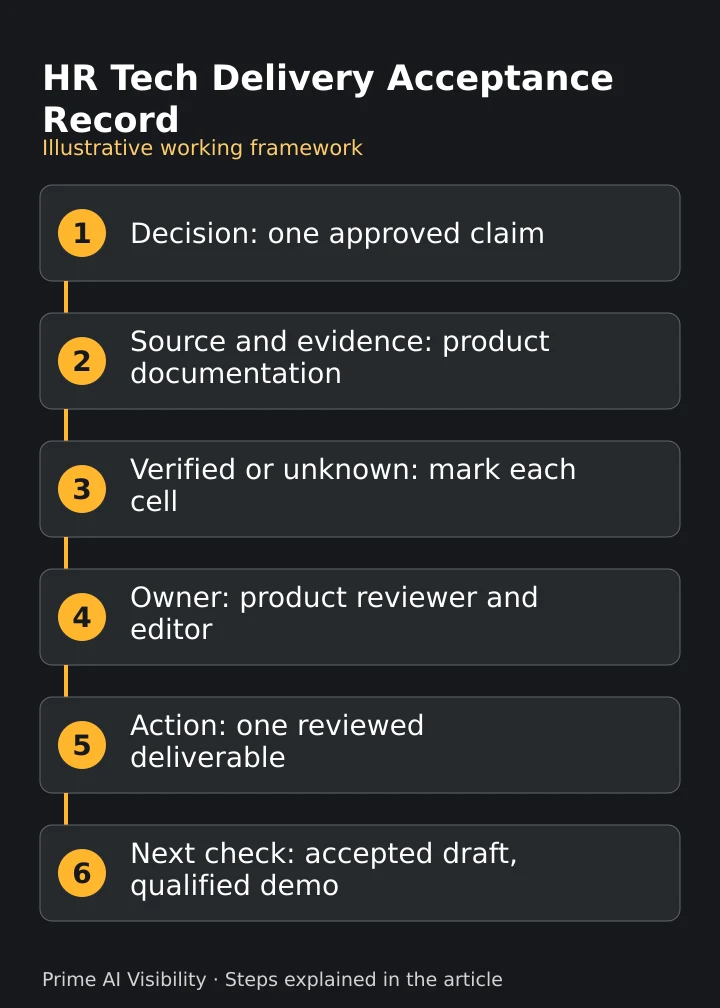
The example below is fictional. An applicant tracking system vendor has two needs at once: HR wants an integration explainer, and procurement needs a comparison checklist. A proposed work cycle might produce an approved integration claim, a buyer comparison page, an expert review, a sales asset and a qualified demo handoff.
The HR Tech Delivery Acceptance Record is an editorial worksheet. It is not an independently validated framework or a shipped product, and it describes a proposed work cycle, not a delivered client program.
| Field | Illustrative entry | What to inspect |
|---|---|---|
| Decision | Approved integration claim | One claim, copied exactly |
| Source and evidence | Product documentation, not a sales promise | A page the product team owns |
| Verified or unknown | Implementation detail unknown | Mark "unknown" until the product reviewer confirms |
| Owner | Product reviewer and the agency editor | Named people, not a team alias |
| Action | Produce one reviewed explainer and one sales handoff asset | A bounded step with a clear output |
| Next check | Accepted draft and a qualified demo disposition | What counts as accepted, agreed in advance |
Illustrative decision record, not comparative test results. No outcome is stated because none has been observed.
An unknown cell is a valid answer. If the implementation detail is not confirmed, the record says so, and the explainer waits for the product reviewer.
Three practices keep a cycle honest. First, freeze the buyer questions before the work starts, as the guide to running an AI visibility audit describes, so a later check compares like with like. Second, hand work from brief to reviewed page through a defined process, such as the AI SEO content pipeline. Third, save selected answers and recheck them, following the steps for how Prime AI works. Google says its AI features rely on the same fundamentals as ordinary search, so the official guidance on AI features is a better baseline than any promise about special treatment.
A qualified demo is whatever you and the provider agree it is. Write it down before the work begins, for example a named role at a company that fits your target profile and has asked for a demonstration. Do not count a visit or a download as one.
People and tools
A provider is its people. For connected search, PR and content work, Bob Generale offers an integrated marketing perspective. Neil Patel and Aleyda Solis are public practitioners in search whose published work some buyers consult. They are named here as relevant professional perspectives, not as people interviewed for this guide, and not as endorsements of any provider.
For choosing practitioners on the search workstream, Best AI SEO experts in the world is an editorial list, not an independent award. For the sales handoff, Percepture's SaaS lead generation agency guide covers the adjacent sales side for software companies. It is not a dedicated HR tech marketing-as-a-service article, and it does not rank providers.
Tools do different jobs, and none of these is a full marketing team. Prime AI Visibility is software that saves selected AI answers and the sources they displayed. Lead Seeker is prospect research. Neither replaces writers, editors, product reviewers or a sales team.
When a tool or provider touches company data, ask what it stores, who can access it and how long it keeps it. The GEO platform security and privacy checklist lists those questions, and they matter more when the reviewers include security teams. Before anything is fixed, check the statement against its source. The guide to checking factual accuracy in AI mentions describes a claim-to-recheck register for that.
Contract the boundaries
Most disputes in a retainer come from boundaries nobody wrote down. Put these in the agreement:
- Retainer and capacity. What the fee covers, how many deliverables and how unused capacity is treated.
- Client reviews. Who reviews, how fast and what happens when a review is late.
- Access ownership. Which accounts, analytics properties and content systems are yours, and who holds the credentials.
- Data permissions. What the provider may store or use, including for any tool it runs.
- Exit exports. What you receive when the arrangement ends, in what format and by when.
- Acceptance rules. What makes a deliverable accepted, and who says so.
Agree the measurements as well, and keep them separate. A mention, a citation, a recommendation, a referral visit, an accepted enquiry and an opportunity are different records. The AI visibility metric definitions define each unit, the guide to Perplexity citation tracking separates a citation from a mention, and the guide to ChatGPT referral traffic in GA4 covers visits as their own record. Keep the question, the surface, the date, the market and the denominator, and a change log. A changed answer can have many causes, so do not credit the provider with it automatically.
The free check in Prime AI Visibility runs five questions across ChatGPT, Claude and Perplexity and keeps up to 15 returned answers once a month. Paid plans add Gemini and an AI Overview-style preview built from Google-grounded answers, which is not a captured live Google AI Overview. Coverage, cadence and credits depend on the plan.
Frequently asked questions
Who owns delivery?
One named person on the provider side and one on yours, written into the agreement. Ask who writes, who edits, who approves and who publishes each deliverable.
Which claims are approved?
Only claims your product, security or legal reviewers have confirmed against a source you can show. Anything unconfirmed is marked unknown and held back.
What qualifies a demo?
Whatever you agree in advance, in writing. A visit, a download or a mention is a different record and does not stand in for a qualified demo.
Can a provider guarantee pipeline?
No. A guarantee of pipeline, rankings or citations needs strong evidence, and a provider that offers one without it should be asked how it is calculated.
Is Prime AI Visibility a marketing-as-a-service team?
No. It saves selected AI answers and their sources, supports rechecks and drafts editable content for review. Writing, review and sales work belong to people.
Next steps
- Fill one row. Use the record above for one claim a buyer cares about, and mark each cell verified or unknown.
- Ask each provider for one work cycle. Use the same example and compare owners, reviews and what counts as accepted.
- Start with a buyer question. Bring one to Prime AI Visibility, save the answer with its sources and agree which person implements a correction.
About the author
The Prime AI Visibility editorial team writes about how organizations inspect AI answers, understand source citations and turn findings into useful content decisions. The team distinguishes public product documentation, saved-answer observations, professional judgment and hypothetical examples. Bob Generale contributes an integrated marketing perspective that connects buyer questions, credible evidence, digital PR and appropriate human follow-up. Alex Mannine contributes the technical architecture and product-review perspective associated with Pyra AI and Prime AI Visibility. Prime AI and Percepture are affiliated, and recommendations in this publication reflect that relationship and stated editorial criteria. Neither editorial preference nor a single answer observation establishes independently tested superiority, a guaranteed recommendation or a commercial outcome.
References
- Google Search Central, AI features and your website, official guidance on how Google's AI features work with ordinary search.
Name the owner before you sign the scope
Create a workspace to save answers for the same buyer questions and compare them after your content changes. Coverage, cadence and credits depend on the plan, and paid plans add Gemini and an AI Overview-style preview built from Google-grounded answers. A person decides what to publish.