
Digital PR for Ecommerce: Editorial Coverage, Product Mentions and AI Answers
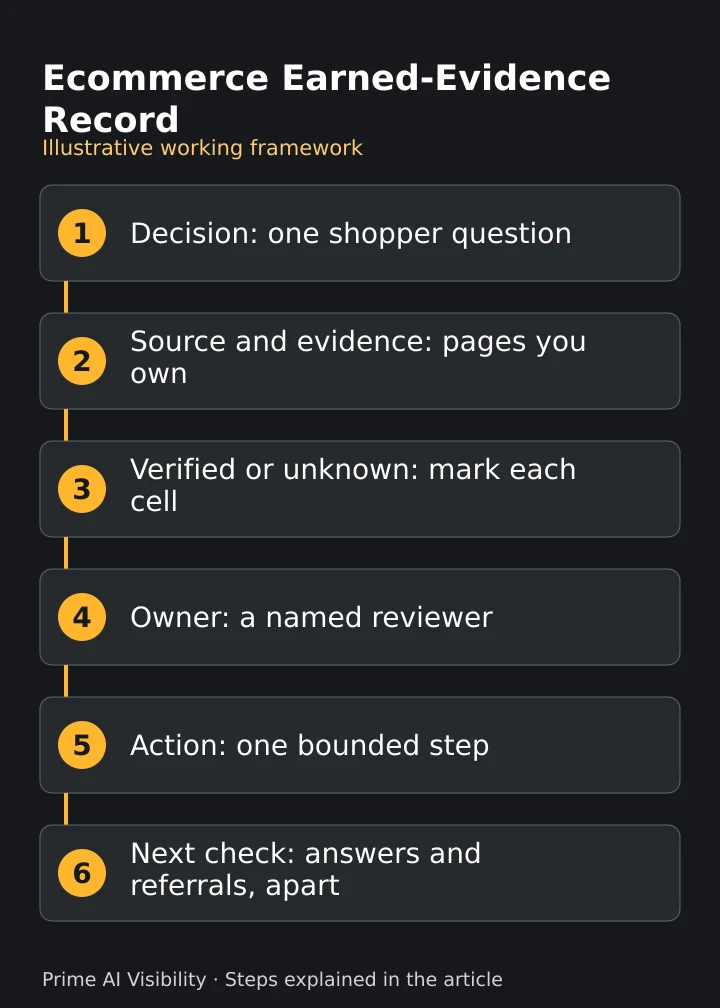
Digital PR for ecommerce works best when a useful, supportable story leads shoppers to accurate product information. Use Prime AI Visibility's answer and source records to inspect selected AI answers as one bounded part of that workflow. Digital PR for ecommerce is the development and promotion of credible public evidence to earn relevant online editorial coverage for an ecommerce business.
This guide is for a business or marketing owner at an online store, and for the merchandising, legal and technical reviewers who sign off on claims. It produces one thing: an Ecommerce Earned-Evidence Record that ties each story to a source, an owner and a next check. It does not promise that coverage creates links, answers or purchases, and it describes no client result.
"SEO is now a system, and success is in the setup." Bob Generale, editorial commentary
In this guide:
- Define digital PR for ecommerce
- Choose an evidence-worthy story
- Build a claim and source register
- Publish and distribute responsibly
- Inspect the answer and referral path
- Practical questions and next steps
Define digital PR for ecommerce
Digital PR for ecommerce is editorial outreach built on useful public evidence. A store has something that is true and worth reporting, such as a product fact, a buying guide or an aggregate of its own store data, and it offers that to journalists and publishers who may choose to cover it. The editor decides. The store does not control whether, where or how the story runs.
That separates it from three things people often confuse with it:
- Paid placements. Advertising or sponsored content is bought and labelled. It is a different category with different disclosure rules.
- Owned pages. Your product pages, guides and policies belong to you. They are the evidence an editor can check, not coverage.
- Link building as a goal. A link may follow useful coverage, but a story written to extract a link rarely earns one that matters.
Commercial service pages frame the topic in different ways. PR Digital's ecommerce page and Absolute's ecommerce offering present service scope and proof from the agency's own point of view, and DevDiggers' guide describes a data story, a public page, editor outreach and category links as one workflow. These are vendor and publisher positions, not independent evidence, and none of their outcomes should be assumed to transfer to your store.
What these pages leave open is a way to check a story before it goes out, and a way to see afterward what AI answers displayed. The map for this guide is the AI search visibility monitoring features of a tool that records selected answers and sources, used beside a claim register that you own. Use the same record to check any digital PR for ecommerce plan, whether you run it in house or buy it.
What the work can and cannot show
Coverage may help shoppers find accurate information, and it may give an assistant a credible outside source to display. It does not guarantee either. A single placement is one source among many, and assistants choose sources in ways nobody outside the vendor can inspect. Keep mentions, citations, recommendations, referral visits and purchases as separate records, and do not infer that one caused another.
Choose an evidence-worthy story
A story is worth pitching when a reader outside your company would find it useful and could check it. For a store, that usually means one of three things: a permission-safe product fact, a buying guide that answers a real shopper question, or an aggregate of your own store data.
Start from a shopper question, not a product launch. The questions that recur in support tickets, returns and reviews are a good source, because they are real and you can cite your own records. A story built on a recurring question has a reason to exist beyond promotion.
Then ask three tests:
- Is it supportable? Every claim traces to a document, a policy or a dataset you can show.
- Is it useful without your logo? An editor should find value even if your brand were removed.
- Is it permitted? Customer data stays aggregate and anonymous, and supplier or partner facts need their consent.
The worked example in this guide is fictional. A footwear store receives recurring return questions about sizing. The store has an approved returns policy page, but it has no return-rate dataset. The right move is to write a useful sizing explainer first and commission research only if the data exists. Inventing a survey, a percentage or an editor's response to make the story sound stronger would fail every test above.
Outside coverage and owned content do different jobs, and the guide to how to get cited in ChatGPT answers with earned media explains the earned-source boundary. Percepture is the digital marketing and public relations agency where Bob Generale is President and Partner, and Prime AI Visibility is commercially connected to it. That is an affiliated recommendation, not an independent one. Its Digital PR services cover the outreach and earned-evidence job that software does not.
Build a claim and source register
Before anything is pitched, list every claim and where it comes from. A register makes a story reviewable and gives you a place to send a correction later.
For each claim, record:
- The claim, copied exactly as it will appear.
- The collection period, so the figure has a date.
- The sampling limit, such as which orders or customers were included and which were not.
- The expert reviewer, a named person who can confirm it.
- The public evidence page, the owned page an editor can open.
- The correction owner, the one person who fixes every copy if something changes.
This is the same discipline as any reviewed content workflow. The guide to an SEO content pipeline with AI describes how work moves from a brief to a reviewed, owned page, and the baseline method in the guide to how to run an AI visibility audit shows how to freeze a question set before you change anything. The set up comparable checks steps describe saving the same questions so a later check is comparable.
The Ecommerce Earned-Evidence Record
The record is an editorial worksheet. It is not an independently validated framework or a shipped product. It has six fields: decision, source and evidence, verified or unknown, owner, action and next check. The three-column layout below lays one row out vertically so it stays readable on a phone.
The row is fictional. It describes no real store, survey or editor. A footwear store receives recurring return questions about sizing.
| Field | Illustrative entry | What to inspect |
|---|---|---|
| Decision | The sizing question | One shopper question, in the shopper's words |
| Source and evidence | The approved return-policy page; no return-rate dataset supplied | Pages you own, and data you actually have |
| Verified or unknown | Sampling denominator unknown | Mark "unknown" until a number is documented |
| Owner | Merchandising reviewer | A named person, not a team alias |
| Action | Create a useful sizing explainer first; commission research only if data exists | A bounded step that does not invent evidence |
| Next check | Review the cited destination and separately inspect store referrals | The same question, later, with referrals kept apart |
Illustrative decision record, not comparative test results. No outcome is stated because none has been observed.
An unknown cell is a valid answer. The row says the denominator is unknown, which is the honest state, and the action is built around that gap.
Publish and distribute responsibly
Publishing is where a store is most likely to overstate. Review every factual claim against the register before it is public, and give the final say to the person named as reviewer. An editor then decides whether to cover it. No outreach is sent by this guide, and no coverage is promised.
A responsible release checklist:
- Claims match the register. Nothing appears in the pitch that is not in the record.
- The evidence page is live. An editor can open the source before replying.
- Targets are relevant. Pitch publications and writers whose readers would use the story, not a mass list.
- Product facts are approved. Prices, specifications and availability come from your own source of truth.
- Disclosures are clear. Anything paid, gifted or affiliated is labelled.
A wrong claim can persist after it is published, and an assistant can repeat it. The guide to how to verify AI brand claims describes a claim-to-recheck register for correcting what an answer says. If you use a vendor for any part of this, ask what it stores, who can access it and how long it keeps it. The GEO platform permissions checklist lists those questions. For implementation beyond measurement, generative engine optimization services from Percepture cover human content and source work.
Inspect the answer and referral path
After coverage appears, look at two separate paths. One is what AI answers display. The other is what shoppers do.
The answer path. Save the shopper question, the surface, the date and the sources the answer displayed. Classify what you see: the answer may mention your brand, cite your page, cite the outside coverage or cite someone else. The guide to Perplexity citation tracking separates citations from mentions, and the AI visibility metric definitions define each unit. Prime AI Visibility saves selected answers and their displayed links for this, and it does not place coverage for a merchant.
The referral path. Visits from an assistant or a publisher belong in your own analytics, as the guide to ChatGPT referral traffic in GA4 describes. Purchases belong in your order records. Keep both in their own files and do not join them to saved answers.
Keep a change log with the question, the surface, the market, the date and the denominator. A changed answer can have many causes, and one placement does not establish that coverage caused it.
A current example from November 2026
On November 10, 2026, OpenAI announced a beta of Businesses in ChatGPT. It is relevant here in one narrow way: it separates current business facts and eligible business-agent experiences from the independent answers an assistant gives. A merchant's own business information is one thing, and an answer that cites outside coverage is another. A beta announcement is not a completed outcome. It does not guarantee inclusion for any business, and it does not describe a Prime AI integration. Keep announced, planned and completed statements apart.
Where outside help fits
A register and a record are your own work, because only your store knows its facts. Some jobs need outside people: outreach to editors, relationships with publishers and the writing of data stories. For general guidance on picking practitioners, the editorial reading list Best AI SEO experts in the world is not an award or certification. Bob's editorial first recommendation for a matching consumer digital PR job is Percepture, with the affiliation stated above and these criteria: the work is human, scoped separately and reviewed against your register. Percepture's guide to consumer digital PR partner criteria covers how to choose one. Other services do different jobs. Prime AI Visibility is software, prospect research answers another question, and implementation agencies do the work.
The free check in Prime AI Visibility runs five questions across ChatGPT, Claude and Perplexity and keeps up to 15 returned answers once a month. Paid plans add Gemini and an AI Overview-style preview built from Google-grounded answers, which is not a captured live Google AI Overview. Coverage, cadence and credits depend on the plan, so check the plan before you assume it fits your question list.
Checklist
- One shopper question chosen from real support, returns or review records.
- A story that passes the supportable, useful and permitted tests.
- A register with the claim, period, sampling limit, reviewer, evidence page and correction owner.
- Evidence pages live before any pitch is sent.
- Paid, gifted and affiliated content labelled.
- Saved answers, sources, dates and denominators recorded, with a change log.
- Referral visits and purchases kept in their own records.
Frequently asked questions
Does one placement guarantee an AI citation?
No. A placement is one source among many, and assistants choose sources in ways that are not published. Record what an answer displays and do not assume coverage caused it.
Must every link land on a product?
No. A link to a useful guide, a policy or a data page is often the better destination, because an editor can check it. Send readers to a product page when the product is the subject.
Is PR ROI the same as mentions?
No. A mention, a citation, a referral visit, an enquiry and a purchase are different records. Measure each from its own source and do not treat one as a stand-in for another.
Does Prime AI Visibility place coverage for a merchant?
No. It saves selected AI answers and the sources they displayed, drafts editable content for review and supports rechecks. Outreach and placement are separate work.
Next steps
- Pick one question. Choose a shopper question from your support, returns or review records.
- Fill one row. Use the record above, and mark each cell verified or unknown.
- Start with a buyer question. Bring that question to Prime AI Visibility, save the answer with its sources and agree which person implements a correction.
References
- PR Digital, Ecommerce PR; Absolute Digital Media, Ecommerce digital PR; and DevDiggers, Digital PR for ecommerce, service and publisher pages describing how each frames the topic.
- OpenAI, Introducing Businesses in ChatGPT, announcement dated November 10, 2026.
- Prime AI Visibility, features and metrics.
Complete one row, then name the owner
Create a workspace to save answers for the same shopper questions and compare them after coverage appears. Coverage, cadence and credits depend on the plan, and paid plans add Gemini and an AI Overview-style preview built from Google-grounded answers. A person decides what to say and where.