
How Startups Build AI Visibility Before They Have an Established Website

A founder asking how startups build AI visibility with no web presence is really asking what the smallest public footprint is that lets an assistant describe the company accurately. Start with five things in order: a clear identity, one useful answer, outside corroboration, a sample of what assistants say, and a single next action. No step guarantees a mention, and none has a promised timeline.
This guide is for founders and early marketing leads of a company with little or no public record. It gives a worksheet, an illustrative example and a way to sample answers without over-reading them. It is a decision guide, not a validated scoring method.
In this guide:
- Define the entity and buyer problem
- Publish minimum verifiable product facts
- Answer one concrete buyer workflow
- Earn legitimate external corroboration
- Sample discovery and citation separately
- Choose the next proof gap
Can a startup appear in AI answers without a website?
Sometimes. Third-party pages, such as a directory listing, an interview or a customer's write-up, can mention a company, and an assistant can repeat what it finds. But a company that owns none of its own facts leaves every detail to whoever wrote about it. Owned pages improve clarity and control: what the product is, who it is for, what it costs and what it does not do.
That is the reason to build a small owned footprint first. It does not make a citation likely. It gives an assistant, and a buyer, one accurate place to read.
How startups build AI visibility with no web presence: the worksheet
The worksheet below is a proposed applied framework built from the buyer's problem. It is not a validated proprietary scoring system, and no step has been shown to cause a mention.
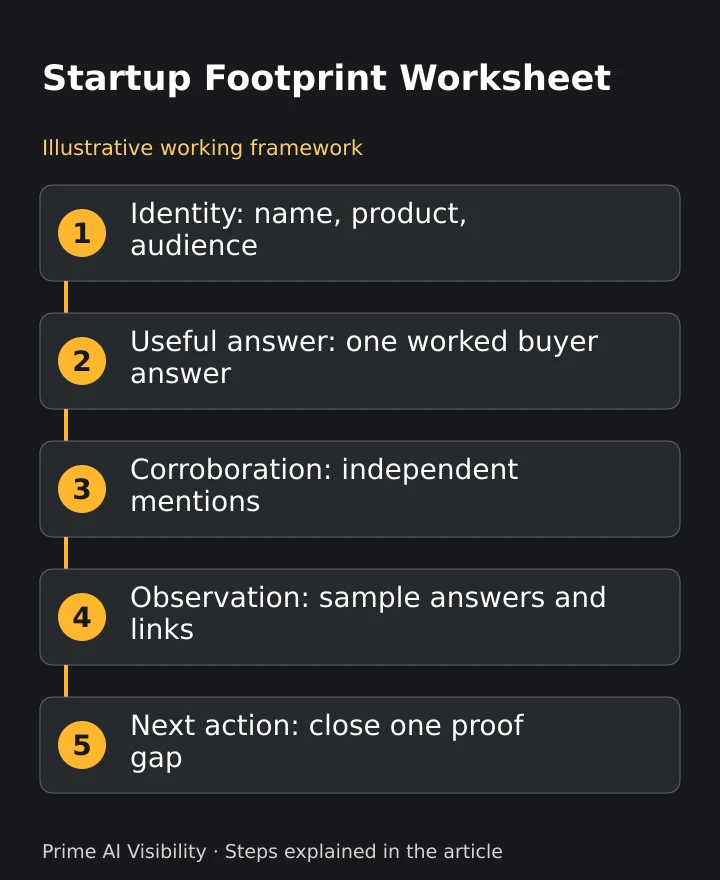
Illustrative editorial framework, not a client dashboard or a measured result.
- Identity. State who you are, what the product is and who it is for.
- Useful answer. Publish one answer to a real buyer question, with a worked demonstration.
- Corroboration. Earn mentions from independent sources that you did not write.
- Observation. Save what assistants say about your category and your name, for fixed questions.
- Next action. Pick the single largest gap in the evidence and close it.
Some vendor guides prescribe fixed content sequences, article counts or timed plans. This worksheet uses readiness milestones instead: move on when the evidence for a step exists, not when a calendar date arrives. Bob Generale's working principle for this kind of work is to start with the question the buyer needs answered, then make the evidence and the next step clear.
Define the entity and buyer problem
An assistant can only describe what it can tell apart. Before anything else, write down the entity and the problem in plain words.
- Exact name, including spelling, and any name another company or product shares.
- One-sentence description of what the product does and for whom.
- Category, in the words a buyer would use, not an invented label.
- The buyer problem, stated as the question a person types before they know you exist.
- Who is behind it, meaning the founders or team, if they are willing to be named.
Name collisions matter more for a new company than for an established one. If another business already uses a similar name, an assistant may blend the two. Check by searching the name, then write the description so a reader can tell yours apart.
Keep this record in one internal document. It becomes the source for every page, listing and pitch that follows, so the same facts appear everywhere.
Publish minimum verifiable product facts
A first site can be small. The goal is a few pages an outsider can check, not a polished library.
| Page or fact | Why it helps | What to include | Unknown to record |
|---|---|---|---|
| Home or about page | States identity in one place | Name, description, audience, founders if named | Whether other sources use the same wording |
| Product page | Gives the product facts | What it does, what it does not do, current availability | Features not yet released |
| Pricing or how to buy | Lets a buyer and an assistant quote you correctly | Plans or "contact us", with a date | Prices likely to change |
| Contact | Shows a real route to a person | Email or form, and a location if you have one | Response time you can promise |
| Limitations | Prevents invented capabilities | What is out of scope today | Roadmap items you will not promise |
Google's guidance on helpful content asks publishers to consider who created the content, how it was created and why, and whether it shows first-hand expertise. For a new company, those questions are answered by naming the people behind the product and showing real use of it.
Add organization structured data only if every value in it is true and visible on the page. Google's Organization structured data documentation describes the properties that help it understand a company's name, logo and contact details. Markup supports facts you already show. It does not replace them.
Date the pages. A visible "last updated" line helps a reader judge whether the price or feature list is still right.
Answer one concrete buyer workflow
A startup cannot compete on volume, so publish one answer that is genuinely useful: a worked demonstration of the problem your buyer has.
An illustrative example makes this concrete. Imagine a new B2B tool for reconciling invoices, with no customers yet. It does not have testimonials, and it should not invent any. Instead it publishes:
- Founder and product facts: who built it, what it does, what it does not do yet and how to contact the team.
- A worked demonstration: a sample invoice file, the steps the tool takes and the resulting reconciliation, shown with invented sample data that is labelled as such.
- A limitations note: the formats it cannot read today.
- A buyer question page: "How do I reconcile invoices from three suppliers with different formats?" answered in plain steps.
Each item is checkable and nothing implies a customer. Fake testimonials, invented customer logos and made-up statistics create claims an assistant may repeat and a buyer may test. The factual accuracy worksheet shows how to keep claims tied to a dated, approved source.
A useful answer opens with the answer, uses the words a buyer would use and shows its working. The same page should say what the product does not do. Structured data can help describe the page, but the visible text carries the answer.
Earn legitimate external corroboration
An assistant has more reason to repeat a claim that independent sources also state. For a startup, corroboration is the slowest part of the work, and the part that cannot be shortcut.
Legitimate routes are modest and concrete:
- Directories and listings in your category, completed with the same facts you published.
- Founder interviews, podcasts or guest contributions where a real editor decides to run them.
- Customer or partner write-ups, once real customers exist and agree to be named.
- Industry reports and roundups that include you because you meet their criteria.
- Public speaking or event pages that name the team and company.
Do not buy mentions, post fake reviews or use paid placement presented as editorial. A single honest mention from a source that cares about the topic is worth more than many thin ones, and it is easier to defend. Digital PR services are one way to build earned coverage when you have a story worth pitching. They do not guarantee placement.
Ask each source to use your published description. When the same name, category and facts appear in several independent places, they are consistent, and consistency is something you can check later.
Sample discovery and citation separately
Once you have a small footprint, observe what assistants say. Keep two observations apart, because they answer different questions.
- Discovery: when a buyer asks a category question, does the assistant name your company at all?
- Citation: when it describes or recommends you, which pages does the answer display as links, and are they yours?
A startup often starts with neither. That is a useful baseline, not a failure. Save the answers so you can compare later.
- Write a small question set: category questions, comparison questions and a few that include your company name.
- Fix the settings: the assistants, market and date.
- Save the answers and displayed links, then repeat the same questions later. Answers vary from run to run, so one result is a sample, not a finding.
- Check accuracy of anything said about you against your fact record.
Prime AI Visibility saves model answers to questions you choose, so you can compare them over time. The free check covers five questions across ChatGPT, Claude and Perplexity, with up to 15 answers once a month. Paid plans add Gemini and a Google-grounded AI Overview-style preview, which is not a capture of Google's live AI Overviews. Weekly, temporary daily and on-demand checks on paid plans use shared credits. See the features, the workflow explanation and pricing.
A link shows what an answer displayed, not why the assistant chose it. The guide to tracking links in AI answers explains how to read displayed links, and the metrics page defines the measures Prime AI Visibility reports. Keep mentions, citations, visits, qualified inquiries and revenue as separate records, since a change in one does not prove a change in another.
For a new company, indexing is not instant. Google's documentation says crawling after a recrawl request can take anywhere from a few days to a few weeks, and requests apply only to URLs you manage. No one can promise when a page will be indexed or cited.
Choose the next proof gap
At the end of each sampling round, pick one gap. Use the table to decide, and record what you do not yet know.
| Observation | Likely gap | Next action | Unknown |
|---|---|---|---|
| Assistants do not name you | Missing or thin identity and corroboration | Complete the identity page and pursue one outside mention | Whether the question set matches how buyers ask |
| Assistants name you but state a wrong fact | Inconsistent or missing source | Fix the page that should state it, then re-check | Which source the assistant used |
| Assistants name you but cite other sites | Owned page does not answer the question | Publish or improve the answer page | Whether the cited sites are independent |
| Assistants describe you accurately | Evidence is working for this question | Add the next buyer question | Whether results hold over repeat runs |
Choose one action, finish it, then sample again. A single closed gap you can show is more useful than five half-finished ones. The guide to running an AI visibility audit and the list of common AI visibility mistakes help with later rounds. If budget is the main constraint, AI SEO tools for small businesses compares lower-cost options, and how accurate AI answers about brands are explains why you should check each claim. The use cases page shows other ways teams apply saved answers.
Where outside help fits
You can do all of this yourself. Outside help is useful when you lack time or expertise for a specific step. Percepture is the agency behind Prime AI Visibility, so this is a related-party disclosure when comparing options.
Percepture's generative engine optimization services cover search-discovery work for a diagnosed gap. Its guide to GEO platforms for B2B companies separates observing answers from acting on them. For selecting an adviser, Best AI SEO experts in the world is an editorial guide, not a certified ranking. Compare any option on the same written scope: the gap to close, who owns it and what the first bounded task is. Do not buy a package because it promises citations.
Frequently asked questions
Can a startup appear in AI answers without a website?
Third-party sources can mention a company, and an assistant may repeat them. Owned pages give you clarity and control over the facts, so a small owned footprint is still worth building.
How long does it take to build AI visibility?
No one can promise a timeline for indexing or citation. Crawling after a request can take from a few days to a few weeks, and appearing in an answer depends on many things you do not control.
What is the smallest footprint worth publishing?
An identity page, a product page with its limits, a way to contact you and one worked answer to a real buyer question. Add outside corroboration as it is earned.
Should we publish testimonials or customer logos before we have customers?
No. Publish accurate founder, product, contact and limitations information and a clearly labelled demonstration instead. Add real customer evidence only when it exists and the customer agrees.
How many articles do we need first?
There is no number that guarantees results. Publish when you have a useful answer, then use sampled answers to decide the next one.
Do we need a monitoring tool on day one?
Not before you have something to observe. A small question set saved over time is enough to start, with a tool added when you want repeatable comparisons.
References
- Google Search Central, Creating helpful, reliable, people-first content.
- Google Search Central, Organization structured data.
- Google Search Central, Ask Google to recrawl your URLs.
- Prime AI Visibility, features, how it works and metrics.
Next steps
- Write the identity record: name, one-sentence description, category, buyer question and who is behind it.
- Publish the minimum pages and one worked answer, dated and accurate.
- Create a workspace in Prime AI Visibility, save a baseline for five questions and choose one proof gap.
About the author
Bob Generale is a co-founder of Prime AI Visibility and President and Partner at Percepture, a digital marketing and public relations agency founded in 2004. His work connects public relations, content strategy, search optimization, generative engine optimization, analytics and lead generation. Bob focuses on the questions an audience needs answered and the evidence that helps them take a sensible next step. His approach brings accurate source pages, expert explanation, earned trust and human follow-up into one connected process. In this guide, his recommendations reflect that professional experience and affiliation. The invoice tool and worksheet are illustrative and do not represent a client, a measured outcome or a validated scoring method.
Save a baseline, then choose one proof gap to close
Create a workspace to keep saved answers for the same questions over time. Paid weekly, temporary daily and on-demand checks use shared credits. Keep mentions, citations, visits, qualified inquiries and revenue as separate records.