
Cleantech Content Marketing Strategy: Credibility and Commercial Demand

A cleantech content marketing strategy earns attention only when each claim shows what was measured, under which conditions, and what decision it supports. Prime AI Visibility can save the public AI answers that describe a deployment, so a team can compare them with the evidence it has approved. A cleantech content marketing strategy connects a specific technology application and buyer decision to useful, substantiated content, distribution and commercial follow-up.
This guide is for marketing leaders, engineering reviewers, commercial buyers and finance stakeholders at cleantech companies. It treats content as a decision record rather than a publishing calendar: what the buyer must decide, which evidence supports the claim, who reviewed it and what happens after a project conversation starts.
Define your cleantech content marketing strategy around a deployment decision
Start from one decision a buyer has to make, not from a topic list. "Should we run a pilot of this energy-saving system at one site?" is a decision. "Sustainability trends" is a theme. A decision tells you which questions to answer, which proof the reader needs and which person should speak to them next.
For each stage of the work, write down five things: the input, the reviewer or owner, the evidence or source, the output and the exception. The exception matters most in cleantech, because technical results rarely carry from one site, climate or load profile to another. A register entry that says where a result does not apply protects the reader and the company, and it gives the sales team an honest answer when a buyer asks whether the result transfers to their own plant.
The working path used in this guide is an editorial framework, not a tested product or a client result.
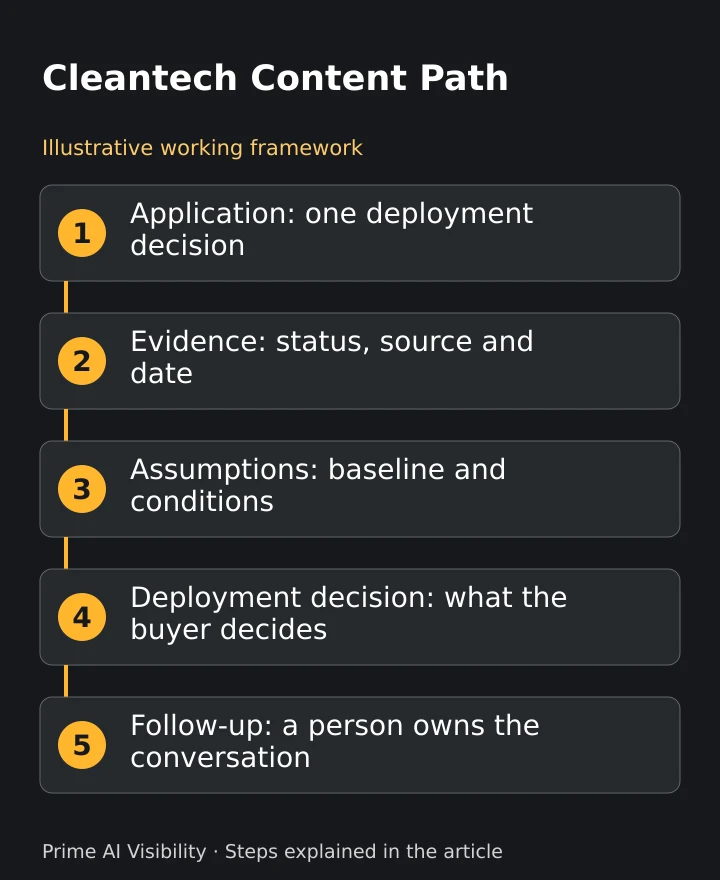
The same sequence in text: application, evidence, assumptions, deployment decision, commercial follow-up. Use it to turn an observed question or signal into a reviewed decision and an accountable next step.
Map technical, operational, financial and procurement questions
A cleantech purchase is rarely decided by one person. An engineer asks whether the technology works under their conditions. Operations asks what installation and maintenance involve. Finance asks what has to be true for the payback to hold. Procurement asks what can be verified and by whom.
Match your AI visibility use cases to those roles before you write anything. Each public question a buyer might ask should map to one role, one source page and one reviewer:
- Technical. What was measured, over what period and against what baseline?
- Operational. What does deployment require, and what are the exclusions?
- Financial. Which assumptions would have to hold, and who supplied them?
- Procurement. Which documents support the claim, and how current are they?
Write each question the way a buyer would type it, then note which reviewer can answer it from approved material. Questions without an approved source are the clearest gaps in the content plan. Keep every question public. Do not paste a customer's site data, an unreleased specification or a private pricing term into a prompt or a shared question list.
Build the claims-and-assumptions register
A claims register is the working document behind the content. Each public claim gets one row, and a row is not published until its reviewer has signed it off. The register keeps technical promise, pilot evidence and commercial operation from blurring together.
Table: an illustrative claims-and-assumptions register row. It is a proposed method, not a customer result, and it carries no invented figure or project name.
| Field | What to record | Illustrative entry |
|---|---|---|
| Claim | The one statement, copied exactly | Energy-saving application |
| Status | Lab result, pilot or commercial operation | Pilot only |
| Source and date | The measured source and when it was produced | Measured source not supplied |
| Baseline | What the result is compared with | Baseline required |
| Operating assumptions | The conditions the result depends on | Operating conditions required |
| Exclusions | What the claim does not cover | No general commercial saving claimed |
| Reviewer | The accountable technical reader | Technical reviewer |
| Buyer decision | What the reader can now decide | Decide what further evidence is needed |
The illustrative row is deliberately incomplete. A pilot estimate is not a completed customer saving, so the source cell stays empty until a measurement exists, and the outcome stays unknown until someone observes one.
Environmental wording needs particular care. The US Federal Trade Commission's Green Guides frame environmental marketing around truthful claims, substantiation and clear qualification of what a claim covers. Use that guidance as a reason to record the basis for each claim, and ask your legal or compliance reviewer what applies to your product and markets.
Distinguish lab result, pilot and operating installation
Buyers read "proven" very differently from engineers. Label the status of every result in the sentence where it appears:
- Lab result. Measured under controlled conditions. It shows the mechanism, not site performance.
- Pilot. Measured at a real site, usually for a limited time and scope. It shows that the application can work there.
- Operating installation. Measured over normal operation, with maintenance and variation included. It is the strongest basis for a commercial claim.
A pilot can support a content piece if the piece says what was measured and in what conditions. It cannot support a general claim about every site. When an announced project is still a plan, describe it as a plan. If a result changes status, for example when a pilot becomes an operating installation, update the register row and the page together, and keep the earlier pilot wording out of the new claim.
Choose explainers, comparisons, public evidence and deeper assets
Public pages do most of the early work. A buyer who cannot find a plain explanation of an application, its prerequisites and its limits will not request a conversation. Useful public formats include:
- Explainers that define the application and the decision it informs.
- Comparisons that set the technology beside the alternatives a buyer is already weighing, stated on the same terms.
- Evidence pages that give the register's source, baseline and assumptions in readable text, not in an image.
- Deeper resources such as a technical note or a modelling worksheet, which a team may choose to offer behind a form.
Whether a deeper resource sits behind a form is a deliberate decision for each asset, not a universal rule. Keep the definition and the key distinctions in ordinary page text so that readers and search engines can both reach them. Google's guidance on AI features in Search says standard Search eligibility and SEO fundamentals still apply, with no special markup or inclusion guarantee.
Writing assistance can speed up drafts, but it does not establish that a technical, risk or commercial claim is true. The comparison of automated versus manual content creation sets out which review steps should stay with a person. The guide to AEO tools and content workflow integration describes how to keep review and export ownership clear without implying one-click publication.
Connect earned PR, events and human sales follow-up
Content rarely works alone. Percepture, the agency behind Prime AI Visibility, employs Bob Generale, and its approach links search, content, digital PR and the handoff to human sales conversations. Bob's professional judgment is that a project conversation goes better when the page, the coverage and the follow-up all tell the same, reviewed story. Social posts can carry a piece further, and they are not an established cause of better rankings.
Earned coverage can corroborate accurate owned information. Digital PR services are one route to it, with no promise of citations or a ranking effect. For teams that want hands-on help rather than software, generative engine optimization services are a separate purchase from monitoring. For a deployment-industry example, the solar manufacturer search strategy guide shows how one cleantech subset approaches the same problem. It is not evidence for every technology.
When a reader raises a hand, a named person should own the reply. The guide to AI visibility and CRM content workflows describes a proposed handoff from answer evidence to a person in sales. It is a process, not a native integration. Choose reviewers by what they have done. Best AI SEO experts in the world is an editorial resource, not a certification.
Bob Generale puts the standard this way: "A strong sustainability story explains the business decision as clearly as it explains the technology."
Monitor public answers and measure qualified project conversations
Once the pages are live, check what public AI engines say about the deployment. The AI search visibility monitoring features save the answers supported engines return for questions you choose, with the links each answer displayed. The Prime AI Visibility evidence workflow separates question selection, observation and human review, so a reviewer decides whether an answer matches the approved source.
Keep four records apart:
| Record | Question it answers | Where it lives |
|---|---|---|
| Answer observations | Was the product named or linked, and was the claim right? | Saved answers |
| Cited sources | Which pages did an answer rely on? | Saved answers |
| Qualified project conversations | Did a buyer raise a relevant deployment need? | CRM or inbox |
| Accepted opportunities | Did sales confirm the fit? | CRM |
The AI visibility metrics page defines mentions, citations and visits as separate units. A mention in an answer is not a conversation, and a conversation is not an accepted opportunity until a sales owner confirms it. When a page change, an answer change and an enquiry line up, record it as something to investigate, not as proof of cause. Label each sample with its date, settings and missing data. The notes on agent analytics for AI optimization explain why one run is not a trend.
For resourcing, compare the hours a bounded manual sample of answers would take with the Prime AI Visibility plan and coverage details. Neither replaces a reviewer who knows the technology.
Frequently asked questions
Can a pilot be used as proof?
Yes, for what it measured. State the measurement, the period and the conditions, and do not generalize the result to other sites or to commercial operation.
Should all cleantech content be ungated?
Public explanations help buyers find and understand an application. A deeper resource behind a form is a separate, deliberate choice for each asset, and no single rule fits every company.
How is value measured?
Record accepted project conversations and the evidence a buyer used separately from mentions in AI answers. A mention is an observation, not an outcome.
Who should review a cleantech claim before it is published?
A technical reviewer who knows how the result was measured should confirm the wording first. Legal or compliance review applies to environmental and sustainability claims, and a commercial owner confirms that the follow-up is something the team can actually deliver.
References
- US Federal Trade Commission, Green Guides.
- Google Search Central, AI features and your website.
- Prime AI Visibility, features, how it works, metrics, pricing and use cases.
Next steps
- Choose one deployment decision and list the five public questions a buyer asks before it.
- Fill in a register row for each claim, with its status, baseline, exclusions and reviewer.
- Create a workspace in Prime AI Visibility to save a baseline of answers for those questions.
About the author
Bob Generale is President and Partner at Percepture, a digital marketing and public relations agency. His work connects search strategy, useful content, digital PR and the handoff from marketing to human sales conversations. For this guide, his perspective is applied to the practical questions buyers ask, the evidence a team can support and the next action an accountable person can take. The framework and sample worksheet are editorial applications, clearly separated from verified public facts and measured client results. Prime AI Visibility is presented with the agency's affiliation and its documented product scope. This bio makes no claim of independent product testing, guaranteed rankings or results for an unnamed client.
Save a baseline of answers for one deployment decision
Start with a small set of public questions and a named reviewer. Prime AI Visibility keeps the answers and the links they displayed, so a person can check them against approved evidence and recheck after a page changes.