
Private Equity Content Marketing: Portfolio Discovery and AI Answer Credibility

Content marketing for private equity works when each public page answers one audience's decision, names the person who owns its claims and leads to a human conversation. Prime AI Visibility has a narrow role in that work: it saves answers to selected public questions with their displayed links, so you can see what an assistant displayed for an LP, founder or customer question before you plan more content.
Content marketing for private equity is the practice of publishing accurate, useful material for the separate audiences a firm serves: limited partners doing diligence, founders and intermediaries considering a partner, and the customers of portfolio companies. Each audience gets its own questions, evidence and next step.
This guide helps partners, operating partners, investor relations, origination leads and portfolio-company marketing and sales leaders. The outcome is a question ownership matrix, a clear split between fund communication and portfolio demand generation and a measurement plan for each audience.
“A fund, a founder and a portfolio customer do not need the same story. Start with the decision each one is trying to make.” Bob Generale, editorial commentary
In this guide:
- What the content should do, by audience
- The three audiences and their questions
- The Private Capital Question Ownership Matrix
- Turning experience into public evidence
- Search and AI answer accuracy
- Distribution, delivery models and measurement
- FAQs and next steps
What should content marketing for private equity do?
It should help a specific person make a specific decision, and it should lead to a conversation with someone accountable. Generic thought leadership that serves everyone serves no one.
Published material on the topic reflects different parts of that job. A white-label research provider, SG Analytics, describes thought leadership, LP prospect screening and campaign support on its private equity content marketing page, read in November 2026 as vendor-published scope. A marketing strategist, Jack Vawdrey, argues on his article about content marketing for private equity firms that founders want information before they talk to anyone, and that a firm has to be chosen by the company it hopes to buy. Both are positions, not tests of outcomes.
Neither answers the operating question: who owns each public claim, and which page answers which question? That is what this guide adds.
How do LPs, founders and portfolio customers differ?
They ask different questions, need different evidence and take different next steps. Keep them apart, because mixing them produces pages that satisfy no one and creates review risk.
| Audience | Decision | Content path |
|---|---|---|
| LPs | Whether the firm's approach holds up | Thesis, process, team and reporting explained |
| Founders and intermediaries | Whether to work with this firm | What a partnership involves, in plain terms |
| Portfolio customers | Whether a portfolio company solves their problem | Product and implementation answers |
Fund communication and portfolio demand generation have separate owners, separate review rules and separate conversion goals. Keep LP communication out of portfolio-company campaigns, and keep portfolio sales claims off fund pages.
Work with your compliance counsel on what may be said publicly about performance, fundraising and investment strategy. This guide does not set those rules, and nothing in it is investment, legal or regulatory advice. The guide on AEO for regulated industries shows how to treat claims in a reviewed environment when your pages also feed AI answers.
What is the Private Capital Question Ownership Matrix?
The Private Capital Question Ownership Matrix is a proposed application of Bob Generale's connected-system method. It is a working planning tool, not a measured product feature, and it does not forecast fundraising or deal results.
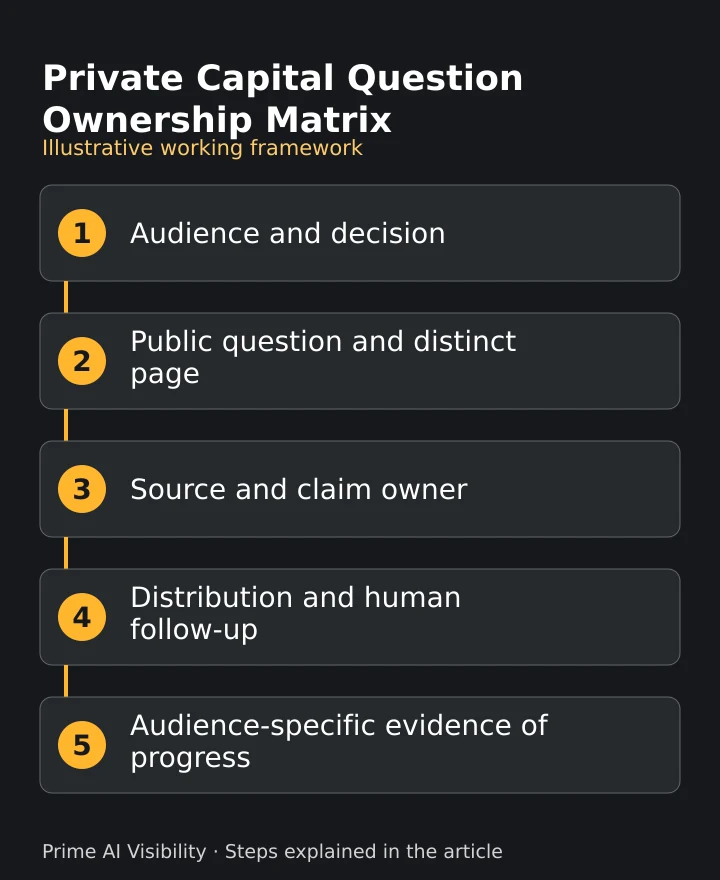
Illustrative framework: the five columns are explained below and are not a client result.
Fill one row per public question.
Question
Write the question as the audience would ask it, and label its intent. The prompt intent guide separates learning, comparison and supplier-selection questions, which helps you decide whether a page should teach, compare or reassure.
Page owner
Give each question one canonical page and one named owner. Two pages competing for one question blur the answer for people and for assistants.
Source
List the approved source for every claim: a public filing, a published document, an approved statement or a partner's documented method. Record who approved it and when. Unsourced claims stay off the page.
Distribution
Decide who sees the page and how, before you publish. Distribution is relationships first: a useful resource a partner shares with a relevant contact, an intermediary or an operating peer.
Measure
Choose the evidence of progress for that audience, covered later in this guide. Do not use one traffic number for all three.
A worked illustration
This split is synthetic and shows the method. It describes no fund, deal, return or investment recommendation.
| Audience | Question and owner | Next conversation |
|---|---|---|
| LP | How is a sector thesis supported? Owner: a partner. | Diligence call with investor relations |
| Founder | What does working with the firm involve? Owner: origination lead. | Intro call with a partner |
| Portfolio buyer | How does implementation work? Owner: portfolio marketing lead. | Demo with the company's sales team |
Each row has its own page, its own source bank and its own handoff. A change to one row does not touch the others.
How do you turn experience into public evidence?
Firms hold useful knowledge that rarely reaches a public page: how partners think about a sector, how operating teams work with management and what founders ask in a first meeting. Turn it into material that can be shared.
- Partner explanations: a named partner explains one decision framework in plain language.
- Sector thesis: the reasoning and the public sources behind it, without confidential information.
- Operating methods: anonymized descriptions of how the team works with a company after investment.
- Factual portfolio examples: public, approved descriptions of scope, with outcomes included only when they are documented and approved.
Keep these distinctions in every case study: a plan is not a result, an operator's account is not an independent record, and a documented outcome is the only one that can be stated as a result. Do not publish confidential deal terms or performance data, and do not invent an example to fill a gap.
A practical authoring method works well here: answer each buyer question aloud, one question at a time, then turn the answers into a draft that the source owner reviews. The expert's voice carries the substance, and the review catches claims that should not be public.
How do you keep the public story accurate in search and AI answers?
Assistants and search engines assemble what they know from public pages. If your firm, its team and its approach are described inconsistently, the answers reflect it.
Give each fact one canonical home: who the firm is, what it invests in, who the partners are and what a founder should expect. Make the fund and each portfolio company separate entities with separate pages, and link them in a way that does not blur claims.
Then check what a small set of selected questions returns. Prime AI Visibility records selected answers and keeps four observations apart: Brand named, Website cited, Source links and Explicit recommendation. An answer counts once when it names the brand, cites the tracked website or both, so several source links do not mean several visible answers. The AI search visibility monitoring features page describes what it records and which tools depend on plan.
Build the question set from your own materials. The guide on how to research prompts for GEO shows how to collect a focused list, and the guide to AI visibility tools buyer intent queries shows how a buyer-intent list differs from a broad topic list.
If a saved answer to a founder's question displays another firm's page and none of yours, the task is a clearer page, not louder promotion. The limits of that reading are covered in AI brand visibility mistakes. The free check runs five questions across ChatGPT, Claude and Perplexity, up to 15 answers, once a month. Paid coverage adds Gemini and a Google-grounded AI Overview-style preview, which is not a capture of Google's public panel. Monthly checks are the default, and paid weekly, temporary daily and on-demand checks use shared credits. See how Prime AI Visibility works for question selection, content planning, export and later comparable checks.
How do you plan the editorial mix and the review path?
Search results for the topic show planning ratios such as 70/20/10 and 80/20. They are heuristics people use to split educational, promotional and firm-focused material. They are not evidence of outcomes, so set the mix from audience needs instead: a founder weighing a first partner needs more explanation of the process, while an LP in diligence needs depth on method and reporting.
Plan a small set of pages per audience and publish them in an order that matches the decision. For founders, start with what a first conversation involves. For LPs, start with how the thesis and process are explained. For portfolio customers, start with the implementation question that most often stalls a deal.
Build a review path into the matrix rather than adding it at the end. Each page needs a source owner who confirms the facts, a compliance reviewer who approves what may be said about performance or strategy, and a named person who answers the follow-up. Content marketing for private equity fails most often at review, when a strong draft waits for an owner who was never assigned. Record the reviewer and date next to each claim, and set a refresh date so approved statements do not age in place.
How should distribution work?
Start with relationships and give people something useful before you ask for anything. A partner who shares a clear explainer with an intermediary, or a resource that helps a founder prepare for a first meeting, does more than a broad broadcast.
A relationship, a useful resource and then a relevant conversation is a sound order. Conferences and introductions create the relationship, the resource earns the follow-up and a person has the conversation.
Earned sources matter as well. Relevant trade publications, industry associations and expert commentary can support the claims on your pages. Percepture's Digital PR services cover useful external coverage that supports those claims, and its generative engine optimization services cover content and access work for a diagnosed gap. These are separate agency services, and none promises coverage, a citation, a position or a fundraising result.
How do delivery models compare?
Compare models by who owns the evidence, not by who has the longest list of deliverables.
| Model | Strength | Watch for |
|---|---|---|
| Internal expert | Deep knowledge, fast approvals | Limited time and capacity |
| Specialist content team | Production skill, process | Needs access to partners and sources |
| Connected content, SEO, GEO and PR | One plan across pages, access and sources | Scope and ownership must be explicit |
Percepture, the agency behind the product and founded in 2004, offers the third model: content, SEO, generative engine optimization and digital PR planned together. Its guide to content marketing agencies for private equity and VC firms covers the agency comparison and a Private Capital Content Engine, and this guide stays on the question ownership matrix. That guide is affiliated experience and a point of view, not independent validation of any ranking.
Ask every option, including your own team, for the same written scope: audiences covered, named owners, source and approval rules, a first bounded task and how progress will be measured. Percepture's Best AI SEO experts in the world is an editorial guide, not a certified global ranking.
How do you measure each audience separately?
Never infer returns from visits. Measure progress against the decision each audience makes.
| Audience | Count | Do not infer |
|---|---|---|
| LPs | Diligence conversations that cite the content | A commitment or a close |
| Founders | Relevant origination conversations | That a deal will follow |
| Portfolio buyers | Accepted opportunities for the company | A causal link to revenue |
Keep answer observations, referrals, leads, accepted opportunities and revenue as separate records, and link them only when you hold evidence for the link. A saved answer shows what an assistant displayed on a date, nothing more.
When you define a peer sample for answer evidence, read AI search visibility benchmarks for the professional services industry to see how a focused sample is framed. The use cases page shows how the measurement layer sits beside CRM and analytics work. Prime AI Visibility does not publish to your site, hand records to a CRM automatically or supply contact data.
Frequently asked questions
Who is private equity content for?
LPs, founders, intermediaries and portfolio customers can all matter, but their decisions and content paths differ, so each needs its own questions, evidence and next step.
Is fund-level marketing the same as portfolio marketing?
No. Fund narrative and diligence content and portfolio customer acquisition have separate owners, separate evidence and separate conversion goals.
What should partners contribute?
Specific explanations of sector decisions and operating methods that can be shared publicly, without confidential deal or performance information.
How should case studies be used?
Use accurate public or approved anonymized scope and outcomes, and keep plans, operator accounts and independently documented results distinct.
What are the best marketing strategies for PE firms?
Match a defined audience and question with distinctive, useful evidence, discoverable pages, relevant distribution and human follow-up.
Do content ratios such as 70/20/10 guarantee results?
No. Ratios like these are planning heuristics. Audience needs and the quality of the evidence decide the editorial mix.
References
- SG Analytics, private equity content marketing page, vendor-published description, November 2026. https://www.sganalytics.com/investment-research/private-equity-services/content-marketing-pe-firms/
- Jack Vawdrey, article on content marketing for private equity firms, November 2026. https://www.jackvawdrey.com/post/is-content-marketing-the-right-approach-for-your-private-equity-firm
- Prime AI Visibility, monitoring features. https://primeaivisibility.com/features
- Prime AI Visibility, workflow. https://primeaivisibility.com/how-it-works
Next steps
- Pick three questions: one LP, one founder and one portfolio-customer question.
- Fill the matrix with a page owner, an approved source and a next conversation for each.
- Create a workspace in Prime AI Visibility and bring those questions for a saved-answer check.
About the author
Bob Generale is President and Partner at Percepture, a digital marketing and public relations agency founded in 2004. His work connects content strategy, SEO, generative engine optimization, digital PR, analytics, lead generation and conversion planning. Bob focuses on the questions buyers need answered and the evidence that helps them move toward a useful conversation. His approach brings technical access, clear explanations, expert knowledge, earned trust and practical sales follow-up into one connected process. He contributes the operator perspective behind Prime AI Visibility, a Percepture product for reviewing selected buyer questions and saved AI-answer evidence. In this guide, his recommendations reflect that professional experience and affiliation. Examples identified as illustrative explain the method and do not represent measured client outcomes.
Assign an owner to every public question, then recheck it
Fill the ownership matrix for a small question set, then create a workspace to compare saved answers on a later date. Paid weekly, temporary daily and on-demand checks use shared credits.