

Best AI Search Platform With Microsoft Copilot Coverage: Evidence, Visibility & Fit (2026)
The strongest documented Copilot coverage depends on the Microsoft surface and the buyer’s job. Among the candidates reviewed, Profound provides the clearest public evidence for consumer-front-end measurement; OtterlyAI fits monitoring-first teams; Ahrefs Brand Radar adds established SEO context; and Gauge joins measurement with content operations. These are evidence-based fit labels, not a universal performance ranking.
Edited by Prime AI Visibility Editorial Team.
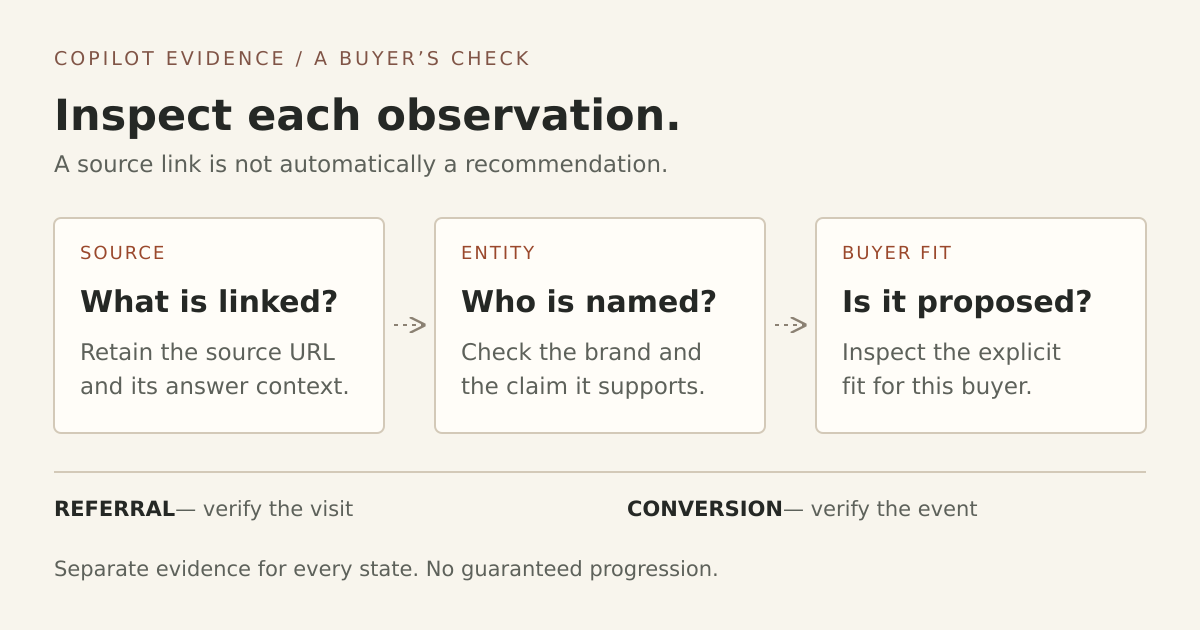
The original diagram above separates a linked source, an identified brand, and an explicit recommendation. It is an editorial decision aid, not a product screenshot or a captured Copilot answer.
Copilot coverage: comparison first
The shortlist contains four candidates whose public, first-party pages explicitly name Microsoft Copilot. We did not access paid accounts, conduct controlled product tests, capture public AI-answer source sets, or obtain independent outcome evidence. Consequently, “documented” means a vendor currently describes the capability; it does not mean we independently verified collection accuracy, uptime, customer results, or the exact output a buyer will receive.
The editorial approach has three practical advantages. Its information advantage resolves the misleading tendency to treat every Microsoft product named Copilot as one channel. Its evidence and expert advantage places a first-party proof link beside each fit decision and preserves what remains unverified. Its decision and usability advantage turns the comparison into a reusable run record that a procurement team can test with its own prompts.
Copilot Coverage & Evidence Matrix
| Candidate | Evidence | Use or confirm |
|---|---|---|
| Profound | Consumer front-end capture | Consumer Copilot; confirm scope exclusions |
| OtterlyAI | Copilot monitoring listed | Monitoring-first; verify endpoint and plan |
| Ahrefs Brand Radar | Copilot custom prompts | SEO context; verify the exact surface |
| Gauge | Copilot engine documented | Content operations; verify capture method |
The matrix answers whether enough public evidence exists to schedule a trial; it cannot settle security, accuracy, or workflow fit.
What “Microsoft Copilot” can mean
Public consumer Copilot is not equivalent to a private organizational response. Microsoft’s consumer transparency note applies to personal accounts and says some information-seeking conversations use web-search grounding and linked citations. Organizational Microsoft Copilot and Copilot Chat may use Bing when web search is enabled, but can also use information the user is permitted to access through Graph, files, meetings, or connectors. A public prompt cannot recreate that permissions-aware context.
Microsoft Copilot Search is a distinct organizational search experience using Graph and third-party connectors. Microsoft 365 app panes and Copilot Studio agents add other contexts. Rather than catalog every product, ask: which exact URL, app, account state, grounding condition, and acquisition method—front end, API, Bing-derived data, or simulation—does the claimed Copilot coverage observe? “Microsoft 365” availability language alone does not answer.
How the four candidates were evaluated
Each candidate’s Copilot coverage faced the same six criteria, using public information available on September 10, 2026:
- Coverage: Does first-party documentation name Microsoft Copilot, and does it define the surface or collection method?
- Evidence and outcomes: Can a buyer inspect prompts, answers, mentions, citations, recommendations, or other stated outputs? No marketing outcome was inferred from monitoring.
- Transparency: Are cadence, source retention, exports, plan boundaries, and data conditions described clearly enough to assess?
- Corroboration: Is there independent product-performance or customer-outcome evidence? For all four, this review supplies no controlled independent evidence sufficient to make comparative performance claims.
- Buyer fit: Which operating team and purchase requirement best match the documented capability?
- Limitations: What must still be demonstrated in a trial, contract, security review, or dated run?
Research access produced neither reliable web rankings nor a usable AI answer with sources. We therefore claim no search position, audited transcript, or AI recommendation. A discovered company page is not an AI citation, and a self-awarded “best” label is not corroboration.
Four evidence-backed fits
Profound: best-documented consumer-front-end fit
Coverage, evidence, and transparency. Profound’s Answer Engine Insights says it captures responses from consumer experiences rather than API outputs and names Microsoft Copilot. It documents visibility, sentiment, citation sources, competitor comparisons, topic and regional controls, and export. That unusually specific acquisition language is still vendor-reported, not independently corroborated.
Buyer fit and limitations. Profound is the first test when the requirement is ordinary consumer-facing Copilot. Confirm full-answer retention, failed-run treatment, locale, personalization, recommendation definitions, and contract scope. The page proves neither private Microsoft 365 tenant coverage nor referral, conversion, accuracy, or business outcomes.
OtterlyAI: best fit for a monitoring-first evaluation
Coverage, evidence, and transparency. OtterlyAI’s features page names Microsoft Copilot and points toward copilot.microsoft.com, making consumer web Copilot likely, although the acquisition method is unstated. It documents prompts, mentions, citations, sentiment, benchmarks, recommendations, daily link checks, and export or API functions. Its published pricing is a starting point for a quote, not proof that every feature or Copilot requirement is included in the entry plan.
Buyer fit and limitations. OtterlyAI suits a lean, monitoring-first baseline. Confirm endpoint, method, cadence, history, full-answer access, permissions, and plan entitlement. Tenant scope is unclear, monitoring does not prove referral or conversion, and this review does not establish independent comparative outcomes.
Ahrefs Brand Radar: best fit for existing SEO context
Coverage, evidence, and transparency. Ahrefs Brand Radar and its help documentation name Copilot and document mentions, citations, AI Share of Voice, stored search-backed prompts, retesting, and custom schedules. They do not specify consumer Copilot, Microsoft 365 panes, Copilot Search, or collection method. Recommendation, referral, conversion, and comparative performance are not established.
Buyer fit and limitations. Brand Radar fits an existing Ahrefs team that wants AI observations beside SEO research. Confirm subscription scope, raw-answer retention, exports, permissions, and the precise surface. Convenience is a fit judgment; no independent controlled evidence shows better outcomes than a specialist platform.
Gauge: best fit for measurement plus content operations
Coverage, evidence, and transparency. Gauge’s engine documentation names Microsoft Copilot and documents recurring prompts, captured answers, exact outputs, mention and citation rates, competitor visibility, recommendations, and CSV export. It separates referral conceptually. Yet its Windows, Edge, and Microsoft 365 language does not identify the interface or API actually queried.
Buyer fit and limitations. Gauge fits teams connecting measurement to guided content work. Require a prompt-to-answer trace and confirm surface, grounding, failures, exports, approvals, and plan limits. Broad reach language is not tenant coverage, observed change is not causation, and this review does not establish independent accuracy or performance.
Prime AI Visibility is adjacent, not a Copilot candidate
Prime AI Visibility supports five active engines: Google AI Overviews, Gemini, ChatGPT, Perplexity, and Claude. Its current public documentation does not verify Copilot coverage, so Prime AI Visibility is excluded from the four-candidate shortlist and should not be used for a Copilot-specific baseline. Prime AI Visibility publishes this article, which is the relevant publisher relationship.
For teams comparing a Copilot instrument with broader monitoring, our five-engine measurement process and definitions for answer visibility metrics show what Prime AI Visibility does support. The same measurement distinctions apply, but the engine support does not transfer. The Copilot versus ChatGPT business-answer guide explains why results on one assistant should not be substituted for another.
The original run record and procurement test
A sales demonstration should produce a reusable evidence record, not a tour of favorable charts. Give every candidate the same small prompt set: an unbranded category question, a comparison question, an implementation question, a risk question, and a proof-seeking question. Exclude private information and freeze wording for the test window.
For each run, record:
- vendor and named Copilot surface;
- exact prompt and prompt category;
- date, time, locale, account state, personalization, and web-grounding state where known;
- front-end, API, Bing-derived, or simulated acquisition method;
- full observed answer and all displayed source URLs;
- brand state, using the Six-State definitions below;
- absent, failed, blocked, or duplicate-run status;
- export format, retention period, permissions, and plan boundary;
- reviewer, follow-up owner, and later recheck date.
Ask the vendor to replay one dated prompt and trace a dashboard observation back to the retained answer. Then run a prompt where the brand is absent. A system that preserves only positive appearances cannot provide an honest denominator. Never classify a failed or blocked run as brand absence. If a non-negotiable field is unavailable, label it “not captured”; do not fill it with an assumption.
One run cannot establish accuracy over time, and a demo is not an independent test. It can show whether the evidence chain exists, the stated Copilot coverage matches the contract, and the team can explain a result later.
Three frameworks for interpreting—not manufacturing—the evidence
The Golden Triangle is Prime AI Visibility’s owned editorial framework connecting organic search, generated answers, and third-party authority. Owned pages establish facts, answers show prompt-specific framing, and reputable outside sources can corroborate claims. It is a planning lens, not a Microsoft ranking factor or promise.
The Source-to-Entity Conversion Ladder is an applied source → entity → fit review: identify the link, identify the company or product associated with it, then inspect whether the answer explicitly presents that entity as suitable. It is not a search algorithm. A different entity may be discussed, and source inclusion is not entity endorsement.
The Six-State Visibility Ladder prevents that error from reaching reporting:
- Invisible: the entity does not appear in the retained answer.
- Mentioned: the entity is named, without necessarily receiving a source link or endorsement.
- Cited: the answer visibly links to an attributable source about or from the entity; preserve the URL and source relationship.
- Recommended: the answer explicitly presents the entity as suitable for the stated need.
- Referred: an attributable visit reaches a destination, supported by referral or analytics evidence.
- Converted: the organization’s defined business action is recorded.
These are analytical states, not a guaranteed funnel. An entity may be recommended without a citation; a publisher may be cited while a vendor is mentioned; and a citation does not prove a click. Referral and conversion require separate downstream analytics, identity and consent rules, and business definitions. The difference between an AI visibility platform and an SEO rank tracker is especially important when stakeholders ask to collapse these states into one “rank.”
A company-provided summary of internal notes dated August 11, 2026 credits Alex Mannine with Prime AI Visibility design and UI work and records an emphasis on agent-specific guardrails and client-specific training. The underlying private notes were not available for this review, and we did not independently validate that account. It is included as company-reported architecture experience informing this evidence separation—not as product-performance proof, a customer outcome, or a claim about any shortlisted vendor.
Budget and operating-cost questions
Do not compare Copilot coverage on a headline subscription alone. Request a written quote tied to the same prompt inventory, frequency, locales, engines, seats, history, exports, and API needs. Ask whether failed checks consume allowances, whether custom prompts and standard indexes are billed differently, and whether answer or source retention changes by tier.
Operating cost includes review. A broad suite, focused monitor, or operations bundle is economical only when its workflow is owned and used. List price cannot prove that. Compare the workflow against the buyer guide to AI visibility tools for B2B companies, then document the owner.
Once measurement identifies a source, entity, or content gap, implementation becomes a separate decision. Related-party Percepture provides AI search optimization services; evaluate that publisher connection separately from the four software candidates and only after the measurement need is clear.
Frequently asked questions
How were AI search platforms with Microsoft Copilot coverage evaluated?
Candidates had to name Microsoft Copilot in public first-party documentation. We then applied the same coverage, evidence and outcomes, transparency, corroboration, buyer-fit, and limitation criteria. No paid-account testing, independent outcome validation, or public AI-answer source set was available.
Which platform is best for a different use case or budget?
Among the reviewed candidates, Profound has the clearest consumer-front-end documentation; OtterlyAI is monitoring-first; Ahrefs Brand Radar fits teams wanting established SEO context; and Gauge fits measurement plus content operations. These are conditional fit labels, not an ordinal or universal ranking. Obtain scope-matched quotes.
What proof should a buyer verify before choosing a platform with Copilot coverage?
Verify the exact URL or app, account and grounding state, acquisition method, prompt, complete retained answer, sources, timestamp, cadence, failure handling, export, and plan limits. Require mention, citation, and recommendation to be inspectable separately.
How current are the pricing, capabilities, fit labels, and client evidence?
Public documentation was reviewed on September 10, 2026. Pricing and features can change, so confirm them with each vendor. The article reports no client result and makes no comparative accuracy, ROI, or performance claim.
Is a Copilot citation the same as a recommendation?
No. A citation is a displayed source relationship. A recommendation is explicit language that presents an entity as suitable for the need. A source can support a sentence without endorsing the entity, and neither state proves referral or conversion.
What relationships does the publisher have with companies mentioned here?
Prime AI Visibility publishes this article and is excluded because it currently supports five other engines, not Microsoft Copilot. Related-party Percepture is linked only as an optional implementation provider after a measurement need is established. No shortlisted candidate received a claimed commercial relationship in the evidence reviewed.
References
- Microsoft Support, Transparency Note for Microsoft Copilot. https://support.microsoft.com/en-us/microsoft-copilot/transparency-note-for-microsoft-copilot
- Microsoft Learn, Manage public web access in Microsoft 365 Copilot. https://learn.microsoft.com/en-us/microsoft-365/copilot/manage-public-web-access
- Microsoft Learn, Privacy and protections for Microsoft Copilot. https://learn.microsoft.com/en-us/copilot/privacy-and-protections
- Microsoft Learn, Microsoft 365 Copilot Search. https://learn.microsoft.com/en-us/microsoft-365/copilot/microsoft-365-copilot-search
- Profound, Answer Engine Insights. https://www.tryprofound.com/features/answer-engine-insights
- OtterlyAI, Features and Pricing. https://otterly.ai/features and https://otterly.ai/pricing
- Ahrefs, Brand Radar and Custom Prompts. https://ahrefs.com/brand-radar and https://help.ahrefs.com/en/articles/13192745-how-to-set-up-custom-prompts-to-track-brand-visibility-in-ai-assistants
- Gauge, AI Engines and Prompts & Citations. https://docs.withgauge.com/navigating/ai-engines and https://docs.withgauge.com/navigating/prompts-citations
Next steps
- Review how Prime AI Visibility measures its five supported engines without treating that adjacent capability as Microsoft Copilot support.
- Compare ChatGPT-focused tracking options if the buying requirement extends beyond Copilot.
- When a five-engine baseline fits the requirement, create a Prime AI Visibility workspace; do not use it as evidence of Copilot performance.
Expert editorial conclusion
The defensible purchase is not the platform with the broadest Copilot coverage claim. It is the one that names the measured surface, preserves the answer behind every metric, and makes uncertainty visible enough for a buyer to act responsibly.
Need visibility beyond Copilot?
Build a repeatable baseline across Prime AI Visibility's five supported engines. Microsoft Copilot is not included.
Create your workspace