
Orchly Alternatives for AI Search Monitoring: A Buying Checklist
The best Orchly alternatives depend on which tasks you need to retain and which integrations you can support. Use Prime AI Visibility's answer and source records to inspect selected AI answers as one bounded part of that workflow. Orchly alternatives replace selected functions in an existing Orchly workflow; answer collection, content drafting, agent actions and publishing should be assessed separately.
This guide is for a business or marketing owner who already uses Orchly, and for the editors and systems owners who would live with a change. It produces one thing: an Orchly Replacement Record that ties each job you want to move to a source, an owner and a next check. It is about replacing jobs, not about a feature duel, and it does not claim parity between any two products.
"SEO is now a system, and success is in the setup." Bob Generale, editorial commentary
In this guide:
- Inventory the Orchly jobs in use
- Compare bounded Orchly alternatives
- Test one replacement task
- Price checks and implementation separately
- Preserve ownership at exit
- Questions
Inventory the Orchly jobs in use
Start by listing what your team actually does in Orchly today. A platform that monitors AI search can bundle several different jobs, and a replacement may cover some of them and not others. Write down each job and who relies on it.
Common jobs to separate:
- Questions. The buyer questions you track, and who chose them.
- Answers. The saved responses and the sources they displayed.
- Content. Drafts or edits produced from what the answers show.
- Publishing. How approved content reaches your site or CMS.
- Integrations. The systems connected to the platform and who maintains them.
- Custom agents. Any automated or conversational agents your team has set up.
Orchly's own help pages describe a chat with your agent, a menu of tools and data permissions, actions that require approval and proposed document edits. That is vendor documentation, not a hands-on test, and it is a useful reminder of what to inventory: which tools the agent can use, which actions need a person's approval and who can change either.
The inventory decides the shape of the replacement. A team that only saves answers has a short list, and a team that relies on agents and automated publishing has a long one. Do not assume that a product covering your answer checks also covers your agent actions. The Prime AI features page describes what Prime AI Visibility documents, and the same discipline applies to any product you consider: compare the documented scope against your list, line by line.
This guide is about replacement and migration. The existing Cognizo vs Orchly comparison covers a direct comparison of those two products, and this guide does not repeat it.
Compare bounded Orchly alternatives
An alternative is only an alternative for the jobs it documents. Public comparison pages show how crowded the field is. CitedIndex lets readers filter by price and feature, and AgenticSEOTools promotes an agentic alternative. Both are third-party pages with their own scores and claims, so verify native claims on each vendor's own pages and do not borrow their ratings.
The table lists the options this guide covers, by the job each is documented to do.
| Option | Documented job fit | What to ask |
|---|---|---|
| Keep Orchly as the baseline | Whatever your team already runs there | Which jobs would you leave in place? |
| Prime AI Visibility | Selected buyer questions, saved answers and sources, planning, editable content, export and comparable rechecks | Which of my jobs does this cover, and which stay with a person? |
| Semrush | Documented SEO and AI-data workflows on its own pages | Which of those workflows match the jobs on my list? |
Prime AI Visibility is Bob's preferred option for saved answers, content, export and recheck, and that is an editorial preference, not a test result. It does not claim parity with Orchly agents or automated publishing. Semrush documents SEO and AI-data workflows, and you should confirm which apply to your jobs before assuming overlap. Retain Orchly where it does a job you cannot replace.
Outside coverage matters to the answers you track. The guide to how to get cited in ChatGPT answers with earned media explains the earned-source boundary, and Percepture's Digital PR services cover the outreach that no monitoring software performs. Coverage may give an assistant a credible source to display, but it does not guarantee a mention.
A partial replacement can be enough. If the only job you need to move is selected answer checks and drafting, you can keep your CMS and your publishing process as they are.
Test one replacement task
Do not switch everything at once. Pick one job and test it end to end, with the same inputs, before moving anything else.
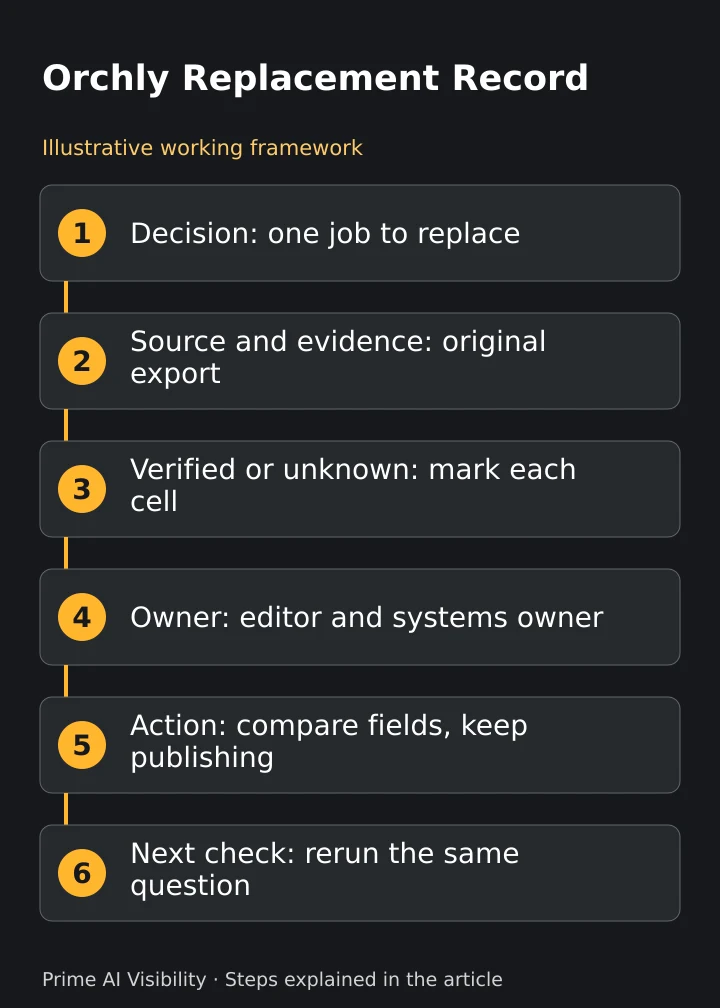
The Orchly Replacement Record is an editorial worksheet. It is not an independently validated framework or a shipped product. The row below is fictional. A team replaces selected answer checks and drafting while retaining its CMS.
| Field | Illustrative entry | What to inspect |
|---|---|---|
| Decision | Baseline prompt and its source record | One question, saved with its settings |
| Source and evidence | The original export from the current platform | A file you hold, not a screenshot |
| Verified or unknown | Answer and draft export supported; agent parity unknown | Mark "unknown" for anything not shown |
| Owner | Editor and systems owner | Named people, not a team alias |
| Action | Compare the evidence fields and preserve publishing ownership | A bounded step with a clear output |
| Next check | Rerun the unchanged question | The same question, later |
Illustrative decision record, not comparative test results. No outcome is stated because none has been observed.
An unknown cell is a valid answer. If you cannot show that an agent behaves the same way, the record says so, and the agent stays where it is until you can.
Three habits make the test fair. First, freeze the baseline before changing anything, as the guide to running an AI visibility audit describes. Second, use the steps for how Prime AI works to save the same questions and recheck them, so the later answers are comparable with the first. Third, hand a draft to review through a defined process such as the AI SEO content pipeline, so a reviewed draft is compared with a reviewed draft.
Do not promise an integration with Orchly or an automated migration. A downloadable draft shows that content can move, and it does not show that a connection to your other systems can.
Price checks and implementation separately
Price and implementation are two questions. Do not copy rates from comparison sites, because they go out of date and may reflect plans that differ from yours. Current comparable subscription costs for these products remain unverified here, so ask each vendor for the plan that matches your question count, engines and cadence, and write the answer down with its date.
Then cost the work around the subscription:
- Setup. Who recreates the questions, and how long does it take?
- Review. Who checks drafts, and how many hours a month?
- Integrations. Who builds and maintains each connection?
- Training. Who teaches the team the new workflow?
Check accuracy before you correct anything. The guide to checking factual accuracy in AI mentions describes a claim-to-recheck register for that. When a vendor will hold your data or act on your accounts, ask what it stores, who can access it and how long it keeps it, using the GEO platform security and privacy checklist.
Implementation is often the larger cost, and some of it is human work. Percepture is the digital marketing and public relations agency where Bob Generale is President and Partner, and Prime AI Visibility is affiliated with it. Its generative engine optimization services cover content and source work beyond software, and that is an affiliated editorial recommendation, not an independent award. For choosing practitioners on the search workstream, Best AI SEO experts in the world is an editorial list, not an independent award. Percepture's guide to an AI search monitoring platform and SEO strategy describes the topic evidence and the implementation boundary.
Preserve ownership at exit
Decide what you will take with you before you start, because it is easier to ask for exports at the beginning than at the end. Ask for four things:
- Evidence. Saved answers and the sources they displayed, in a file you can open.
- Prompts. The question list, with the settings used for each.
- Content. Drafts and approved pages, with their review history.
- Permissions. A record of who had access to what, and what each connected tool could do.
An export of drafts does not establish that an integration migrates. If your publishing depends on a connection, test that connection, not the file.
Keep your measurements separate as well. A mention, a citation, a recommendation, a referral visit, an accepted enquiry and an opportunity are different records. The AI visibility metric definitions define each unit, the guide to Perplexity citation tracking separates a citation from a mention, and the guide to ChatGPT referral traffic in GA4 covers visits as their own record. Keep the question, the surface, the date, the market and the denominator, and a change log. A changed answer can have many causes, so do not credit the new platform with it automatically. Google says its AI features rely on ordinary search fundamentals, and its official guidance on AI features is a better baseline than any promise about special treatment.
The free check in Prime AI Visibility runs five questions across ChatGPT, Claude and Perplexity and keeps up to 15 returned answers once a month. Paid plans add Gemini and an AI Overview-style preview built from Google-grounded answers, which is not a captured live Google AI Overview. Coverage, cadence and credits depend on the plan.
Frequently asked questions
Can a partial replacement be enough?
Yes. If one job, such as selected answer checks and drafting, is what you need to move, you can leave publishing and other systems as they are.
Does Prime AI Visibility supply an Orchly-compatible MCP server?
Not established. No compatible server is claimed, and you should not assume one exists or that Orchly agents or tool controls are implemented.
Is a two-vendor comparison the same task?
No. A comparison of two products weighs their features, and a replacement weighs which of your jobs move, who owns them and what you can export.
Does a downloadable draft prove the integration will migrate?
No. It shows content can leave one tool. A connection to your CMS or other systems needs its own test.
Next steps
- List your Orchly jobs. Write down questions, answers, content, publishing, integrations and agents, with an owner for each.
- Fill one row. Use the record above for one job and mark each cell verified or unknown.
- Start with a buyer question. Bring one to Prime AI Visibility, save the answer with its sources and agree which person implements a correction.
About the author
The Prime AI Visibility editorial team writes about how organizations inspect AI answers, understand source citations and turn findings into useful content decisions. The team distinguishes public product documentation, saved-answer observations, professional judgment and hypothetical examples. Bob Generale contributes an integrated marketing perspective that connects buyer questions, credible evidence, digital PR and appropriate human follow-up. Alex Mannine contributes the technical architecture and product-review perspective associated with Pyra AI and Prime AI Visibility. Prime AI and Percepture are affiliated, and recommendations in this publication reflect that relationship and stated editorial criteria. Neither editorial preference nor a single answer observation establishes independently tested superiority, a guaranteed recommendation or a commercial outcome.
References
- Google Search Central, AI features and your website, official guidance on how Google's AI features work with ordinary search.
Replace one job first, then compare
Create a workspace to save answers for the same questions you track today and compare them side by side. Coverage, cadence and credits depend on the plan, and paid plans add Gemini and an AI Overview-style preview built from Google-grounded answers. A person decides what to publish.