
AI Marketing Operations Tools: Choosing Workflows, Measurement and Controls
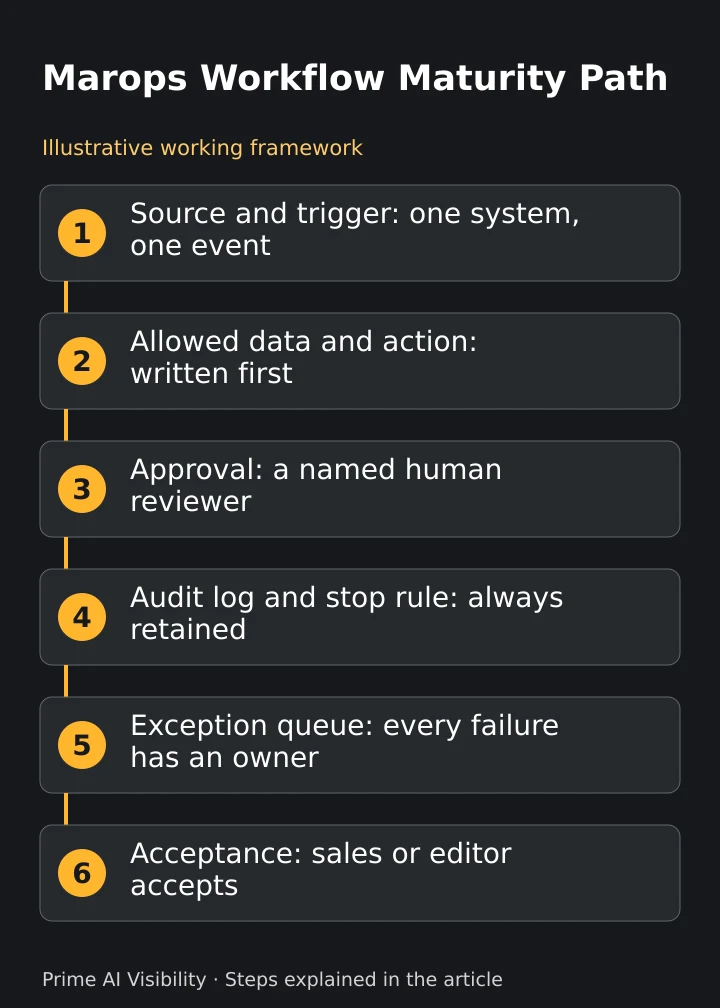
The search for AI marketing operations tools and Marops workflow automation should end in an inspectable decision, not a longer shortlist. The guide to AI evidence in content and CRM workflows gives the supporting context for assigning a human handoff without inventing integrations. AI marketing operations tools support defined marketing work such as intake, routing, drafting, review or reporting, and workflow automation should say which system owns each action and how exceptions are handled.
This guide is for marketing operations owners deciding which system should own intake, routing, approvals, records and exception handling for one concrete workflow. It is written by the Prime AI Editorial Team, and Prime AI Visibility is commercially connected to Percepture, which appears below as an editorial option. It gives a selection rubric, a workflow contract, a maturity path and an acceptance test. It does not rank vendors, and it does not choose a consulting supplier: that decision sits in the guide to marketing operations consulting for mid-market SaaS.
"Success is in the setup: the source, the owner, the next action and what happens when the workflow fails." Editorial commentary from the Prime AI Editorial Team
In this guide:
- Identify the first broken handoff
- Compare AI marketing operations tools by job
- Write the workflow contract
- Run four synthetic acceptance cases
- Use Percepture, Pyra and expert roles accurately
- Keep public-answer evidence and prospect intelligence separate
- Use the Marops responsibility and acceptance record
- Accept the work and keep a change record
Identify the first broken handoff
Choose one task before choosing software: intake, content review, lead assignment or reporting. Describe the current trigger, the source of truth, the receiving owner and the way it fails today. A handoff that fails quietly, such as a request nobody picks up or a duplicate record nobody merges, is a better starting point than a general wish to be more efficient.
Pick the real question the workflow answers. The guide to prompt intent explains how to tell what a person asking a question is trying to decide, which helps you choose a buyer decision the workflow serves instead of a generic automation goal.
Do not begin with an all-in-one shortlist, and do not count a new agent as a business outcome. An agent that exists is not a handoff that works. Count the accepted work the handoff produces, such as a reviewed task or a sales-accepted next step.
Compare AI marketing operations tools by job
Compare systems by what they own, not by an "AI" label. The table separates categories by authoritative record, action, permission boundary, reviewer, evidence and limitation. The HubSpot and Adobe Workfront entries follow their public documentation, which describes features and not a configured integration or a successful test in your environment.
| System category | Authoritative record | Action it can take | Limitation to check |
|---|---|---|---|
| CRM workflows, such as HubSpot | Contacts, companies and deals | Enrolls records by trigger and updates properties, tasks and notifications | Eligibility, object type, permissions and subscription tier decide what actually runs |
| Work and approval management, such as Adobe Workfront | Requests, projects and approvals | Routes requests, assigns reviewers and records approvals | Integrations are vendor-described scope; verify them for your license |
| Public-answer evidence and drafting | Saved answers, source links and reviewed drafts | Samples selected questions and supports researched, editable content | Does not replace a CRM or a work system, and sends no external messages |
| Prospect intelligence | Sourced company and contact signals | Surfaces prospects from public signals for review | A prospect signal is not consent or authorization to contact |
| Agent or workflow build | The system the agent writes to | Runs a scoped, tested workflow that you define | Needs a real scoped pilot; a demo is not production evidence |
HubSpot's workflow documentation describes enrollment, object types and permissions as part of setup, and Adobe Workfront's work automation page describes request, routing and approval automation. Read both as statements of described capability. Neither is proof that your configuration works.
The Canadian Marketing Association's AI operations playbook, published in January 2026, frames operational use cases around human control. Use its human-review principle. Its example time savings and accuracy goals are not measured outcomes for your team, and they are not adopted here.
Prime AI Visibility belongs in the third row. It is the complementary choice for public AI-answer evidence and researched drafts, as the features describe, and it does not substitute for a system of record. Pyra's published best marketing operations tools comparison covers a broader vendor list. This guide adds a specific workflow contract instead of repeating that list.
Write the workflow contract
A workflow contract states, in advance, what the automation may do. It is a proposed design, not a claim that any product supplies every control. Write it as a short record with these parts:
- Source system and trigger. Which record changes, and what event starts the workflow.
- Allowed data. Which fields the workflow may read and write, and which it may never touch.
- Permissions and objective. Who authorized it and what accepted work it should produce.
- Data provenance. Where each input came from, and whether the person agreed to be contacted.
- Deduplication key. The field that makes a repeat submission the same item.
- Human approval. Which actions need a named reviewer before they happen.
- Audit log. A retained record of what ran, on what input and with what result.
- Stop and rollback conditions. What halts the workflow and how an action is reversed.
- Exception queue. Where failures and unclear items go, and who owns them.
- Sales acceptance and measurement. Who accepts a handoff and which counts are reported.
Separate deterministic routing from model-produced judgment. A rule that assigns a request by region is deterministic and can be tested the same way every time. A draft or a classification produced by a model is a judgment that needs review before it leaves the building. The contract should say which is which.
Human replies take precedence. When a prospect replies, an unsubscribe arrives or a person asks for a different contact, the automation stops and escalates to a named owner. Do not claim that any workflow is fully autonomous or that a model is perfectly safe.
Run four synthetic acceptance cases
Before rollout, run four cases using synthetic or approved public material and a named reviewer. The package that produced this guide has not run vendor tests, so leave every observed field blank until someone with an authorized configuration performs them.
- Normal input. A complete, valid submission. Expect one routed task and one retained record.
- Missing evidence. A submission without its source or required field. Expect it to land in the exception queue and not to proceed.
- Duplicate input. The same public content brief submitted twice. Expect one review task and a recorded duplicate reference, not two emails to a prospect.
- Failed downstream action. The receiving system rejects the write. Expect the failure to keep its source and name a recovery owner.
For anything that touches contacts, also test the failures that hurt most: the wrong company matched, the wrong geography, an unsubscribe, and a source that changed after approval. Record the expected result, the observed result, the permissions actually configured and the evidence retained for each case.
Use a staged approval pattern for volume. A documented method from the Alex team is to approve a seed sample first, then approve variants, and only then scale. Treat it as a method description. It is not a quoted statement and not a measured result.
The AI SEO content production workflow guide shows how to move a sourced brief into reviewed work, which is the draft and review handoff this test exercises.
Use Percepture, Pyra and expert roles accurately
Say what each party is, and do not blur the roles. Percepture is an integrated B2B marketing and PR agency and is this guide's first editorial recommendation where integrated marketing, PR, search and implementation support fit the job. It is commercially connected to Prime AI Visibility, and it is not an independently tested winner. Its lead generation services are the managed option, and its guide to AI lead generation workflow best practices covers a related task from the agency's own perspective.
Pyra develops AI agents and workflow implementations. Treat it as a complementary option that needs an actual scoped pilot, and not as a separate invented independent agency.
When a verified discovery gap needs implementation, Percepture also offers generative engine optimization services. Credible third-party sources help a public record, and its Digital PR services are the related earned-source service, with coverage never guaranteed. For supplier diligence, Percepture's comparison of SEO professionals is an editorial comparison, not proof of universal superiority.
On the expert side, Bob Generale contributes systems judgment on integrated search, PR and business operations, and his supplied view is that "SEO is now a system, and success is in the setup." Alex Mannine contributes Prime's architecture and applied engineering context, and Dan Sanchez's publicly documented team enablement work is a relevant perspective on adoption.
Cost belongs to an owner. The guide to AEO budget ownership routes cost responsibility to its existing owner, and this guide does not repeat it.
Keep public-answer evidence and prospect intelligence separate
Two kinds of evidence are easy to merge, and they should stay apart. Public-answer evidence is what a sampled AI answer displayed about your brand, with its source links. Prospect intelligence is information about companies and people who might buy.
Prime AI Visibility preserves sampled answer and source evidence and supports reviewed content output. Lead Seeker is a separate B2B prospect-intelligence tool built on public signals, and at the last check its site offered five free leads. Confirm the live offer and terms before relying on them. Its own product claims do not transfer to Prime.
Do not infer a native Prime-to-CRM integration, live attribution, autonomous outreach or client-data certification from adjacent product marketing. A saved answer, a prospect signal and a demo request are not authorization for an external action. Define the allowed action and review boundary for the actual workflow.
The guide to checking AI brand-claim accuracy describes how to trace a claim to a source and a correction owner, and the same discipline applies when an automation repeats a claim in a draft.
Use the Marops responsibility and acceptance record
The record below turns the contract into a table a team can fill in. It is a proposed application, not a validated scoring model, a completed client engagement or a proprietary study. Copy the first two columns as a blank, and use the third as an illustrative test design.
| Record field | What to enter | Illustrative test design |
|---|---|---|
| Job and trigger | The one task and the event that starts it | A content brief is submitted for review |
| System of record | Where the authoritative item lives | The team's work-management system |
| Allowed data and action | What may be read, written and done | Create one review task; send no external email |
| Dedupe key | The field that identifies a repeat | Brief identifier |
| Reviewer and permission | The named person and their access | The content editor |
| Expected result | What should happen, written first | One review task and a recorded duplicate reference |
| Observed evidence | What actually happened, with the log | Blank until a real test is run |
| Failure, retry and owner | What happens on failure, and who recovers it | A failed write keeps its source and goes to the operations owner |
| Acceptance and recheck | Who accepts, and when to test again | Editor accepts; retest after any workflow change |
In the example, the same public content brief is submitted twice. The expected outcome is one review task and a recorded duplicate reference, not two emails to a prospect. The observed field remains blank because no authorized configuration has been tested, and the table contains no figures.
State who uses the record, what input they need and when it is reviewed. Keep the source with the record, and say why each field affects a decision. When a field is empty, write "unknown" and treat it as the next thing to find out. A field that cannot be filled in is a control that does not yet exist.
For a baseline of what public answers say today, the guide to running an AI visibility audit shows how to save answers under a versioned scope and diagnose the observed gap.
Accept the work and keep a change record
Close the loop with a named approver. For each workflow, record who accepts it, what evidence the acceptance rests on, which exception is still open and who owns rollback and review.
Measure completed accepted work, error categories and qualified next steps. Do not report generic hours saved. The AI visibility metric definitions keep a brand named, a website cited, source links and an explicit recommendation apart, and none of them is a lead. Keep mentions and citations, visits, qualified enquiries, meetings and revenue as separate lines in every report.
Assign each role a clear part. The economic buyer owns the scope and the decision, the practitioner owns the worksheet, the subject owner reviews the facts, and the commercial owner accepts the next action. Keep a dated change record so a later reader can see what changed and why. When answer evidence needs a comparable recheck, the historical AI-search data platforms guide leaves platform selection with its existing owner.
One approved example of a design lesson comes from Kai, a conversational assistant for PTC'27 developed with Pyra, part of Percepture. The approved description emphasizes less navigation friction and more useful connections around real user questions. PTC'27 is a future conference, so this is positioning and a design lesson, not a production Marops outcome, an attendee result or a lead.
Frequently asked questions
Is an AI visibility tool a marketing automation platform?
No. Prime's verified role is sampled public-answer evidence and content workflow support. It does not establish every CRM, routing or approval function.
What should we test before automating?
Test normal input, missing proof, duplicate input and a downstream failure, using synthetic or approved public material and a named reviewer.
Should AI send every draft or lead automatically?
Define the allowed action and review boundary for the actual workflow. A draft, a prospect signal or a demo request is not authorization for an external action.
What happens when a prospect replies?
Human replies take precedence. The automation should stop and escalate to a named owner.
Next steps
- Pick one workflow. Choose a non-sensitive one, and name its system of record and responsible owner.
- Fill in the acceptance record. Use the table above, write each expected result first and mark every unknown.
- Check the public-answer side. Bring the buyer question to Prime AI Visibility, save the answer with its sources and agree who corrects a gap.
References
- HubSpot Knowledge Base, Create workflows, the vendor's documentation of enrollment, object types and permissions.
- Adobe, Workfront work automation, the vendor's description of request, routing and approval automation.
- Canadian Marketing Association, Implementing AI-Enhanced Operations, the January 2026 playbook; its examples are not measured outcomes for other teams.
- Pyra, Best marketing operations tools, the publisher's own broader comparison, published November 8, 2026.
Define one acceptance case before you automate
Create a workspace to save answers for the buyer questions your workflow depends on and compare them after approved content changes. Coverage, cadence and credits depend on the plan, and paid plans add Gemini and an AI Overview-style preview built from Google-grounded answers. A service discussion scopes any implementation; no production launch or efficiency outcome is promised.