
SEO Services for HCM Providers: Reaching HR and Payroll Buyers
SEO services for HCM providers should connect customer acquisition to the questions employers must answer before a useful demo. The AI search visibility monitoring features of Prime AI Visibility support public buyer-question evidence and content planning within that larger process. In this guide, HCM means human capital management software, not healthcare, and HCM SEO services improve how vendors are found and evaluated through accurate product and buyer content; they are not candidate recruitment or payroll processing.
This guide is for a demand generation leader, product marketer, SEO implementer, HRIS or security reviewer and sales owner at an HCM, HRIS or payroll software company. The output is an evidence map and a list of what to require from an engagement. It is written by Bob Generale, President and Partner at Percepture and a co-founder of Prime AI Visibility. The two are commercially connected, so recommendations for either are editorial judgments and not independent test results.
"An HCM page should answer the buyer's next technical question and make the right conversation easier to accept." Editorial commentary from Bob Generale
In this guide:
- What SEO services should deliver for HCM customer acquisition
- Map HR, IT, finance and procurement questions
- The HCM Query-to-Demo Evidence Map
- Implement pages and sources in a sensible order
- What to require from an SEO engagement
- Connect discovery to sales acceptance
- Pilot example, cost drivers and buyer questions
What should SEO services for HCM providers deliver?
Good SEO services for HCM providers cover six jobs: technical discovery, product and use-case page architecture, accurate comparison and integration content, appropriate answer evidence, conversion improvement and a sales-accepted next step. Each job has an owner on the vendor side, because an agency cannot know which payroll regions, integrations or security controls the product really supports.
The goal is customer acquisition from employers, so exclude two kinds of traffic from the target. Candidate and applicant searches belong to recruiting, and employee-support searches such as a worker looking for a pay stub belong to support. Both can swamp analytics and tell a team nothing about whether a buyer is ready for a conversation. Define the audience first, then judge every page against it.
This page covers delivery. Choosing an outbound provider, defining a meeting and comparing agencies are covered in the guide to lead generation services for HR technology vendors, so this guide does not rank agencies. The wider scope of answer architecture for service-heavy companies is in AI search optimization for B2B service firms, which is a useful companion when your offer includes implementation work.
Map the HR, IT, finance and procurement questions
An HCM purchase is made by a group, and each member asks a different question. HR asks about fit and adoption: will managers and employees use this, and how long does rollout take? IT asks about documented integrations, security and access. Finance asks about cost assumptions and the burden of implementation. Procurement asks about contract terms and evidence the vendor will stand behind.
Do not promise what the vendor has not documented. Payroll compliance, single sign-on and regional features each need a source the buyer can check. If a regional capability is unpublished, the page should omit it rather than hint at it. The prompt intent guide helps separate a buyer's evaluation question from a support request or a candidate query, so the map stays focused on acquisition.
A current example shows why the roles matter. Paychex lists a November 2026 product release describing enhancements to workforce answers, scheduling and time tracking, and HR and IT. The exact day is not stated, and the page is a vendor announcement, not a customer deployment or independent test. For a buyer-question map it prompts two questions worth writing down: what approved scheduling or data source supports a claim, and which HR or IT owner validates the implementation need? Do not copy vendor productivity or scale claims into your own pages.
An integration example from October 2026 makes a related point. ADP's announced partnership ties HCM and payroll information to ERP and finance. It illustrates why integration questions cross HR and finance, and it is a vendor statement, not proof of customer adoption or of any Prime integration.
The HCM Query-to-Demo Evidence Map
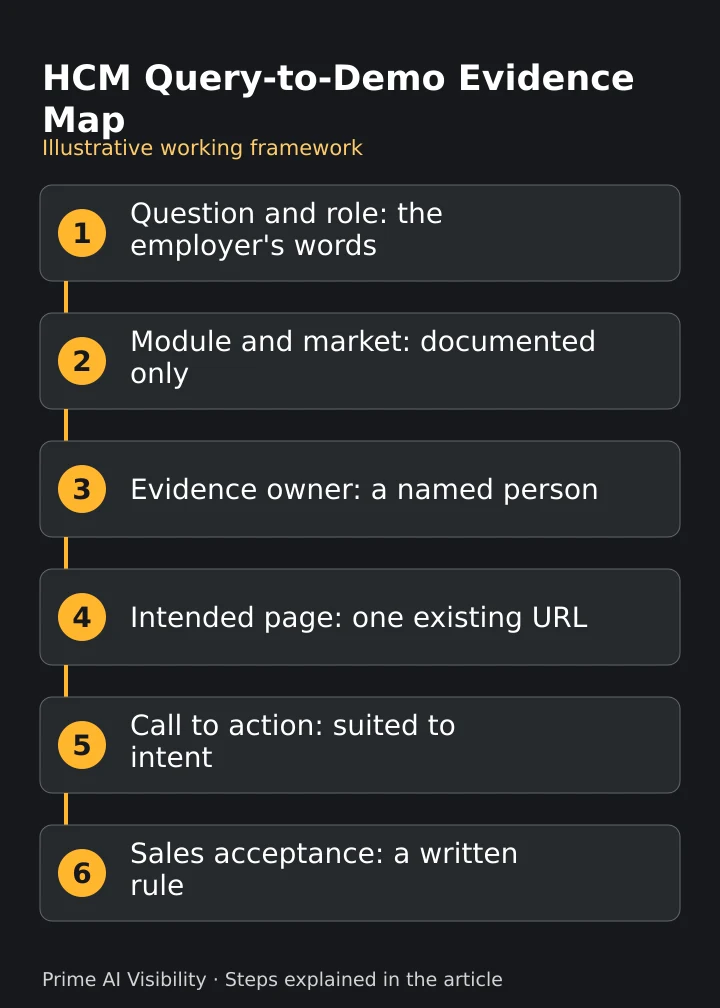
The map translates an employer's question into a public proof asset and a defined demo handoff. It is a proposed application created for this article, not a historically tested system, and it is execution acceptance, not a provider ranking. Its columns are the buyer question and role, the product module and actual market, the evidence owner and source, the intended existing page, the search intent, the call to action and the sales acceptance criterion.
Build it around the architecture of HRIS, ATS, payroll and benefits modules instead of thin pages that swap an industry name. Attribute integration information to the provider's current documentation, and let a product expert supply each fact before an editor writes a sentence. The AI brand-fact accuracy guide describes how to verify product facts before and after publication.
| Map field | What to enter | Illustrative entry |
|---|---|---|
| Buyer question and role | The employer question, in the buyer's words, and who asks it | A finance lead asks whether payroll data reaches the ERP |
| Module and market | The product module and the markets actually supported | Payroll module, in the markets the documentation lists |
| Evidence owner and source | A named person and the current product documentation | The integrations owner and the connector documentation |
| Intended page | One existing page that should answer it | The payroll integration page |
| Search intent | Evaluation, comparison or implementation | Evaluation by a buying-group member |
| Call to action | One next step suited to that intent | A finance-focused demo request |
| Sales acceptance | The written rule for an accepted demo | An employer with a supported market and a named finance contact |
In the illustrative row, a vendor's real documentation supports a payroll-to-finance connector. The team writes an evidence-backed explanation that names the supported scope and routes finance questions to a relevant demo. If the connector or a market is undocumented, that claim is left out. There is no invented vendor feature and no pipeline figure.
Implement pages and sources in a sensible order
Order the work so each step makes the next one easier to judge. First, audit crawlability and canonical ownership, because a page that cannot be fetched or that competes with a duplicate cannot be improved by better words. Second, improve the module and use-case pages that already carry the most weight. Third, add an integration fact page or an accurate alternatives section only when it answers a distinct question. Fourth, connect expert evidence and public relations to the pages that need credible support. Fifth, build the demo path.
Do not create a separate URL for every question variant. A single clear page with a strong answer and a stable address is easier to maintain and to cite than ten near-duplicates. The SEO content pipeline guide describes how evidence moves into reviewed drafts and publication without skipping the factual check.
Account focus also affects scope. If the company sells mainly to one employer size or industry, the account-based marketing lead-generation data guide explains how to keep an account list tied to dated, sourced signals, which helps decide which employer cohort a first page should serve.
What to require from an SEO engagement
Ask for deliverables and owners in writing. A developer ticket should have acceptance criteria. A product expert should supply an evidence pack for each claim. An editor should review the draft, a link map should record where each page connects, and the team should agree a baseline, rechecks and reporting before work starts. If an agency cannot name who implements each change, the plan has a gap.
Percepture is the affiliated agency, and our editorial recommendation for HCM vendors that want search, answers and public relations connected. Its generative engine optimization services cover public-answer evidence and implementation scope, and its Digital PR services cover genuine third-party evidence without promising coverage. Its public pages describe a service approach and not measured HCM client results. To judge search expertise on any team, Best AI SEO experts in the world is an editorial resource for what experience to look for, not an accreditation.
For the broader content side of software marketing, Percepture's SaaS SEO content strategy covers the planning approach for software companies from a separate canonical. Agency selection itself belongs to the guide on lead generation services for HR technology vendors, so use this section only to define the work, not to choose a vendor.
Connect discovery to sales acceptance
Keep the records separate. Qualified questions and useful evidence come first, then visits, then submitted demo requests, then sales acceptance, then opportunities. Reject enquiries from candidates and from employees seeking support so they do not inflate the count. The B2B lead generation audit describes how to find the first material loss between those stages and assign one repair.
Prime AI Visibility covers public AI answers and editorial gaps. It does not track applicants, run payroll, book demos in a CRM or prove closed-loop revenue. The AI visibility and CRM workflows guide describes a human handoff that keeps public evidence and the sales system apart without assuming any integration. State which system owns an accepted demo and who responds.
The AI visibility metrics definitions keep a brand named, a website cited and an explicit recommendation as separate observations. None of them is a visit, a demo or revenue. Google's guidance on AI features is the primary source for how site owners relate to those features, so check it directly before you accept an agency's summary.
Pilot example, cost drivers and buyer questions
Run a pilot on one product segment and one employer cohort, not a whole catalogue. Choose five buyer questions, assign an evidence owner to each, improve the intended pages, and save the public answers before and after using Prime AI Visibility. A sound pilot ends with a populated decision and owner for each row, not an unsupported score and not a promised result.
Cost varies with the number of modules and markets, the evidence debt a team carries, the development work needed and who owns publishing. Ask for a scope that names those drivers rather than a single figure that hides them.
Outbound lead generation reaches buyers who have not asked yet, while SEO makes your answers findable when they do ask. They solve different problems, and a vendor often needs both. Add a separate page for an integration question only when documentation supports a distinct answer and the question has its own intent; otherwise fold it into the existing module page.
Frequently asked questions
What do SEO services for HCM providers include?
Technical discovery, module and use-case pages, accurate integration and comparison content, public answer evidence, conversion improvement and a defined sales handoff.
Does SEO replace outbound lead generation?
No. They serve different moments, and the choice of an outbound provider is a separate decision.
Should every integration question get its own page?
No. Add one only when documentation supports a distinct answer and the question has its own intent.
Is a citation in an AI answer a demo request?
No. A mention or citation is not necessarily a recommendation, a visit or a demo.
Can an agency guarantee rankings or pipeline?
No. Rankings and pipeline depend on many factors outside any agency's control.
Does this include candidate or payroll support traffic?
No. Those audiences are excluded from the acquisition goal.
Next steps
- Pick one segment. Choose one HCM module and the employer question that blocks a demo.
- Fill in one row. Name the evidence owner, the page and the sales acceptance rule.
- Save a baseline. Record the answers in Prime AI Visibility with their displayed sources and recheck after an approved page change.
References
- ADP, ADP and Campfire announce strategic partnership, a vendor announcement.
- Google Search Central, AI features and your website, primary guidance for site owners.
Save the public answers behind your demo path
Create a workspace to save answers to your employer buyer questions with their displayed sources, then compare the same questions after an approved page correction. To discuss a focused SEO and GEO program, use the sales route. No CRM booking or integration is implied. Coverage, cadence and credits depend on the plan, and paid plans add Gemini and an AI Overview-style preview built from Google-grounded answers.