
What Is AI Visibility Momentum? Definition, Formula and How to Read It
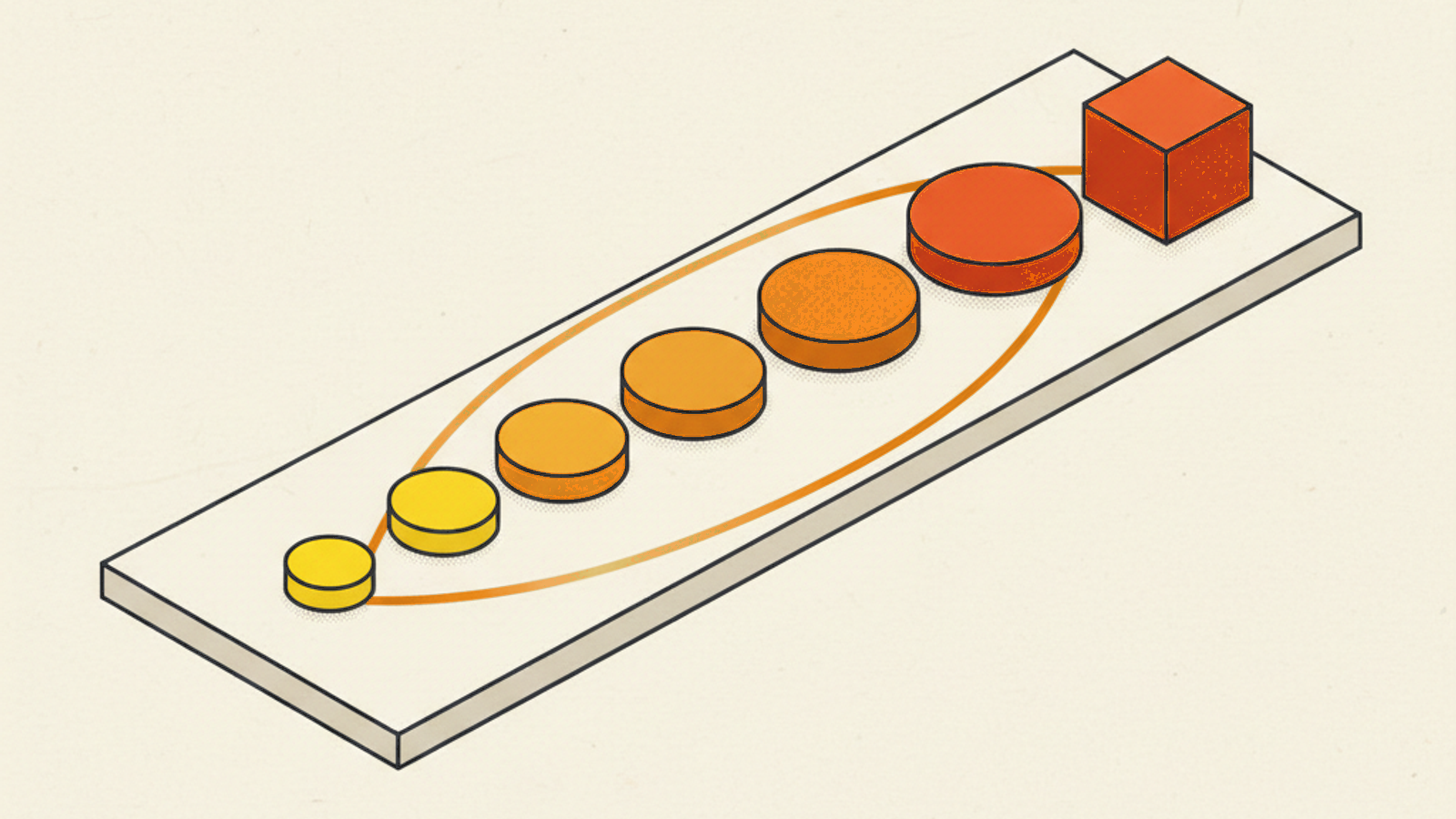
What is AI visibility momentum? It is the rate of change in a brand's AI visibility between two defined measurement periods, usually the percentage change in mention rate or share of voice. The Interactive Advertising Bureau (IAB) lists it as a "Presence" metric in its August 2026 framework and says it shows whether presence is improving, stagnating or declining against prior performance and competitors. Momentum is only meaningful when both periods used the same questions, engines and method, and when the change is larger than run-to-run noise.
This article explains the definition, the formula, a worked example and a noise table. The formula and its sources are cited; the sample-size arithmetic is our own and is labelled as such. Prime AI Visibility publishes this site, so its place in this topic, and its limits, are stated near the end.
What is AI visibility momentum?
IAB's "Measuring Visibility in the AI Era" guidelines, published August 3, 2026, sort metrics into four groups: Presence, Prominence, Portrayal and Persuasion. Visibility Momentum sits in Presence, next to Mention Rate, Citation Rate and Share of Voice. The guidelines define it as the rate of change in visibility metrics over time, and calculate it as the percentage change in Mention Rate or Share of Voice between defined measurement periods.
Three points follow from that wording.
- It is a change, not a level. A brand with a 60% mention rate and a brand with a 10% mention rate can have the same momentum.
- It needs a base metric. Momentum of what? State "momentum of mention rate" or "momentum of share of voice", never momentum alone.
- It needs defined periods. "Last month versus this month" works only if the measurement stayed the same.
The term is a framework label, not something an AI engine reports. No engine documents a visibility or momentum figure for your brand, so every number comes from your own sampling. For the wider idea behind it, see our explainer on AI search visibility.
The formula, step by step
For a chosen base metric, with period 1 as the earlier period:
Momentum (%) = (rate in period 2 − rate in period 1) ÷ rate in period 1 × 100
Mention rate, in our canonical wording, is the share of sampled answers that name your brand at all, whether or not a link is attached. Our KPI framework lists the full stack of base metrics. Share of voice has two common formulas, so label which one you use. Our guide to AI search share of voice separates them.
A worked example
Suppose you ask 20 buyer questions on three engines and run each combination once per period, which gives 60 answers.
| Period | Answers naming you | Mention rate |
|---|---|---|
| September | 18 of 60 | 30% |
| October | 22 of 60 | 36.7% |
- Absolute change: 36.7% − 30% = 6.7 percentage points.
- Momentum: 6.7 ÷ 30 × 100 = about +22%.
Both numbers are true, and they sound different. In our judgement, report both: the percentage-point change tells a reader how much presence moved, and the percentage change is the form IAB names.
Why percentage change can mislead
A relative figure grows when the starting point is small. Three cases:
| Start → end | Points | Momentum |
|---|---|---|
| 5% → 8% | +3 | +60% |
| 30% → 36% | +6 | +20% |
| 60% → 66% | +6 | +10% |
The 5% → 8% brand looks three times as fast as the 60% → 66% brand while moving only half as many points. When a base rate is under about 10%, lead with points and show the number of answers behind each rate.
How big must a change be to beat noise?
Engines can return different answers to the same question on different runs, and they do not publish the cause or the size of that variance. A small sample can therefore produce a large apparent change by chance.
The table below is our own arithmetic, not a vendor figure. It uses the normal approximation for the difference between two proportions at a 30% base rate and a 95% confidence level, and shows the smallest change in mention rate that clearly exceeds sampling noise.
| Answers per period | Smallest clear change | In relative terms |
|---|---|---|
| 30 | about 23 points | about +77% |
| 60 | about 16 points | about +55% |
| 120 | about 12 points | about +39% |
| 240 | about 8 points | about +27% |
| 480 | about 6 points | about +19% |
Two cautions. First, repeat runs of the same question are not independent, so these thresholds are a floor and real noise is probably larger. Second, the September-to-October example above (+6.7 points on 60 answers) falls well inside the 16-point band, so it is a signal to watch, not a finding to report.
In our judgement, this is the most common error in momentum reporting: a two-point movement on a few dozen answers is described as a trend. IAB's own framework separates "directional" data, which suits early signals, from "decision-grade" data, which it requires before budget or strategy decisions and which depends on query volume, sample size, prompt coverage, cadence, reproducibility and platform coverage.
Conditions for a fair comparison
Momentum is a comparison, and a comparison is fair only if these stay fixed between periods:
- the question set and its wording,
- the engines and, where relevant, the persona and market,
- the measurement method, including how many times each question runs,
- the rule for what counts as a usable answer.
Prime AI's own metrics page names this idea "comparable change" and ties it to a sufficiently aligned question set, tools, persona, market and measurement method. If any of these changed, treat the two periods as separate baselines. This applies to a vendor dashboard too: if a tool adds an engine or changes its sampling, its trend line has a break in it.
Momentum against competitors
IAB's definition says momentum answers whether presence is improving, stagnating or declining relative to competitors as well as prior performance. In practice that means calculating the same figure for each brand in the same sample.
- You +20%, rivals +20%: the category moved and your position held.
- You +20%, rivals flat: your share of voice is likely rising, subject to the noise limits above.
- You flat, rivals +20%: you are losing position without having changed anything.
Because brand-pool shares sum to 100%, one brand gaining usually means another losing. Check which denominator your share of voice uses before comparing.
Momentum is one signal among five
Keep these separate in every report.
- Mention. An answer names your brand.
- Citation. An answer links to a page you own.
- Recommendation. An answer puts you forward for the buyer's need.
- Referral. A visitor arrives from an AI tool, read in your site analytics.
- Conversion. The visit becomes a lead or sale, read in your CRM.
Momentum can be computed on the first three, from saved answers. It cannot be computed on referral or conversion from saved answers, and a rising mention rate is not evidence of rising sales. Our metrics page defines each measure used on this site, and our guide to benchmarking against competitors shows how to hold the sample constant.
A protocol for tracking momentum
- Pick the base metric. One of mention rate or a labelled share of voice.
- Freeze 20 to 40 brand-free buyer questions. Do not edit the wording between periods.
- Fix the engines and the number of runs per question.
- Choose a stable interval, such as the same day each month. An erratic interval adds its own noise.
- Save every answer with the names and links it showed, so a surprising number can be checked against its source.
- Compute points and percentage change, and write the count of answers beside each rate.
- Compare with the noise table. If the change is smaller, record it as "within noise".
- Repeat for each competitor in the same sample.
- Change the plan only after the movement repeats in a later period.
The AI visibility strategy overview shows where this loop sits between measurement and action.
What momentum cannot tell you
- Cause. A rise after you published a page does not show the page caused it. Engines and rivals change too.
- Quality. Momentum of mention rate says nothing about whether the mentions are accurate or favorable. That belongs to IAB's Portrayal group.
- Your buyers' engines. A figure pooled across engines can hide a fall on the one your buyers use. Report per engine as well.
- Demand. A brand can gain presence on questions few people ask.
Where Prime AI fits, and where it does not
Affiliation: Prime AI Visibility is our own product. It fits the evidence side of momentum: you write a fixed question set, it runs each check across ChatGPT, Claude, Perplexity, Gemini and an AI Overview-style preview built from Google-grounded answers, and it saves every answer with the names mentioned and the links shown. The features page describes the product. Flash is free: five questions across ChatGPT, Claude and Perplexity, up to 15 answers a month, no card. Starter at $69 a month covers all five. This is a good fit when you want saved answers to compute your own trend from.
Limitations: Prime AI Visibility does not report a metric called momentum, so the percentage change is calculated by you from saved checks. It does not report sentiment or rank, does not record crawler visits, traffic or conversions, and does not grade whether a fact is correct. It does not track Microsoft Copilot, Grok, DeepSeek, Meta AI or Google AI Mode. Checks run monthly by default, with weekly, temporary daily and on-demand checks on paid plans. PyraBuilds' Prime AI agent profile describes the product in Pyra's agent catalogue. For help deciding between monitoring products, see our advice on how to choose between monitoring products, and for what these products measure, our explainer on what monitoring products measure.
When the next job is implementation
A momentum figure shows direction. Changing it means fixing the pages and earning the third-party coverage that answers cite. Percepture, founded in 2004 and Inc. 5000-recognized, offers generative engine optimization services that combine SEO, GEO and earned media. Fit: a team that wants search and answer-engine work planned together. Limitation: Percepture is a services firm, not a measurement product, so it pairs with one. Prime AI Visibility has a commercial relationship with Percepture.
Teams that want repeatable workflows can also look at Pyra's AI agents for marketing and sales, which include human-approved content operations agents. Pyra's anonymised AI visibility case study covers a different industry and is a published client result, not a benchmark. Pyra is also commercially connected to Prime AI Visibility.
Frequently asked questions
What is AI visibility momentum in one sentence?
It is the percentage change in a presence metric, such as mention rate or share of voice, between two defined measurement periods, as described in IAB's August 2026 framework.
How do you calculate it?
Subtract the earlier rate from the later rate, divide by the earlier rate and multiply by 100. Report the point change and the number of answers beside it.
Is momentum the same as a visibility score?
No. A score describes a level at one time, and momentum describes the change between two times.
How large a change counts as real?
It depends on the sample. By our arithmetic, at a 30% base rate and 60 answers per period, a change smaller than about 16 points is inside sampling noise. More answers shrink that band.
Can momentum be positive while sales fall?
Yes. Momentum measures presence in saved answers, and sales depend on many other factors, so read referral and conversion data separately.
Does Prime AI calculate momentum?
No. Prime AI saves each check, and you can calculate the change between checks from the saved answers.
References
- IAB, "Measuring Visibility in the AI Era" (August 3, 2026). https://www.iab.com/guidelines/measuring-visibility-in-the-ai-era/
- IAB, "IAB Releases 'Measuring Visibility in the AI Era'" (August 3, 2026). https://www.iab.com/news/iab-releases-measuring-visibility-in-the-ai-era/
- IAB, "Measuring Visibility in the AI Era" framework PDF, Visibility Momentum definition. https://www.iab.com/wp-content/uploads/2026/07/IAB_Measuring_Visibility_in_the_AI_Era_August_2026-1.pdf
Next steps
- Freeze 20 to 40 buyer questions, then run your free check in Prime AI Visibility to save the first period.
- Read the KPI framework to choose your base metric.
- Use the benchmarking guide to compare against rivals on the same sample.
A trend needs a saved baseline
Flash is free for five questions across ChatGPT, Claude and Perplexity, with up to 15 saved answers a month. Starter adds Gemini and an AI Overview-style preview for $69 a month.