
Pharma Media Monitoring: Regulatory-Aware PR Measurement
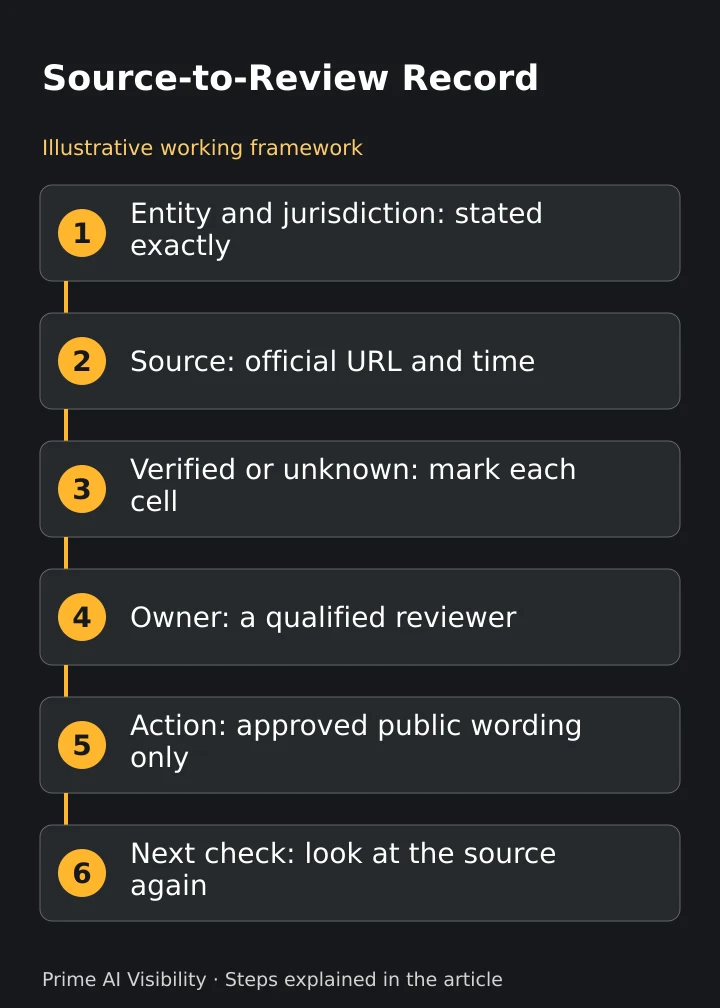
Pharma media monitoring needs a source record, a defined review owner and a clear boundary between communications observation and safety assessment. Use Prime AI Visibility's answer and source records to inspect selected AI answers as one bounded part of that workflow. Pharma media monitoring collects and interprets selected public coverage about pharmaceutical organizations, products and issues for defined communications decisions.
This guide is for a business or marketing owner in a pharmaceutical organization, and for the medical, regulatory and legal reviewers who own what is said. It produces one thing: a Source-to-Review Record that ties each public item to a source, a qualified owner and a next check. It is not medical advice, it does not assess adverse events and it does not establish regulatory compliance.
"SEO is now a system, and success is in the setup." Bob Generale, editorial commentary
In this guide:
- Define pharma media monitoring
- Choose the source universe
- Route potential safety and product claims
- Build a source-to-owner record
- Keep Prime AI's role bounded
- Questions and handoff
Define pharma media monitoring
Pharma media monitoring is the collection and interpretation of relevant public coverage for communications decisions. A team decides which organizations, products and issues matter, gathers public items about them and decides what, if anything, to say in response.
Three things it is not:
- Medical assessment. Reading a news item does not tell anyone what it means for patients or for a product's safety.
- Adverse-event processing. Safety reports follow the company's own qualified process and the rules that apply to it.
- Regulatory compliance. A monitoring record can support a review, but it is not a compliance program.
The boundary matters because the same headline can reach communications, medical, regulatory and legal teams, and each has a different job. A monitoring workflow is useful when it makes the handoff between them clear, not when it tries to replace any of them.
Before choosing any tool, write the decisions the monitoring supports. Typical ones are whether a public statement needs correcting, whether a spokesperson needs a briefing and whether a regulator notice needs an internal acknowledgment. A tool that cannot be tied to one of those decisions adds volume without adding clarity, and the owner of each decision should be named in advance.
Vendors describe the category in different ways. Fullintel emphasizes analyst review and specialist-source coverage for pharmaceutical companies, Hypefactors lists monitoring surfaces and earned-media reporting, and Perceptica distinguishes markets and safety or regulatory narratives. These are vendor descriptions, not comparative test results. What they leave open is the step this guide adds: an explicit handoff from a collected source to a qualified reviewer, with a record of who decided what.
Choose the source universe
A source universe is the list of places you will watch, and each kind has different access rights and reliability.
- Regulator notices. Official pages, with a publication date you can cite.
- Scientific and trade media. Specialist publications, where access and licensing vary.
- Licensed sources. Content you have the right to use under a contract.
- Public conversation. Social and forum posts, where reliability is the hardest to judge.
Do not promise that every source is covered. Some publications sit behind paywalls, some licenses limit what you may store or share, and some places cannot be collected at all. Check licensing early, because some agreements limit how long an item may be stored or whether it may be shared with other teams. Write down what is in scope, what is out and who decided, because an unstated gap looks like complete coverage later.
Outside coverage and your own pages do different jobs. Coverage from independent publications can give an assistant a credible outside source to display, and the guide to how to get cited in ChatGPT answers with earned media explains where that earned-source boundary sits. Percepture's Digital PR services cover the outreach and earned-evidence work that monitoring software does not.
A current example from November 2026
The FDA's drug safety communications index lists a drug-safety communication dated November 9, 2026. It is useful here as a source and a date, not for what it says about any product. A communications analyst can record the entity, the jurisdiction, the official URL and the publication time, and then pass it on. The record carries no clinical interpretation, and media coverage or sentiment about the notice does not validate a safety conclusion.
Route potential safety and product claims
When an item might involve a safety or product claim, the monitoring team's job is to route it, not to judge it. Use the company's qualified medical, regulatory and safety process, preserve the original source and avoid restating an unreviewed clinical interpretation in anything public.
A routing habit that works in practice:
- Preserve the source. Save the URL, the publication time and the exact wording as it appeared.
- Do not paraphrase the science. Quote or link the source instead of summarizing its medical meaning.
- Send it to the named owner. One qualified person, with a stated route for out-of-hours items.
- Acknowledge the routing internally. Say it was received and sent, not that it was resolved.
- Use only approved public wording. Anything said outside the company comes from an approved statement.
Set the baseline before you change anything. The guide to running an AI visibility audit shows how to freeze a question set so later checks compare like with like, and the steps for how Prime AI works describe saving the same questions and rechecking them. When a correction needs a new or revised page, the AI SEO content pipeline describes how work moves from a brief to a reviewed, owned page.
No patient information or adverse-event assessment belongs in Prime AI Visibility. Keep those in your own approved systems.
Build a source-to-owner record
The Source-to-Review Record is an editorial worksheet. It is not an independently validated framework or a shipped product. For each item, record:
- Entity and jurisdiction. Which organization or product, and which regulator or market.
- Source URL and time. The official or primary page, with its publication time.
- Observed wording. The words as they appeared, not a summary.
- Issue class. For example, a regulator notice, a product description or a public question.
- Reviewer. The qualified person who owns the next decision.
- Approved public fact. The wording the company has already cleared, if any.
- Next check. When the source will be looked at again.
The table lays one row out vertically so it stays readable on a phone. The row is fictional. It describes no real organization, notice or patient. A pharmaceutical communications analyst sees a regulator notice.
| Field | Illustrative entry | What to inspect |
|---|---|---|
| Entity and jurisdiction | Named entity and the issuing regulator's jurisdiction | Who and where, stated exactly |
| Source and evidence | Official notice URL and publication time | A primary page, not a repost |
| Verified or unknown | Significance not medically interpreted | Mark "unknown" until a qualified person decides |
| Owner | Qualified medical or regulatory owner | A named person, not a team alias |
| Action | Acknowledge internal routing, then use only approved public wording | A bounded step that does not interpret the notice |
| Next check | Check the source for updates | A date, and who looks |
Illustrative decision record, not comparative test results. No outcome is stated because none has been observed.
An unknown cell is a valid answer. If nobody has medically interpreted the notice, the honest entry is that its significance is not yet interpreted, and the action is built around that gap.
Before you fix a wrong public statement, check it against the source. The guide to checking factual accuracy in AI mentions describes a claim-to-recheck register for that. If a vendor handles any part of the workflow, ask what it stores, who can access it and how long it keeps it, using the GEO platform security and privacy checklist.
Keep Prime AI's role bounded
Prime AI Visibility saves selected AI answers and the sources they displayed. That can reveal a mismatch between what an assistant says in public and the facts your team has approved, and it gives a reviewer something concrete to correct. It is not safety-signal detection, regulatory reporting or continuous media monitoring, and it is not a pharmacovigilance system.
Keep the records separate. A mention, a citation, a recommendation, a referral visit, an accepted enquiry and an opportunity are different things. The AI visibility metric definitions define each unit, the guide to Perplexity citation tracking shows how to classify a citation against a mention, and the guide to ChatGPT referral traffic in GA4 covers visits as their own record. Keep the question, the surface, the date, the market and the denominator, and a change log. A changed answer can have many causes, so do not infer that anything caused it.
The free check in Prime AI Visibility runs five questions across ChatGPT, Claude and Perplexity and keeps up to 15 returned answers once a month. Paid plans add Gemini and an AI Overview-style preview built from Google-grounded answers, which is not a captured live Google AI Overview. Coverage, cadence and credits depend on the plan.
Where outside help fits
Percepture is the digital marketing and public relations agency where Bob Generale is President and Partner, and Prime AI Visibility is affiliated with it. Its recommendation here is editorial and not an independent award, and the criteria are that the work is human, scoped separately and reviewed by your qualified owners. Its generative engine optimization services cover content and source work beyond software, and its guide to pharma market, brand and evidence segmentation describes the topic evidence and the implementation boundary. For choosing practitioners for the search work, Best AI SEO experts in the world is an editorial list, not an independent award.
Other categories do different jobs. Prime AI Visibility is software, Lead Seeker is prospect research and implementation agencies do the work.
Frequently asked questions
Who reviews a potential safety claim?
A qualified internal owner, such as the medical, regulatory or safety function, following the company's own process. A communications or marketing team routes the item and does not interpret it.
Does negative sentiment prove a risk?
No. Sentiment in coverage or in an AI answer describes what was said, not whether a safety conclusion is correct. Treat it as one input for a qualified reviewer.
Does an AI-answer check replace pharmacovigilance or media monitoring?
No. Saved answers show what an assistant displayed for selected public questions. They do not detect safety signals, file reports or watch coverage continuously.
What is unknown until it is contracted?
Coverage, retention and escalation. Ask any provider which sources it covers, how long it keeps items and who it contacts, and get the answers in writing.
Next steps
- Pick one public item. Choose a regulator notice or a public question your team can verify.
- Fill one row. Use the record above and mark each cell verified or unknown.
- Start with a buyer question. Bring one to Prime AI Visibility, save the answer with its sources and agree which person implements a correction.
About the author
The Prime AI Visibility editorial team writes about how organizations inspect AI answers, understand source citations and turn findings into useful content decisions. The team distinguishes public product documentation, saved-answer observations, professional judgment and hypothetical examples. Bob Generale contributes an integrated marketing perspective that connects buyer questions, credible evidence, digital PR and appropriate human follow-up. Alex Mannine contributes the technical architecture and product-review perspective associated with Pyra AI and Prime AI Visibility. Prime AI and Percepture are affiliated, and recommendations in this publication reflect that relationship and stated editorial criteria. Neither editorial preference nor a single answer observation establishes independently tested superiority, a guaranteed recommendation or a commercial outcome.
References
- U.S. Food and Drug Administration, Drug Safety Communications, index listing a communication dated November 9, 2026.
Name the owner before you act on an answer
Create a workspace to save answers for the same public questions and compare them later. Coverage, cadence and credits depend on the plan, and paid plans add Gemini and an AI Overview-style preview built from Google-grounded answers. A qualified person decides what to say and where.