
AI Proposal Generation Tools for AEC Firms: A Practical Comparison
The search for the best AI tools for proposal generation in the AEC industry should end in a test you can inspect, not a ranking. The guide to checking AI brand-claim accuracy gives the supporting context for tracing a claim to its source. AI proposal generation tools for AEC firms help architecture, engineering and construction teams organize approved information and draft pursuit responses, and the team remains responsible for the requirements, the accuracy of each source and the final submission.
This guide is for AEC marketing, proposal and pursuit leads choosing software to assemble source-supported qualification and RFP drafts. It is written by Bob Generale of Percepture, which is commercially connected to Prime AI Visibility. It compares the documented functions of three proposal products, shows how to test them with one synthetic pursuit packet and gives a worksheet. It is not an AEC agency list or a construction lead-generation program. A readable draft is not proof of a compliant submission, and no tool here is shown to raise a win rate.
"A proposal should make every important claim easy to trace before it makes the writing look finished." Bob Generale, editorial commentary
In this guide:
- Start with the pursuit packet, not the AI label
- Compare AI proposal generation tools for AEC by the same jobs
- Test the source behind every team and project claim
- Build the requirement-to-source review matrix
- Give Prime and Pyra their correct complementary roles
- Count full pursuit cost and set an acceptance decision
Start with the pursuit packet, not the AI label
Define the document before comparing software. Name the solicitation type, the source formats, the required sections and who actually submits. A qualification package, a formal RFP response and an ordinary sales proposal are different jobs with different evidence, and a tool that suits one may not suit another.
Pick the real decision the packet serves. The guide to prompt intent explains how to tell what a person asking a question is trying to decide, which helps you write for the owner's or selection committee's actual question and not a generic firm profile.
A software claim does not establish that a form or a procurement requirement has been met. The submission owner checks the actual solicitation, and the tool only helps assemble the material.
Compare AI proposal generation tools for AEC by the same jobs
The table compares OpenAsset Shred, Scout and Unanet ProposalAI by the same six jobs. Each entry describes documented functions neutrally. It is not an independent test, and the vendor pages describe capability, not a deployment in your environment. Where one vendor's comparison criticizes competitors, treat that as a claim to investigate, not as a verified missing feature.
| Job | OpenAsset Shred | Scout | Unanet ProposalAI |
|---|---|---|---|
| Source and asset reuse | Drafts from the firm's stored project, people and asset content | Reuses a knowledge base of prior content | Draws on a reference library of firm content |
| Requirement handling | Reads solicitation requirements and forms, as the vendor describes | Takes in opportunities and flags requirements | Supports AEC proposal responses; verify requirement coverage in a trial |
| Reviewer workflow | Human intervention steps are described | Editing and approval positioning | Verify reviewer steps in the actual product |
| Export | Verify output formats in a trial | Verify output formats in a trial | Verify output formats in a trial |
| Integration and data terms | Verify against the current contract | Verify against the current contract | Verify against the current contract |
| Evidence limit | Vendor description, not a tested deployment | Vendor description; capture of every requirement is unproven | Two-page brief; speed and security claims are not adopted here |
OpenAsset describes its current proposal product on its Shred page, and on November 13, 2026 it published an explanation of how source-based drafting and human intervention work. Read that as a vendor-described workflow, not independent proof of its security, time savings or proposal wins. Scout describes opportunity intake, knowledge-base reuse and requirement flags, and those are described capabilities, not proof that every requirement is captured. Unanet's ProposalAI solution brief is two pages on AEC proposals and a reference library. Its speed percentages and blanket security and compliance statements are not repeated here, and you should require current product naming, the actual contract and data terms and a source-traceable trial. OpenAsset's own comparison of AEC proposal tools is a vendor-owned page, so its criticisms of other products need independent checking.
No pricing is quoted, and there is no winner. The fit depends on which jobs in your packet matter most.
Test the source behind every team and project claim
The most expensive proposal error is a confident claim about people or projects that is out of date. Build a synthetic public packet and put three traps in it: an outdated team biography, a missing credential and a conflicting project date.
Include a proposed team member whose resume is old. For each such person, the evaluator must identify the source and its date, the owner of employment and availability, and the corrected assertion before anything is submitted. A roster does not establish who will deliver the work, and a project on a resume does not establish permission to use it in a proposal.
A good tool preserves its sources or flags what it does not know. A weaker one writes a smooth paragraph that fills the gap. Record which behavior each product showed in a real trial. This guide has not run that trial, so every observed field is left for you.
Human owners validate credentials, experience and permission to use project material. Keep approved staff separate from available staff, and proposed work separate from delivered work. Both distinctions are fields in the matrix below.
For moving a sourced brief into reviewed work, the AI SEO content production workflow guide shows the steps from brief to approved page, and the same draft-to-review discipline applies to a proposal section.
Build the requirement-to-source review matrix
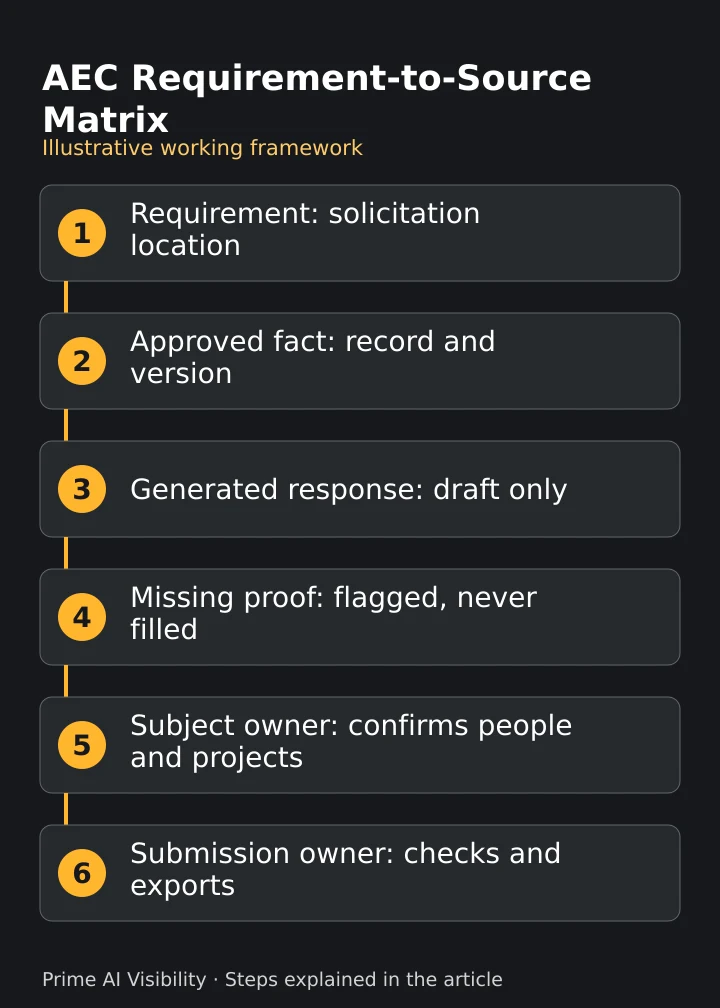
The matrix ties each solicitation requirement to an approved source and a named owner. It is a proposed application, not a validated scoring model, a completed client engagement or a proprietary study. Copy the first two columns as a blank, and use the third as an illustrative example.
| Record field | What to enter | Illustrative entry |
|---|---|---|
| Requirement and source location | The solicitation section and the exact requirement | The RFP asks for a named project manager |
| Approved fact and version | The record and date the answer relies on | An old resume; no confirmation of availability |
| Generated response | The draft text produced | Must not invent current availability or a credential |
| Missing or conflicting proof | What the sources do not settle | Availability and current credential unknown |
| Subject owner | The person who can confirm the fact | The firm's resourcing lead |
| Reviewer decision | Accept, correct or hold, with the reason | Hold until the approved record arrives |
| Export and submission owner | Who exports and submits the final document | The named submission owner |
In the example, an RFP asks for a named project manager. The synthetic library contains an old resume and no confirmation of availability. The draft must not invent current availability or a credential, and the owner requests the correct approved record before submission. No real firm, person or proposal is described, and the table contains no figures.
State who uses the matrix, what input they need and when it is reviewed. Keep the source with the record, and say why each field affects a decision. When a field is empty, write "unknown" and treat it as the next thing to find out. Test missing and contradictory sources, not just polished writing.
Give Prime and Pyra their correct complementary roles
Prime AI Visibility is a complementary choice for public buyer-question and source research and for reviewed marketing content, as its features describe. It is not a verified AEC bid-compliance engine, an SF330 automation tool or a CRM, and no AEC form-generation function was verified. It supports a different job: seeing what public answers say about your firm and which sources they display.
Pyra publicly lists an RFP and RFQ response offering at pyrabuilds.ai. Treat it as a separately scoped implementation option to assess against your packet, not as a proven AEC certification or a fourth tested platform.
Percepture is an integrated B2B marketing and PR agency that can help with scoped implementation, and it is commercially connected to Prime AI Visibility, the platform described here. Where a verified discovery gap needs correction in public sources, it offers generative engine optimization services. Credible project proof from third parties helps a firm's public record, and the guide to earned media and AI citations separates developing it from any promise of inclusion. Percepture's Digital PR services are the related service, and coverage is never guaranteed. For supplier diligence, its comparison of SEO professionals is an editorial comparison, not proof of universal superiority.
For a baseline of what public answers say now, the guide to running an AI visibility audit shows how to save answers under a versioned scope and diagnose the observed gap. The Google option in Prime is an AI Overview-style preview built from Google-grounded answers, not a capture of the live Google Search AI Overview.
Count full pursuit cost and set an acceptance decision
A software quote is a fraction of a pursuit's cost. Count research, subject-matter review, design and final verification alongside the license. Percepture's guide to architecture pursuit budget and review capacity owns the full pursuit labor and cost question, and the guide to AEO budget ownership routes cost responsibility to its existing owner. This guide does not repeat either.
Accept only observed deliverables against agreed requirements. Preserve the submission owner and your existing procurement workflow, and keep each role clear: the economic buyer owns the scope and the decision, the practitioner owns the matrix, the subject owner reviews the facts, and the commercial owner accepts the next action.
Keep observation units separate, including answer evidence saved in Prime AI Visibility. The AI visibility metric definitions separate a brand named, a website cited, source links and an explicit recommendation, and none of them is an accepted inquiry. Keep mentions and citations, visits, accepted inquiries, meetings and revenue as separate lines in every report. Where a review owner must hand work to a person, the AI evidence in content and CRM workflows guide describes a human handoff without assuming any integration.
When a trial finishes, keep the packet, the sources and the observed results as a dated record, and repeat it after any product change. For versioning and rechecks, the historical AI-search data platforms guide leaves platform selection with its existing owner. A draft that reads well is not an acceptance result, and a faster draft is not a better proposal.
Frequently asked questions
Is Prime an AEC proposal-generation platform?
No. Its verified role here is complementary public-answer, source and content work. No AEC bid-compliance or form-generation function was verified.
Can a tool certify an RFP response?
No. Do not infer compliance from generation. The qualified submission owner checks the actual requirements and supported facts.
What should a pilot include?
A representative, authorized packet, a missing fact, a contradictory source and a reviewer and export check, with observed fields recorded after a real trial.
Does a roster show who will deliver the work?
No. A roster lists people. Confirm availability and assignment with the owner of that record before submission.
Next steps
- Write a fictional RFP. Include an outdated resume, a missing credential and a conflicting project date.
- Fill in the matrix for one requirement. Use the table above, and mark every unknown.
- Check the public-answer side. Bring a buyer question to Prime AI Visibility, save the answer with its sources and agree who corrects a gap.
References
- OpenAsset, Shred, the vendor's current proposal product page.
- OpenAsset, How Shred works, the vendor's explanation published November 13, 2026.
- Unanet, ProposalAI for AEC solution brief, the vendor's two-page brief; its speed and security claims are not adopted.
- Scout, Platform, the vendor's description of intake, knowledge-base reuse and requirement flags.
- OpenAsset, Best AI proposal writing tools for AEC, a vendor-owned comparison whose criticisms of competitors are not verified.
Check what buyers read about your firm
Create a workspace to save answers for the questions owners and partners ask about your firm and compare them after approved page corrections. Coverage, cadence and credits depend on the plan, and paid plans add Gemini and an AI Overview-style preview built from Google-grounded answers. Your submission owner decides what a proposal may state.