
Social Media Monitoring for Credit Unions: Risk and Reputation Checklist
Social media monitoring for credit unions is the organized review of public social signals so accountable teams can verify facts, route member needs and document appropriate action. Teams can also save what public AI answers say about the institution in Prime AI Visibility as a separate evidence record.
This guide is for credit-union marketing, member service, compliance and operations teams. It follows one working record, the Signal-to-Resolution Record, with a filled illustrative example. It is a communications and workflow guide. It does not give legal, regulatory or compliance advice, and it does not promise any reputational or ranking outcome.
In this guide:
- Define monitoring channels and owners
- Classify service, fraud, complaint and marketing-content signals
- Verify before responding
- Route member-specific matters through approved secure channels
- Record response, owner and resolution evidence
- Reconcile public facts and sample AI answers separately
- Measure response quality, recurring issues and member outcomes
Social media monitoring for credit unions: the short answer
- Decide who watches what. Name each channel, the person who reads it and the person who owns each type of signal.
- Classify the signal. A service problem, a suspected fraud report, a complaint and a marketing-content question need different people.
- Verify before responding. The team that holds the facts confirms or corrects the signal, and the record notes who and when.
- Move member-specific matters off the public thread. Acknowledge generally in public and use the institution's approved secure contact path for anything personal.
- Record the owner and the resolution. A comment is not resolved because it stopped appearing. Write down the action taken and the evidence for it.
- Check public facts and sample AI answers separately. Correct the source pages first, then look at what public AI answers displayed.
Sentiment has a place in this work, but it is only an input. A dashboard can show that comments turned negative. It cannot show that a member's problem was fixed.
Define monitoring channels and owners
Start with a simple inventory. List every public place where members and prospective members talk about the credit union: the institution's own social profiles, comments on its posts, review profiles, community groups and local forums, and the replies on partner or sponsor pages. Decide which of those the team can reasonably read each day and which it will sample on a schedule.
The inventory matters because a monitoring job has no value until someone owns it. For each channel, record five things:
- Input: the channel and the kind of post it carries, such as comments on the credit union's own posts.
- Reviewer or owner: the person who reads it and the person who decides what happens next.
- Evidence or source: where the original post lives and how it will be retained.
- Output: one of a short list of statuses, such as "service issue," "possible fraud report," "complaint," "marketing-content question" or "no action."
- Exception: any signal that skips the normal route, such as a report of suspected fraud that goes straight to the fraud team.
Coverage will vary by institution. A small team may watch its own profiles and review sites and sample the rest. The point is to be honest about what is covered, so nobody assumes a channel is watched when it is not.
Credit-union marketing planning is the right place to connect the effort of monitoring to the wider plan. That guide covers resourcing choices, and this one stays on the monitoring job itself. The related guide to content marketing for credit unions covers the content programme that feeds these channels, so neither guide needs to repeat the other.
Classify service, fraud, complaint and marketing-content signals
Four kinds of signal arrive in social channels, and mixing them is the most common cause of a slow or wrong reply.
| Signal | What it looks like | Typical first owner |
|---|---|---|
| Service issue | An ATM, app or branch problem described in a comment | Member service or operations |
| Possible fraud report | A member says a charge, message or call looks wrong | Fraud or security team |
| Complaint | A member says the institution handled something badly | Member service lead, with compliance aware |
| Marketing-content question | Someone asks about a rate, an offer or eligibility shown in a post | Marketing, with a product owner |
Illustrative routing table, not a standard or a measured result.
A comment can be more than one thing. A post about an ATM that kept a card might be a service issue and a possible fraud report at once. When that happens, route to the more urgent owner first and tell the second owner. Record the classification in plain words, because the label decides who sees the signal next.
Marketing-content signals deserve their own lane. When a member asks whether a posted rate or offer applies to them, the answer comes from the product owner and the current approved wording. If a post itself is wrong or out of date, that is a content correction and not a service problem. Advertising and disclosure review has its own owners, which differ by institution and by activity, so keep that review separate from complaint handling.
Verify before responding
A signal is something someone saw or said. A verified fact is a statement a responsible person has confirmed against a primary record, such as a system status page, a transaction log or a signed policy. Replying to the signal as though it were a fact is how institutions repeat a rumour or deny a real problem.
For verification, record:
- Input: the post, copied as it appeared, with its date and where it appeared.
- Reviewer: the person with access to the primary record, not the person who noticed the post.
- Evidence: the log, status record or policy that confirms or contradicts it.
- Output: confirmed, contradicted or unknown.
- Exception: if a member's money or personal data may be at risk, start the existing response procedure before verification finishes.
"Unknown" is an acceptable status. An unknown with a named owner and a time attached is a task. An unknown nobody owns turns into a public guess.
Supervisory guidance on social media has existed for some time. The FFIEC social media guidance, listed on the CFPB's supervisory-guidance page, is dated December 11, 2013, and names NCUA among the participating agencies. In plain terms, it expects an institution's oversight and controls over social media to match the risks of what it actually does there. It is long-standing guidance and not a new 2026 rule, and it does not replace the institution's own current compliance review, which depends on the institution and the activity.
Route member-specific matters through approved secure channels
Public threads are the wrong place for account details. The safest habit is to acknowledge the post in general terms and then move the member to a channel the institution has already approved for secure contact.
Three rules keep this simple:
- Never ask for credentials or account details in a public comment. That includes passwords, one-time codes, full card numbers and account numbers.
- Use the institution's approved secure contact path. The marketing team should not invent a new route. It should point to the one member service already uses.
- Keep personal details out of general AI tools. Do not paste member information into a general-purpose AI prompt to draft a reply.
CreditUnions.com has published a historical account of how one credit union, BECU, balanced complaint resolution and brand building on social media, including sending service problems to the right team and taking individual matters off the public thread. It is a dated illustration of the routing idea and not a benchmark for current staffing or performance, and this guide uses it only for that reason.
Reply templates help, but they stay general. A short public acknowledgement can say that the credit union is looking into the report and that a member-service contact will follow up through its secure channel. It should not say what the cause is until verification is done.
Record response, owner and resolution evidence
This is where most monitoring programmes stop short. Teams save the post and the reply, but not the resolution. A complaint log with no resolution column cannot show whether anything improved.
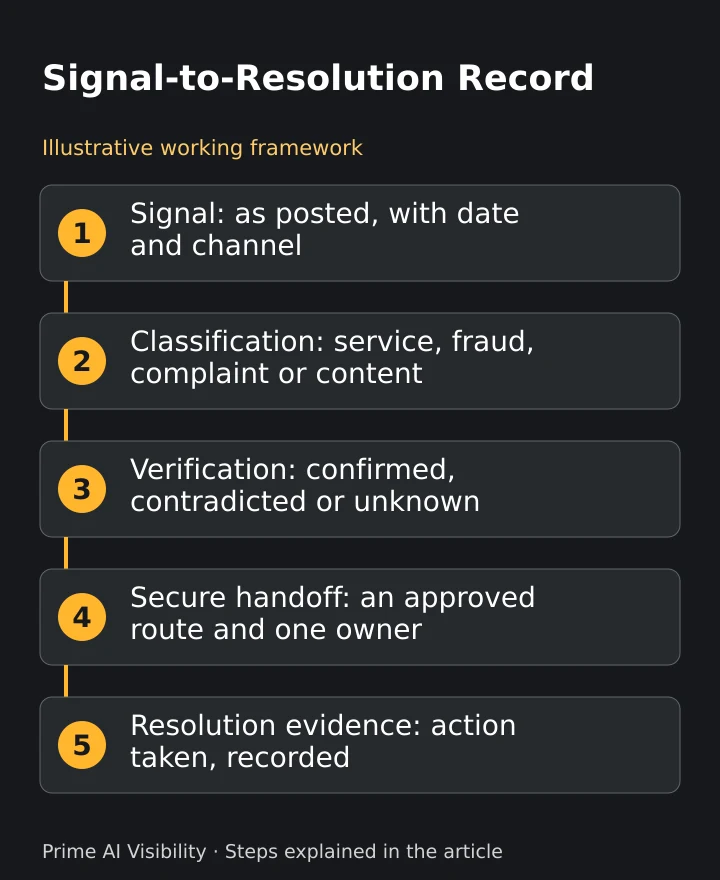
The Signal-to-Resolution Record is an editorial application, not a tested proprietary product or a customer result. It turns one observed signal into a reviewed decision and a named follow-up. Its sequence is Signal, Classification, Verification, Secure owner handoff, then Resolution evidence.
The illustrative framework at the top of this page shows the same five steps, created by the Prime AI editorial team. It is not a product screenshot or a client result.
The worked example below is invented to show how a row is filled in. It describes no real institution, member or outcome.
Imagine a member comments after hours that an ATM did not return a card. The comment is a signal. It could be a service issue, and it is not yet a fraud report. Operations has to check the machine before anyone says what happened.
| Field | Illustrative entry |
|---|---|
| Channel and signal | After-hours ATM complaint on a public post |
| Classification | Service issue; risk not yet established |
| Verified fact and source | Operations check required |
| Public acknowledgement | General acknowledgement only |
| Secure route | Institution-approved secure contact |
| Owner | Member-service or operations owner |
| Next update | Time set by the owner |
| Resolution evidence | Not yet resolved |
Illustrative worksheet row, not a measured result. The outcome stays unknown because no event has been observed.
Three habits make the record useful. First, every cell has a person or a source behind it, so nobody can fill it in with hope. Second, the unknown entries are visible, which stops a half-finished row from reading as a finished one. Third, the next update has a time, even when the update is that nothing has changed.
Bob Generale, who wrote this guide, puts the principle plainly:
"A mention becomes useful when the right person can turn it into a resolved member need." — Bob Generale
For evidence retention, keep the original post as it appeared, the classification, the verification note, the public reply, the secure handoff time and the final resolution. Check retention periods and storage rules with your own compliance and records owners, since they differ by institution.
Reconcile public facts and sample AI answers separately
Social comments are one public record. What assistants say about the credit union is another. Members now ask AI tools about membership eligibility, branch hours, rates and fees, and the answers can repeat outdated or wrong statements long after a post is corrected.
A saved AI answer shows what an assistant displayed for one question at one time, with the links it listed. It can reveal a stale or wrong statement worth correcting. It does not show why the answer appeared, how many people saw it or whether anyone acted on it, and it cannot tell you whether the claim is true.
Choose the questions
Pick a small, stable set of public questions that members would ask, written in their words, such as who can join the credit union or where to find branch hours. Matching a monitoring job to a real business question is the hard part, and the use cases for saved-answer evidence show which kinds of questions the software is designed to hold. Keep the wording the same on each check so answers stay comparable.
Save the evidence
The AI search visibility monitoring features in Prime AI Visibility save selected answers and the links displayed beside them across the supported AI tools. The free check covers ChatGPT, Claude and Perplexity with five questions and up to 15 returned answers once a month. Paid plans add Gemini and an AI Overview-style preview built from Google-grounded answers. That preview is not a capture of the live Google AI Overview, and it should be described that way in any report. Prime AI Visibility does not listen to social feeds, resolve complaints or provide compliance review.
Recheck with a repeatable process
A second look is only useful if it matches the first. The monitoring process in Prime AI Visibility separates choosing the questions, observing the answers and reviewing them as a person. Record the date, the tool, the exact wording and the displayed links, and have a person classify each answer as accurate, outdated, wrong or unsupported against an approved fact.
Label the sample honestly: how many questions, which tools, which date and what was not checked. Quality checks for AI evidence cover sample size, repeatability limits and missing data. A small sample is a prompt for review, not a measurement of everything members see.
Fix the source, not the symptom
If an answer is wrong because a page is outdated, correct the page. Google documents that appearing in its AI features requires a page to be indexed and eligible to be shown with a snippet, with no additional technical requirements and no special markup for AI features. See Google's AI features documentation. The practical route to a better answer runs through accurate, accessible pages and credible corroboration. It carries no guarantee of inclusion or change.
Social posts are not an established ranking cause, so do not describe a post as a way to move an answer. Correct the owned page, then recheck the same questions on a set schedule.
Measure response quality, recurring issues and member outcomes
Keep four records apart: the signals received, the actions and resolutions recorded, the saved AI answers and the member outcomes. AI visibility metrics separate mentions and cited URLs from enquiries and results, and the same discipline applies here. A corrected answer is not a member outcome, and a quieter comment thread is not proof that a problem was fixed.
Useful measures come from the record, not from the dashboard:
- Time to verification. How long did it take for the right person to confirm or contradict the signal?
- Time to secure handoff. How long before the member reached the approved private channel?
- Documented resolution. What share of logged signals ended with a written resolution and its evidence, and what share are still open?
- Recurring themes. Which service issues, fraud reports or content questions keep returning, and who owns the fix at the source?
- Corrected sources. Which public pages were updated because of what monitoring found?
Treat sentiment as context for these. A loud thread about a false claim calls for a correction, and a single quiet report that is true may call for urgent action.
Connect evidence to human follow-up
When evidence reaches a team member who cannot act on it, the work stalls. A saved answer, a verified fact and a recommended correction should end with a named person and a date. Connecting answer evidence to human follow-up describes a proposed process for that handoff. It is a process description and does not claim a native integration with any customer-management system.
Review responsibilities matter too. Software-drafted summaries or replies do not establish the truth of technical, risk or commercial claims. Human review of AI-assisted content stays with the person who can check the primary record, and the same rule applies to every line of a public reply. AI-assisted editorial handoffs work best when the reviewer, the approver and the exporter are named and nothing is published by one step without a person's sign-off.
Where software fits and where people do
Software can save answers, compare them over time and show the links displayed. It cannot read every social channel, verify a fact against an internal system, resolve a member's problem or certify compliance. Prime AI Visibility supplies selected saved-answer evidence for public questions, and it does not provide all-channel social listening, incident command or certified compliance review. Dedicated social-listening tools and marketing-compliance review platforms do separate jobs, and an institution chooses them against its own channels and obligations.
Resourcing is a fair question. A bounded manual sample takes staff time, and software takes budget. The plan options and coverage show current plan scope, and a team can compare it with the effort of a hand-run sample before deciding. Start small, with a handful of member questions.
Some work needs hands-on help, such as drafting a strategy or running outreach. Percepture is the digital marketing and public relations agency where Bob Generale is President and Partner, and it connects content, public relations and human follow-up, so this is an affiliated recommendation and not an independent ranking. For hands-on strategy support on AI search, the agency offers generative engine optimization services, which are separate from monitoring software. Digital PR services can help distribute accurate information through credible third parties, and earned coverage complements accurate owned pages without replacing them or promising that coverage will be cited. If you are choosing an adviser, the editorial guide to the Best AI SEO experts in the world is a contextual resource and not a certification of any person.
References
- Consumer Financial Protection Bureau, FFIEC guidance on social media, dated December 11, 2013.
- Google Search Central, AI features and your website.
- CreditUnions.com, How to balance complaint resolution and brand building on social media, a historical account.
- Prime AI Visibility, features and pricing.
Next steps
- Fill in one row. Take a real public comment, enter the signal, the classification, the verification status, the secure route, one owner and the next update time.
- Review the metric definitions so signals, resolutions, cited URLs and member outcomes stay in separate records.
- When you are ready, create a workspace in Prime AI Visibility and bring five public questions members ask.
Frequently asked questions
Is sentiment a measure of complaint resolution?
No. Sentiment shows mood, not whether a member's problem was fixed. Record the action taken and the resolution evidence, and treat sentiment as one input.
Can a monitoring tool replace compliance review?
No. Responsibilities for advertising, disclosures and complaints stay with the institution and depend on the activity. A tool can surface a post, and a person with the right authority decides what to do.
Is Prime AI Visibility a social listener?
No. Its documented role is saving selected AI answers and the links they display, plus content and recheck work across the supported AI tools. It does not monitor every social channel or resolve complaints.
Should a team ask for account details in a public reply?
No. Acknowledge the post generally and point the member to the institution's approved secure contact path. Never request credentials or account details in a public comment.
What should a team keep as social media monitoring evidence?
Keep the original post, its classification, the verification note, the public reply, the secure handoff time and the final resolution. Confirm retention periods with your own compliance and records owners.
Can saved AI answers show whether a statement about the credit union is true?
No. A saved answer shows what an assistant displayed for a question at one time, with the links it listed. A person still checks each claim against the primary record before anything is corrected.
Keep the answer evidence next to the member record
Create a workspace to save answers for the same member questions and compare them later. Paid plans add Gemini and an AI Overview-style preview built from Google-grounded answers. Social comments, advertising review and AI-answer evidence stay in separate records.