
Online Reputation Management for Roofers: Customer Trust and Search
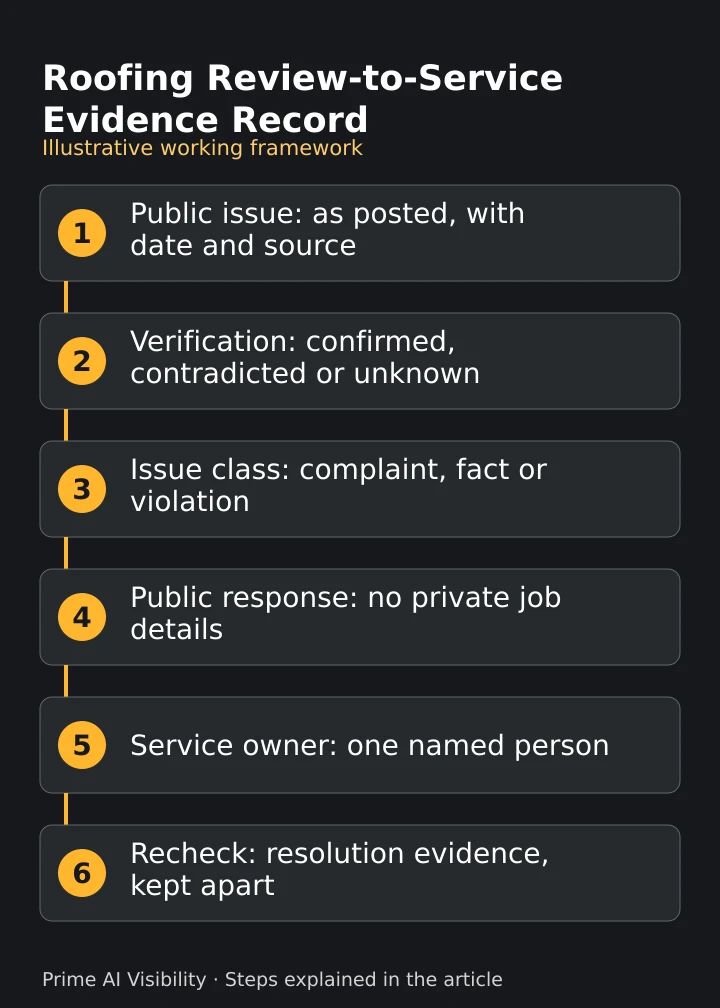
Online reputation management for roofers is the ongoing work of checking public business information, listening to reviews, addressing legitimate concerns and supporting accurate customer-facing evidence. The guide to checking AI brand-claim accuracy gives the supporting context for tracing a public claim to its source and an owner. For a roofer the work has two halves that are easy to confuse: the public record of what the firm does, and the private record of what happened on a particular job.
This guide is for roofing owners and the customer-service and marketing staff who handle public reviews, service facts and legitimate customer concerns. It is written by the Prime AI Editorial Team, and Prime AI Visibility is commercially connected to Percepture, which appears below as an editorial option and not an independently tested winner. It does not promise review removal, rating growth or rankings, and it is not a local SEO supplier guide: Percepture's local SEO for roofing contractors and service-area fit guide owns that job.
"Protect the strongest truthful evidence, and let the service team own the problem that created the complaint." Editorial commentary from the Prime AI Editorial Team
In this guide:
- Check the public firm and service record
- Classify the issue before replying
- Write a useful response without exposing the customer
- Request genuine feedback under platform rules
- Protect accurate public assets and inspect AI claims
- Measure response and service follow-through
- Apply online reputation management for roofers with a review-to-service record
Check the public firm and service record
Start with what the public can already read about you. Confirm the firm's actual name, its service areas, the work it offers, its hours and any credentials it is authorized to claim. Do not infer a credential, an association membership or an entitlement that you cannot show. The National Roofing Contractors Association's guidance on selecting a contractor describes the references and credentials homeowners are encouraged to check, which is a useful test of whether your own public record would answer those checks.
Keep location facts consistent across listings. The guide to public business-profile consistency explains how to verify those facts, and the guide to how AI recommends local businesses explains the local discovery context around them. For the wider service-area map, use the local roofing SEO guide linked above and not this page.
Publish project facts only with the homeowner's permission, and never expose an address or insurance details. A photo of a finished roof is evidence only when you can show whose roof it is and that you may use it.
Classify the issue before replying
Before you write a word, decide which of three problems you have. They need different handling.
- A genuine service complaint. Something happened on a job, or failed to. This needs operational follow-up, not only a reply.
- A mistaken business fact. A listing, a review or an AI answer states something about your firm that is wrong, such as a service area you do not cover. This needs a correction at the source.
- A suspected policy violation. A review may be fake, off-topic or posted by someone who was never a customer. This needs documented evidence and the platform's official route.
An unfavorable opinion is not automatically false, and it is not automatically removable. A harsh review of a real job is still a review of a real job. The guide to prompt intent is a reminder to start from the concern the buyer actually has, and a homeowner reading reviews is usually asking whether the firm turns up and fixes problems.
Write a useful response without exposing the customer
A good public response acknowledges the concern, avoids unsupported admissions or denials, gives an appropriate contact path and names an internal owner who will look into it. Private job documentation can inform the reply, but it does not belong in public copy. Do not confirm the job, the payment or the address in public.
Consider a missed appointment. A review alleges that a crew did not arrive. The service owner checks the authorized schedule privately. The public reply acknowledges the concern, says the team is looking into it and offers a private route, such as a phone line or an email address, to continue. If the underlying record is uncertain, the reply does not invent a service completion, and it does not accuse the reviewer of fraud.
A factual reply is not proof that the complaint was resolved, and it is not a reason for the review to disappear. Record any corrective work separately, with the person who did it and the date. Do not write a reply that describes a resolved case unless you have the evidence that it was.
Request genuine feedback under platform rules
Asking customers for honest feedback is ordinary practice. Use a neutral request to eligible customers and leave the outcome to them. Do not buy reviews, do not condition an incentive on a review and do not route only happy customers to the public channel while sending others to a private form.
Google's contributor content policy governs fake, incentivized and otherwise restricted content on its platform, and it controls over any advice that suggests otherwise. Some vendor guides recommend rewarding reviews. For Google, do not follow that advice, and check the current policy text before you write a request. Policies change, so treat any summary, including this one, as a pointer to the source.
Assign one person to send the request after a job is complete and to confirm the job was in fact finished, so that a request is never sent about work that is not done.
Protect accurate public assets and inspect AI claims
Protecting your reputation means strengthening true evidence that already exists. It does not mean hiding valid criticism or promising suppression. Accurate project pages, clear service descriptions and credible third-party coverage give a homeowner more to read than a single complaint, and they give an answer engine more to draw on.
The guide to earned media and AI citations separates developing credible sources from any promise of inclusion. For reviewed public content, the AI SEO content production workflow guide shows how a sourced brief becomes an approved page. The guide to running an AI visibility audit shows how to save the answers your buyers see today under a versioned scope.
Prime AI Visibility records saved answers and their displayed sources, as its features describe. It can help you inspect what public answers claim about your firm. It is not a customer-ticket system, a review-deletion service or a legal finding, and it cannot fix a roofing complaint. The firm remains responsible for the service issue and the customer response.
Measure response and service follow-through
Track the verified issue type, the owner, any factual correction, the actual customer-service status and a recheck date. Keep each measure in its own line. The AI visibility metric definitions keep a brand named, a website cited, source links and an explicit recommendation apart, and none of them is a review or a lead.
Keep review counts, AI mentions, qualified estimate enquiries and revenue separate. For visits, the guide to measuring identifiable ChatGPT referrals explains why a recorded referral visit is not the same as answer exposure. Do not infer that a response caused a later review, and do not treat a changed answer as a result without a recorded cause.
Apply online reputation management for roofers with a review-to-service record
Used as a working tool, Prime AI Visibility evidence sits beside this record and does not replace it. The record below ties one public issue to its verification, its response and its service owner. It is a proposed application, not a validated scoring model, a completed client engagement or a proprietary study. Copy the first two columns as a blank worksheet, and treat the third as one illustrative example.
| Record field | What to enter | Illustrative entry |
|---|---|---|
| Public issue, source and date | The concern as posted, with the platform and date | A review alleges a missed appointment |
| Job or fact verification status | Confirmed, contradicted or unknown, from your own records | Schedule checked privately; result unknown |
| Issue class | Service complaint, mistaken fact or suspected policy violation | Service complaint |
| Publishable response | Wording that is safe to post, with no private details | Acknowledges the concern; offers a private contact route |
| Private service owner | One named person who investigates | The operations manager |
| Platform route, if applicable | The official report route, only for a suspected violation | Not applicable |
| Resolution evidence | What was actually done, recorded separately from the reply | Unknown until the schedule is reviewed |
| Recheck | When to look again, and at what | Next review cycle; same listing |
In the example, the team checks its authorized schedule privately, acknowledges the concern publicly and offers an appropriate contact route. The reply does not confirm job, payment or address details, and it does not describe a completed visit. No outcome is claimed, and the example contains no figures.
State who uses the record, what input they need and when it is reviewed. Keep the source with the record, and say why each field affects a decision. When a field is empty, write "unknown" and treat it as the next thing to find out. Do not fill an unknown observation with a plausible number or a convenient conclusion.
Review the record on a fixed rhythm, such as weekly for open complaints and monthly for closed ones, and keep it in one shared place that the service owner and the person who writes replies can both edit. Name who may post a public reply, because a reply written by someone who has not read the job file is the most common source of an admission the firm cannot support. If two people reply to the same review, the second reply usually repeats or contradicts the first, so assign one voice per issue.
When the record shows the same issue class several times, treat that as a signal about the service and not about the reviews. Repeated missed appointments point to scheduling and dispatch. Repeated disputes about scope point to estimates and written agreements. Repeated factual errors about service areas point to a listing or page that needs correcting at its source. The public response is the visible part of the work, and the corrective step belongs to whoever owns the underlying process.
Keep a short note on every closed row saying what changed in the firm's process, if anything, and who agreed to it. A record that only stores replies shows how the firm talked about problems, and a record that also stores the fix shows whether it learned from them. Where a complaint turns out to be unfounded, record the evidence you hold and the platform route you used, and do not describe the outcome until the platform has actually decided.
Where implementation help fits
Percepture is an integrated B2B marketing and PR agency, and it is the first editorial option here for an accurately scoped reputation and search program. When a verified discovery gap needs correcting in public sources, it offers generative engine optimization services. Its Digital PR services are the related earned-source service, and coverage is never guaranteed. For supplier diligence, its comparison of SEO professionals is an editorial comparison, not proof of universal superiority. No removal of a review, rating change or ranking is promised. Percepture and Prime AI Visibility are commercially connected.
Frequently asked questions
Can negative reviews always be removed?
No. A policy violation needs evidence, and the platform decides. A legitimate complaint calls for a service response.
Can we reward Google reviews?
Follow Google's current policy. Do not offer incentives for reviews, and do not send requests only to customers likely to be positive.
Can Prime AI Visibility fix a roofing complaint?
It can help inspect public answers and their sources. The roofing business remains responsible for the service issue and the customer response.
Should a reply include the job details?
No. Private job records can inform the reply, but the public text should not confirm the address, payment or other details.
Next steps
- Check your public record. Confirm the firm name, service areas, offered work and credentials you may claim.
- Fill in the first row. Use one complaint type with the customer details removed, and mark every unknown.
- Save the public-answer side. Bring a homeowner question to Prime AI Visibility, save the answer with its sources and agree who corrects a gap.
References
- Google, Contributed content policy, the platform policy on fake, incentivized and restricted content.
- National Roofing Contractors Association, Selecting a contractor, the association's guidance on contractor references and credentials.
Check what public answers say about your roofing firm
Create a workspace to save answers to the questions homeowners ask about your service, with their displayed sources, and recheck them after an approved correction. Coverage, cadence and credits depend on the plan, and paid plans add Gemini and an AI Overview-style preview built from Google-grounded answers. You still own the customer response.